Sunset Cliffs, San Diego
Updated · 1,114 residents
Sunset Cliffs is a scenic coastal enclave in San Diego defined by its high walkability and dramatic ocean vistas. This quiet residential area offers residents excellent access to outdoor recreation and green spaces, though it experiences moderate noise levels from local road traffic.
Key Highlights
About Sunset Cliffs
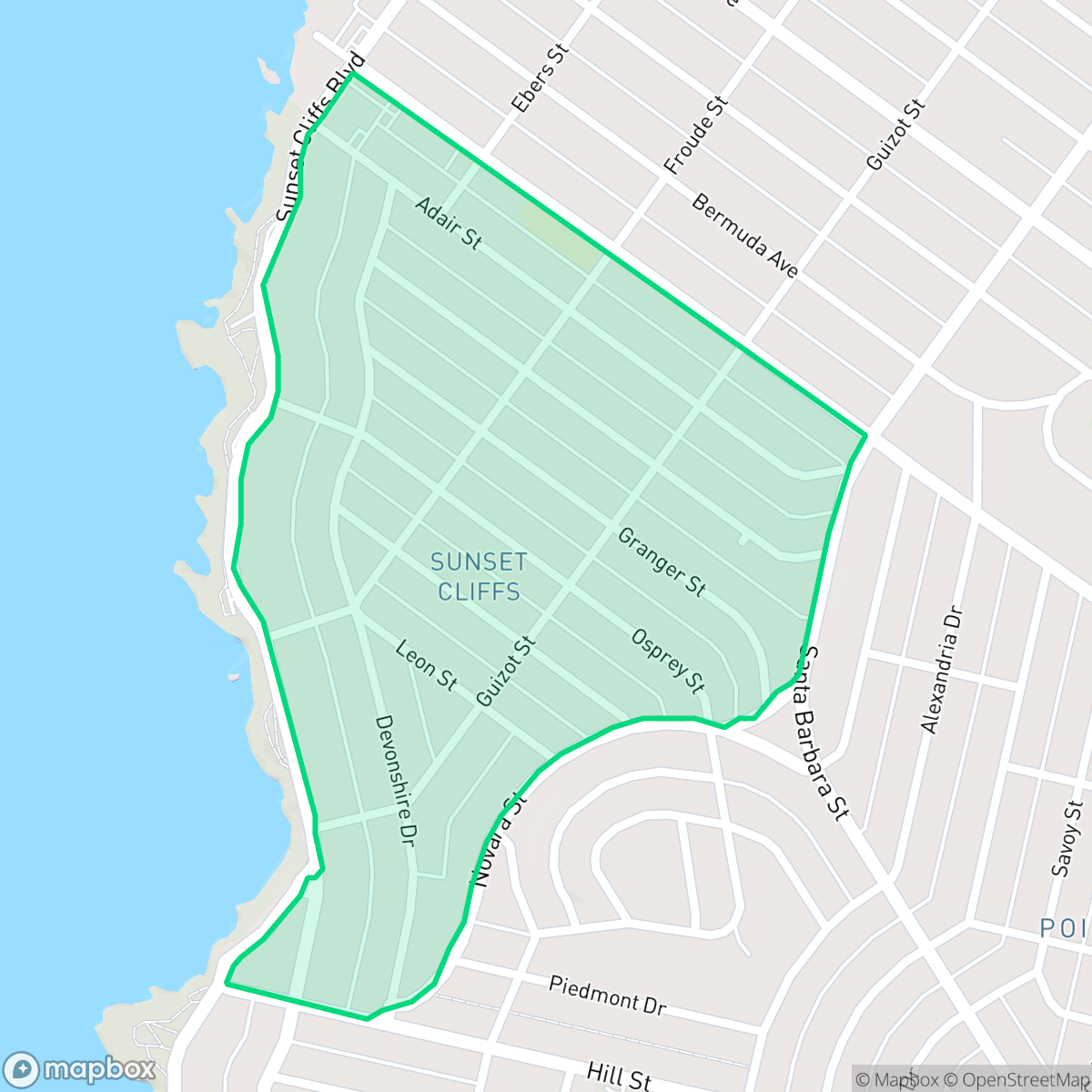
Originally inhabited by the Kumeyaay, who considered the coastal bluffs sacred, the Sunset Cliffs neighborhood began its modern development in 1915. Sporting goods magnate Albert Goodwill Spalding invested $2 million to landscape the cliffs with Japanese-style arched bridges, trails, and a carved saltwater pool. In 1925, developer John P. Mills purchased the land to establish a premier residential enclave modeled after the Mediterranean Riviera. Mills mandated Spanish and Mediterranean Revival architectural designs featuring stucco facades and tile roofs. He also restored Spalding’s coastal features, which eventually became the 68-acre Sunset Cliffs Natural Park, dedicated in 1983. Today, the neighborhood remains a highly desirable residential area defined by its custom cliffside homes, curved streets, and dramatic ocean vistas.
The neighborhood is characterized by its Mediterranean Revival architecture and its position along the Pacific coastline. It functions as a tranquil, pedestrian-friendly retreat where residents can easily access rugged cliffside trails and public parks. While the area offers high visual appeal and is notably welcoming to pets, it maintains a subdued social atmosphere that favors residential privacy over commercial development.
Living in the area involves balancing its aesthetic and recreational benefits with certain environmental considerations. According to iHuus data, the community experiences moderate noise levels primarily from road traffic. While the neighborhood benefits from high rates of health insurance coverage, prospective residents should consider the local fire safety profile, which is a significant factor in this coastal environment. Educational opportunities are provided through the San Diego City Unified School District, which currently faces operational transitions and budgetary pressures.
Neighborhood Scores Across 15 Qualities
Residential spacing is largely consistent with the city average, though some areas feature high density with very little buffer between structures. According to iHuus data, neighbors in certain pockets may live in close proximity to one another.
Pedestrian-priority coastal paths and a dense grid of sidewalks make navigating the area on foot easy. This level of connectivity is significantly higher than the San Diego average, according to iHuus data.
Upscale coastal properties featuring large homes and private amenities characterize the area. According to iHuus data, the visual landscape is notably more polished than the San Diego average.
Narrow sidewalk verges and limited public green space make walking pets more difficult here than in most other San Diego neighborhoods. According to iHuus data, the area relies primarily on private fenced yards rather than accessible parkland.
Highly developed, low-rise urban structures and tightly packed parcels characterize this coastal area. According to iHuus data, the density of built environments here is slightly higher than the San Diego average.
Residential life here is defined by a tranquil, suburban rhythm with limited local commerce. According to iHuus data, the level of activity and social density is slightly lower than the San Diego average.
Steady traffic sounds from a nearby busy street are common here. According to iHuus data, acoustic comfort in this area is higher than the city average.
Air quality fluctuates between acceptable and unhealthy levels, appearing slightly lower than the San Diego average according to iHuus data. Sensitive groups may experience occasional concern during certain periods.
No warehouses, industrial facilities, or hazard sites are present within the neighborhood. This area maintains a higher level of separation from industrial zones than the San Diego average, consisting instead of residential and light commercial coastal zones.
Health insurance enrollment is exceptionally high among residents, significantly surpassing the San Diego city average according to iHuus data.
Political leanings in this area are notably liberal, aligning closely with the broader San Diego landscape according to iHuus data.
Residents experience a balanced demographic spread ranging from young adults to seniors. This population distribution is slightly more varied than the average found across San Diego, according to iHuus data.
Flood risk in this area is higher than the San Diego average, though the precise level of danger remains undetermined due to incomplete federal studies. According to iHuus data, the lack of a detailed study means residents should remain cautious regarding potential coastal or heavy rain flooding.
Address-Level Insights for Sunset Cliffs


iHuus Neighborhood Intelligence Insights
Get address-level neighborhood insights for Sunset Cliffs
- Street-level scores — see how individual blocks compare, not just neighborhood averages
- Micro-zone boundaries — identify quiet pockets, flood boundaries, and walkable clusters before you visit
- 15 dimensions in full — walkability, noise, air quality, school quality, insurance coverage, population age profile, urban/rural index, and more
- Boundary risk alerts — know if your address sits near a block boundary where scores drop, the kind of detail no listing will ever mention
- School insights — individual school ratings and insights, not just district-level data
- Compare before you commit — side-by-side data across neighborhoods, down to block precision
No credit card required
Compare with Any Neighborhood
| Dimension | Sunset Cliffs | Adams North |
|---|---|---|
| 🚶 Walkabilityavg 8.58 | ||
| 🔊 Acoustic Comfortavg 3.33 | ||
| 🤫 Privacy Indexavg 4.87 | ||
| 🎨 Visual Appealavg 6.85 | ||
| 🐕 Dog Friendlinessavg 6.91 | ||
| 🗺️ Urban-Rural Indexavg 6.6 | ||
| ✨ Neighborhood Vibeavg 5.12 | ||
| 🏥 Health Insurance Coverageavg 7.53 | ||
| 🌿 Air Qualityavg 6.36 | ||
| 🏭 Industrial Proximityavg 9.12 | ||
| 🌊 Flood Safetyavg 4.2 | ||
| 🗳️ Ideological Leanavg 8.51 | ||
| 👥 Population Age Profileavg 4.8 | ||
| 🔥 Fire Safetyavg 0.61 | ||
| 🏫 School Quality |
Sunset Cliffs Rankings
School Districts Serving Sunset Cliffs
School Insights for Sunset Cliffs
Below average outcomes; significant attendance and academic challenges.
School Insights
See what's really behind every school rating near Sunset Cliffs
- Individual school ratings — each school's own score with outcome context, not just a district average
- Enrollment & class size data — student-to-teacher ratio and how it compares to the state average
- Full demographics breakdown — ethnicity and gender composition for every school in the enrollment zone
- Every school in the district — all schools within the enrollment boundary ranked by rating, not just the closest one
- Grade levels & benchmarks — elementary through high school, with below/above state-average flags
No credit card required