South Park, San Diego
Updated · 5,690 residents
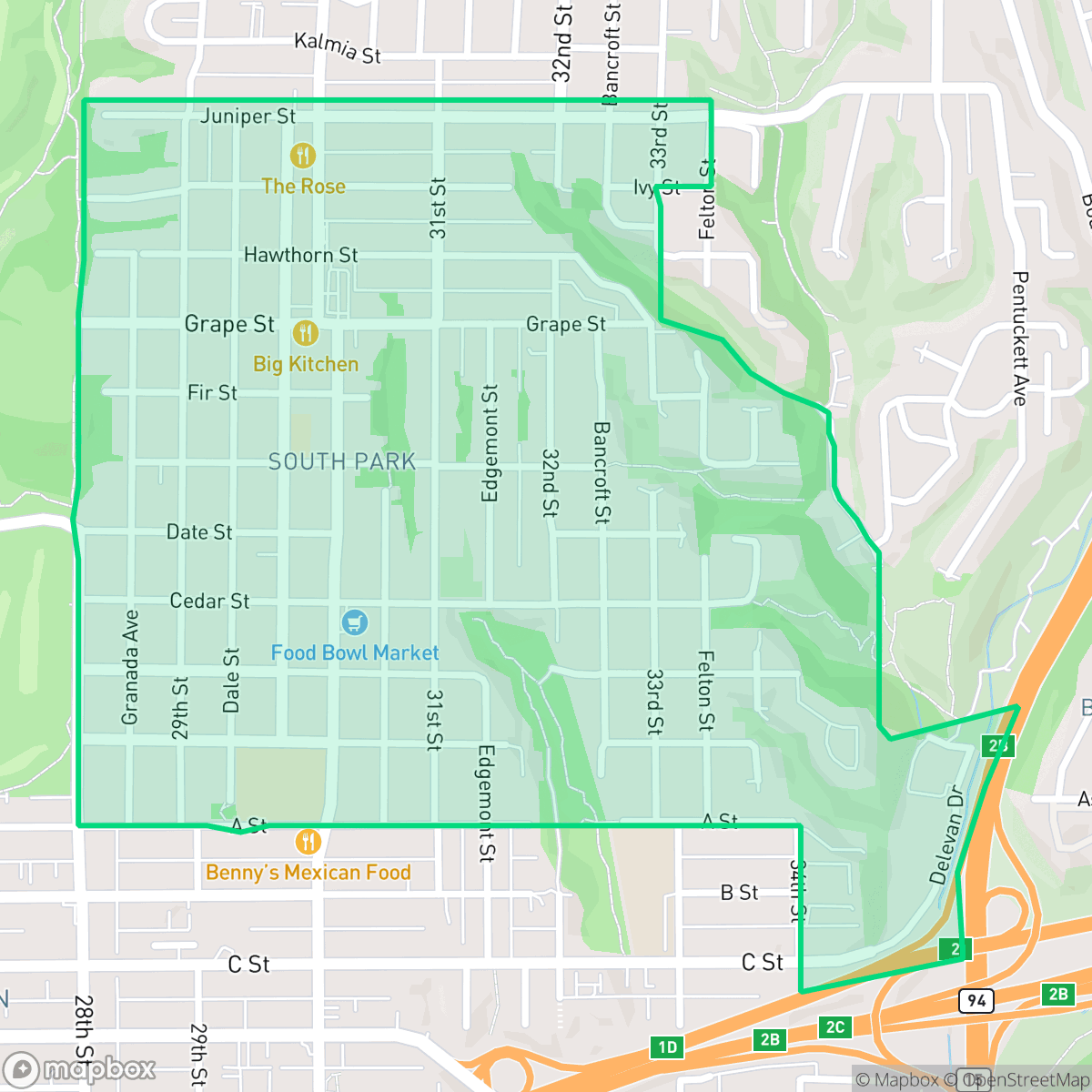
South Park is a highly walkable community defined by its quiet residential streets and proximity to natural canyon trails. Residents enjoy a dense, grid-based layout that provides easy access to local cafes and boutiques while maintaining a relaxed, suburban atmosphere.
Key Highlights
About South Park
Registered as a subdivision in 1870, South Park in San Diego saw little development until 1905 when E. Bartlett Webster purchased the land. In 1906, the opening of the South Park and East Side Railway streetcar line transformed the area into San Diego’s first streetcar suburb. The neighborhood became a showcase for early 20th-century residential architecture, featuring a diverse collection of Craftsman, Prairie, and Spanish Colonial Revival homes, including designs by master architects like Irving Gill and Richard Requa. In 2017, the City of San Diego officially designated the area as the South Park Historic District. Today, South Park maintains its historic charm and pedestrian-friendly character, centered around the independent boutiques, cafes, and taverns along its signature 30th and Fern Street corridors.
The area is characterized by its dense, pedestrian-friendly grid and strong connection to the outdoors, with canyon-side paths and green spaces offering significant recreational opportunities. According to iHuus data, the neighborhood maintains a high level of walkability, allowing residents to navigate the residential blocks and local commercial corridors with ease. The environment is primarily residential, free from industrial activity, and features a layout that balances suburban density with natural open space.
Prospective residents should consider the trade-offs of living in this established district, including a higher risk of fire and moderate noise levels from road traffic and aviation. While the community offers a quiet, steady rhythm of life, the local school options within the San Diego City Unified School District are currently navigating significant operational and financial challenges. This neighborhood is well-suited for those who prioritize a walkable, dog-friendly lifestyle and appreciate the architectural character of a historic streetcar suburb.
Neighborhood Scores Across 15 Qualities
Residential spacing varies from dense apartment blocks to homes separated by canyon buffers; overall, levels of separation between neighbors are slightly higher than the San Diego average according to iHuus data.
Pedestrian travel is easy throughout the area due to a dense street grid with consistent sidewalks and frequent crossings. This level of connectivity is slightly above the San Diego average, according to iHuus data.
Manicured landscaping and large homes with private pools contribute to a visual profile that is slightly above the San Diego average. According to iHuus data, the area features a mix of upscale coastal estates and standard single-family residences.
Extensive canyon-side trails and large adjacent green spaces provide ample walking areas that are well-separated from traffic. According to iHuus data, the abundance of connected parkland and athletic fields makes this area more accommodating for dog owners than the San Diego average.
Residential streets feature a mix of single-family homes and apartment blocks interspersed with natural canyon greenery. This landscape provides a balance of built environments and open land similar to the broader San Diego area.
Low density and suburban streets create a subdued atmosphere that is less active than the San Diego average. While some local dining and social spots are available, the area lacks a high concentration of walkable businesses and features significant pockets of quiet, industrial, and green space.
Frequent sounds from nearby rail lines and freeway traffic characterize the area. According to iHuus data, acoustic comfort in South Park is slightly lower than the San Diego average.
Air quality levels fluctuate between acceptable and unhealthy, presenting occasional concerns for sensitive groups. According to iHuus data, this neighborhood experiences slightly lower air quality than the San Diego average.
Residential life here is free from warehouses, logistics centers, or hazardous industrial sites. According to iHuus data, this area maintains a cleaner environment than the city average due to the absence of heavy industrial activity.
Health insurance accessibility is notably higher than the San Diego average, according to iHuus data. Most residents in the area possess comprehensive medical coverage.
Voting patterns and census indicators reflect a distinctly liberal political leaning that is more pronounced than the San Diego average, according to iHuus data.
Residents live alongside a balanced mix of young professionals, families, and seniors. According to iHuus data, the age distribution in South Park is very similar to the broader San Diego area.
Flood risk in this area is notably higher than the San Diego average, as some portions of the neighborhood fall within a floodplain. Residents should be aware of residual flood risks identified in iHuus data.
Fire hazards in this area are exceptionally high, presenting a significantly greater danger than the typical San Diego neighborhood. According to iHuus data, residents should prioritize maximum fire protection measures and rigorous emergency preparedness.
Address-Level Insights for South Park


iHuus Neighborhood Intelligence Insights
Get address-level neighborhood insights for South Park
- Street-level scores — see how individual blocks compare, not just neighborhood averages
- Micro-zone boundaries — identify quiet pockets, flood boundaries, and walkable clusters before you visit
- 15 dimensions in full — walkability, noise, air quality, school quality, insurance coverage, population age profile, urban/rural index, and more
- Boundary risk alerts — know if your address sits near a block boundary where scores drop, the kind of detail no listing will ever mention
- School insights — individual school ratings and insights, not just district-level data
- Compare before you commit — side-by-side data across neighborhoods, down to block precision
No credit card required
Compare with Any Neighborhood
| Dimension | South Park | Adams North |
|---|---|---|
| 🚶 Walkabilityavg 8.58 | ||
| 🔊 Acoustic Comfortavg 3.33 | ||
| 🤫 Privacy Indexavg 4.87 | ||
| 🎨 Visual Appealavg 6.85 | ||
| 🐕 Dog Friendlinessavg 6.91 | ||
| 🗺️ Urban-Rural Indexavg 6.6 | ||
| ✨ Neighborhood Vibeavg 5.12 | ||
| 🏥 Health Insurance Coverageavg 7.53 | ||
| 🌿 Air Qualityavg 6.36 | ||
| 🏭 Industrial Proximityavg 9.12 | ||
| 🌊 Flood Safetyavg 4.2 | ||
| 🗳️ Ideological Leanavg 8.51 | ||
| 👥 Population Age Profileavg 4.8 | ||
| 🔥 Fire Safetyavg 0.61 | ||
| 🏫 School Quality |
South Park Rankings
School Districts Serving South Park
School Insights for South Park
Below average outcomes; significant attendance and academic challenges.
School Insights
See what's really behind every school rating near South Park
- Individual school ratings — each school's own score with outcome context, not just a district average
- Enrollment & class size data — student-to-teacher ratio and how it compares to the state average
- Full demographics breakdown — ethnicity and gender composition for every school in the enrollment zone
- Every school in the district — all schools within the enrollment boundary ranked by rating, not just the closest one
- Grade levels & benchmarks — elementary through high school, with below/above state-average flags
No credit card required