Skyline, San Diego
Updated · 9,043 residents
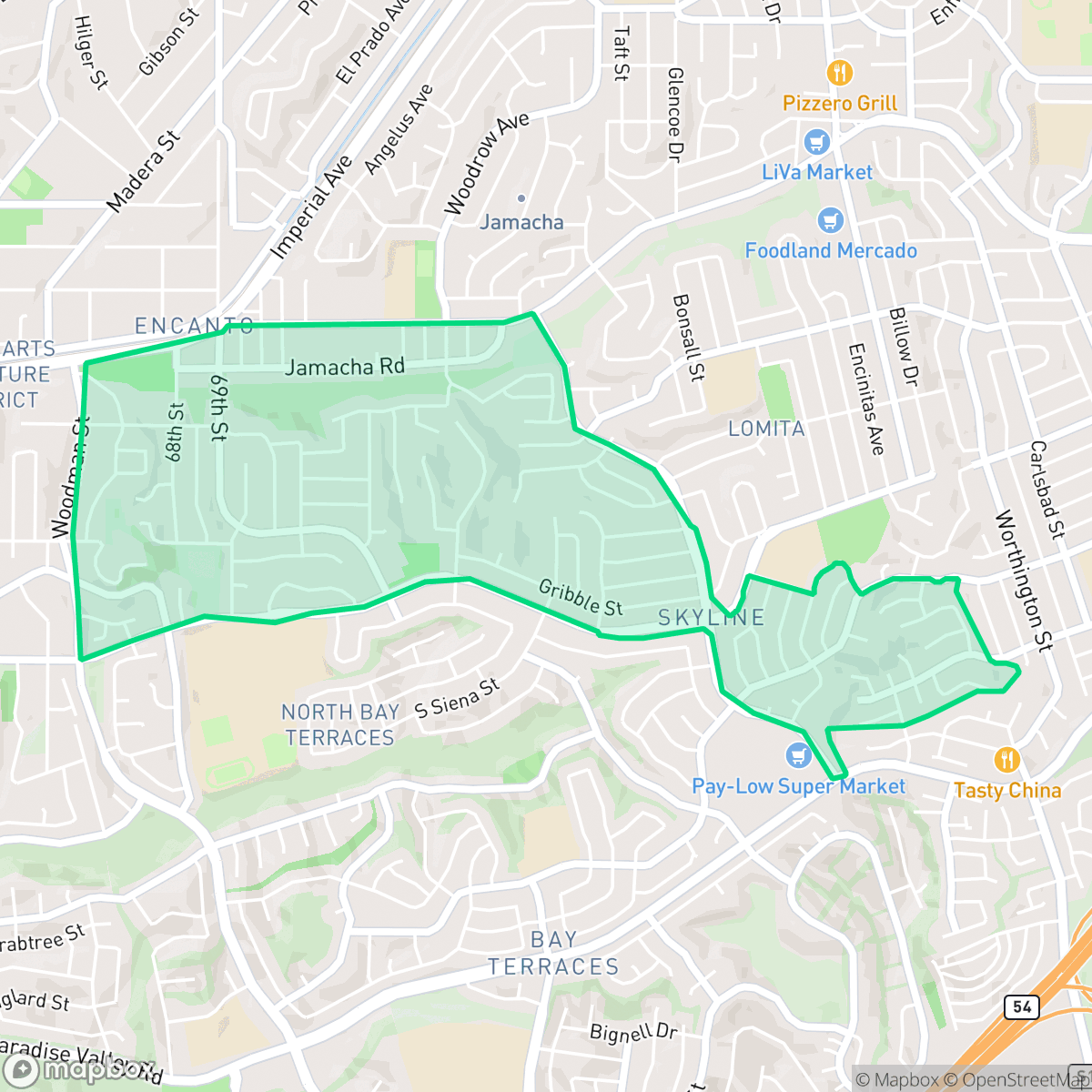
Skyline is a residential enclave in Southeastern San Diego defined by its mid-century tract housing and strong community identity. The area offers exceptional walkability with continuous sidewalk coverage throughout its quiet, suburban streets. Residents enjoy a peaceful environment entirely free from industrial activity, though local commercial amenities remain limited within walking distance.
Key Highlights
About Skyline
Located in Southeastern San Diego, the hilly neighborhood of Skyline was annexed by the city in 1916 as part of the Encanto annexation. Primarily developed in the 1950s and 1960s with postwar tract homes, the neighborhood’s early history was shaped by discriminatory restrictive covenants that barred minority buyers. Following the civil rights era and the lifting of these restrictions, Skyline transformed into a diverse community. From the Vietnam War era through the 1990s, a major influx of Filipino immigrants, many of whom served in the U.S. Navy, settled in Skyline due to its affordable single-family housing and close proximity to Naval Base San Diego. Today, Skyline retains its distinct identity as a tight-knit, residential enclave with deep military ties and a rich multicultural heritage.
Skyline is characterized by its hilly terrain and a dense collection of postwar single-family homes. The area maintains a quiet, suburban atmosphere that prioritizes residential living over commercial density. According to iHuus data, the neighborhood benefits from a highly developed pedestrian infrastructure, featuring sidewalks on both sides of most streets that facilitate easy movement for residents. While the area is primarily composed of standard tract housing, the presence of private backyard pools and well-maintained driveways reflects its established middle-class character. Living in this part of San Diego requires balancing the benefits of a purely residential setting against the relative scarcity of local retail and social spots within immediate reach. The neighborhood is well-suited for those who value acoustic comfort and a lack of industrial hazards, as it remains entirely free from factories or warehouses. While the local school districts present a range of performance outcomes, the area remains a stable choice for families seeking a tight-knit community with close proximity to major regional employers and transit routes.
Neighborhood Scores Across 15 Qualities
Property separation varies across the neighborhood, with some houses featuring small setbacks and others providing more buffer between neighbors. According to iHuus data, this level of spacing offers more privacy than the typical San Diego residential area.
Extensive sidewalk networks and well-marked pedestrian crossings make navigating the area on foot very easy. This connectivity is notably higher than the San Diego average, providing safe and continuous paths throughout the residential streets.
Residential views range from affluent estates with private pools to standard middle-class tract housing, making the overall visual appeal slightly below the San Diego average. According to iHuus data, the landscape is characterized by a blend of large, well-maintained properties and more uniform, smaller suburban lots.
Accessible walking areas are available through a central public park and various green verges; however, overall amenities for pet owners are slightly below the San Diego average according to iHuus data.
Residential layouts consist primarily of single-family homes and low-rise community buildings. This landscape is largely consistent with the typical suburban density found throughout San Diego.
Suburban blocks offer a mix of green space and social hubs, providing a slightly more active atmosphere than the San Diego average. While some areas feature accessible dining and services, other parts of the neighborhood remain quiet with limited businesses within walking distance.
Steady hum from nearby busy streets defines the acoustic environment. According to iHuus data, this level of noise is notably higher than the typical quiet found across the rest of San Diego.
Air quality in Skyline fluctuates between acceptable and unhealthy levels, appearing slightly lower than the San Diego average. Sensitive groups should monitor local conditions, as occasional periods of concern may occur according to iHuus data.
Industrial hazards and warehouses are absent from this area, making it even more residential in character than the San Diego average. Residents can expect a landscape composed primarily of homes, light commercial spaces, and institutional sites without heavy industrial activity.
Health insurance coverage among residents is high and remains very close to the San Diego city average, according to iHuus data.
Voting patterns and census indicators reflect a predominantly liberal political leaning that is slightly more pronounced than the San Diego average.
Residents live alongside a balanced mix of young adults, families, and older populations. This demographic spread is consistent with the broader San Diego area, according to iHuus data.
Flood risk in this area is notably higher than the San Diego average. According to iHuus data, detailed studies from FEMA are currently unavailable for this specific location.
Address-Level Insights for Skyline


iHuus Neighborhood Intelligence Insights
Get address-level neighborhood insights for Skyline
- Street-level scores — see how individual blocks compare, not just neighborhood averages
- Micro-zone boundaries — identify quiet pockets, flood boundaries, and walkable clusters before you visit
- 15 dimensions in full — walkability, noise, air quality, school quality, insurance coverage, population age profile, urban/rural index, and more
- Boundary risk alerts — know if your address sits near a block boundary where scores drop, the kind of detail no listing will ever mention
- School insights — individual school ratings and insights, not just district-level data
- Compare before you commit — side-by-side data across neighborhoods, down to block precision
No credit card required
Compare with Any Neighborhood
| Dimension | Skyline | Adams North |
|---|---|---|
| 🚶 Walkabilityavg 8.58 | ||
| 🔊 Acoustic Comfortavg 3.33 | ||
| 🤫 Privacy Indexavg 4.87 | ||
| 🎨 Visual Appealavg 6.85 | ||
| 🐕 Dog Friendlinessavg 6.91 | ||
| 🗺️ Urban-Rural Indexavg 6.6 | ||
| ✨ Neighborhood Vibeavg 5.12 | ||
| 🏥 Health Insurance Coverageavg 7.53 | ||
| 🌿 Air Qualityavg 6.36 | ||
| 🏭 Industrial Proximityavg 9.12 | ||
| 🌊 Flood Safetyavg 4.2 | ||
| 🗳️ Ideological Leanavg 8.51 | ||
| 👥 Population Age Profileavg 4.8 | ||
| 🔥 Fire Safetyavg 0.61 | ||
| 🏫 School Quality |
Skyline Rankings
School Districts Serving Skyline
School Insights for Skyline
Below average outcomes; significant attendance and academic challenges.
School Insights
See what's really behind every school rating near Skyline
- Individual school ratings — each school's own score with outcome context, not just a district average
- Enrollment & class size data — student-to-teacher ratio and how it compares to the state average
- Full demographics breakdown — ethnicity and gender composition for every school in the enrollment zone
- Every school in the district — all schools within the enrollment boundary ranked by rating, not just the closest one
- Grade levels & benchmarks — elementary through high school, with below/above state-average flags
No credit card required