Sherman Heights, San Diego
Updated · 4,291 residents
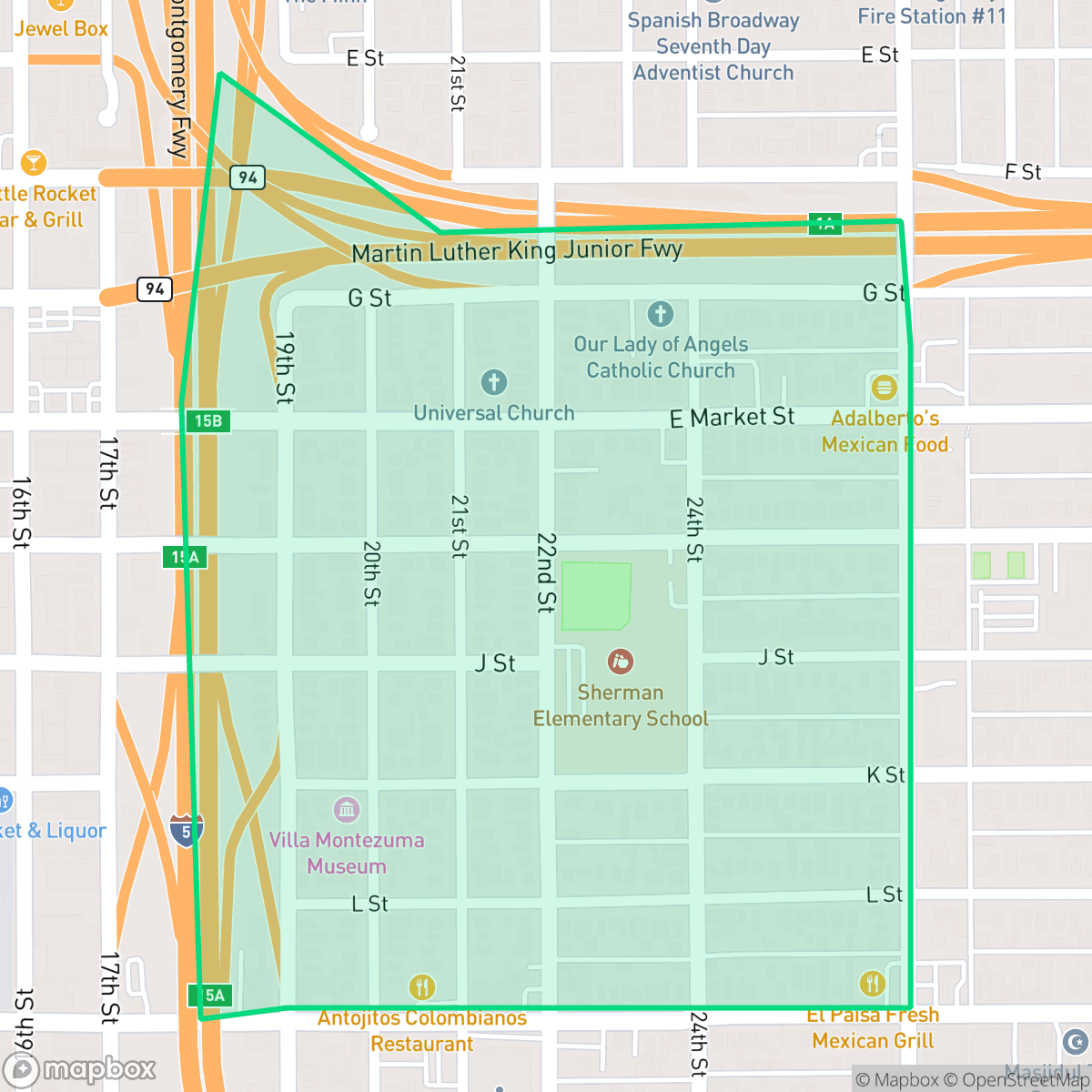
Sherman Heights is a highly walkable, high-density urban neighborhood located just east of downtown San Diego. While the area offers a vibrant, energetic atmosphere with diverse local dining options, residents experience significant noise from nearby freeway traffic and limited privacy due to the compact urban grid.
Key Highlights
About Sherman Heights
Established in 1869 by developer and future mayor Matthew Sherman, Sherman Heights is one of San Diego’s oldest residential neighborhoods. Located just east of downtown, the area is celebrated for its rich collection of late 19th-century Victorian and Queen Anne-style architecture. Its most famous landmark is the Villa Montezuma, a striking 1887 Queen Anne mansion built for musician and spiritualist Jesse Shepard. Designated a historic district in 1987, Sherman Heights has historically served as a gateway for diverse immigrant communities, hosting waves of German, Japanese, and African American residents throughout the 20th century. Since the 1970s, the neighborhood has maintained a vibrant, predominantly Latino cultural identity, celebrated through local institutions like the Sherman Heights Community Center.
The neighborhood functions as a dense, high-energy urban core that benefits from excellent walkability and proximity to downtown amenities. Residents enjoy a variety of local eateries and coffee shops near Fault Line Park, contributing to a lively, active streetscape. According to iHuus data, the area maintains a distinct urban character defined by a mix of modern apartment complexes and traditional residential blocks, placing it in the heart of San Diego's metropolitan activity. Prospective residents should consider the trade-offs of living in such a high-density environment. The area faces challenges with acoustic comfort, as road traffic noise is prevalent throughout the district. Additionally, the lack of public green space makes the neighborhood less ideal for dog owners, and the compact layout results in minimal privacy between homes. While the community benefits from high health insurance coverage and a strong sense of civic engagement, those considering a move should be aware of the environmental risks, including flood and fire safety concerns common to this part of the city.
Neighborhood Scores Across 15 Qualities
Residential structures are tightly packed with very little separation between properties. According to iHuus data, this high density results in significantly less privacy than is typical for San Diego.
A consistent grid of streets features wide sidewalks on both sides of most residential blocks and clearly marked crosswalks. This neighborhood offers much easier pedestrian access than the San Diego average, though the major nearby freeway creates some interruptions to the street network.
Standard urban housing dominates the landscape, featuring dense residential blocks and small lots. This neighborhood offers less visual variety and fewer private amenities than the San Diego average according to iHuus data.
Dense concrete surroundings and narrow parkways make finding open green space difficult. While some areas near the northeast park provide access to larger lawns, overall pet-friendly infrastructure is below the San Diego average according to iHuus data.
Characterized by a low-rise urban grid and multi-family housing, this area feels significantly more urbanized than the San Diego average. Major highway infrastructure and medium-density residential blocks define the landscape, offering a compact environment with limited open green space.
Concentrated pockets of dining and local coffee shops create a more active atmosphere than the San Diego average. Residents will find a notable presence of social hubs and eateries distributed along the neighborhood's varying streetscapes, according to iHuus data.
Frequent aircraft noise from the nearby airport runway is a constant presence. This level of acoustic disturbance is significantly higher than the San Diego average, according to iHuus data.
Air quality in this area fluctuates between acceptable and unhealthy levels, which may pose occasional concerns for sensitive groups. According to iHuus data, the local air quality is slightly lower than the San Diego city average.
Largely residential and park-focused, this area features slightly more commercial and warehouse activity than the San Diego average. While most of the neighborhood is free of heavy industry, some noise and commercial presence can be found near the southwest and northern corridors.
Health insurance accessibility is notably lower than the San Diego average. According to iHuus data, fewer residents in this area have access to employer-sponsored or private health coverage compared to most other parts of the city.
Voting patterns and census indicators show a significantly more liberal political leaning than the San Diego average. This concentration of progressive-leaning residents is reflected in the community's civic engagement and local demographic trends according to iHuus data.
A balanced mix of young adults, families, and older residents characterizes the area. This demographic distribution is largely in line with the average seen across San Diego.
Significant flood risk exists here due to being located within a designated floodplain. According to iHuus data, this level of risk is higher than the San Diego city average and may necessitate flood insurance.
Address-Level Insights for Sherman Heights


iHuus Neighborhood Intelligence Insights
Get address-level neighborhood insights for Sherman Heights
- Street-level scores — see how individual blocks compare, not just neighborhood averages
- Micro-zone boundaries — identify quiet pockets, flood boundaries, and walkable clusters before you visit
- 15 dimensions in full — walkability, noise, air quality, school quality, insurance coverage, population age profile, urban/rural index, and more
- Boundary risk alerts — know if your address sits near a block boundary where scores drop, the kind of detail no listing will ever mention
- School insights — individual school ratings and insights, not just district-level data
- Compare before you commit — side-by-side data across neighborhoods, down to block precision
No credit card required
Compare with Any Neighborhood
| Dimension | Sherman Heights | Adams North |
|---|---|---|
| 🚶 Walkabilityavg 8.58 | ||
| 🔊 Acoustic Comfortavg 3.33 | ||
| 🤫 Privacy Indexavg 4.87 | ||
| 🎨 Visual Appealavg 6.85 | ||
| 🐕 Dog Friendlinessavg 6.91 | ||
| 🗺️ Urban-Rural Indexavg 6.6 | ||
| ✨ Neighborhood Vibeavg 5.12 | ||
| 🏥 Health Insurance Coverageavg 7.53 | ||
| 🌿 Air Qualityavg 6.36 | ||
| 🏭 Industrial Proximityavg 9.12 | ||
| 🌊 Flood Safetyavg 4.2 | ||
| 🗳️ Ideological Leanavg 8.51 | ||
| 👥 Population Age Profileavg 4.8 | ||
| 🔥 Fire Safetyavg 0.61 | ||
| 🏫 School Quality |
Sherman Heights Rankings
School Districts Serving Sherman Heights
School Insights for Sherman Heights
Below average outcomes; significant attendance and academic challenges.
School Insights
See what's really behind every school rating near Sherman Heights
- Individual school ratings — each school's own score with outcome context, not just a district average
- Enrollment & class size data — student-to-teacher ratio and how it compares to the state average
- Full demographics breakdown — ethnicity and gender composition for every school in the enrollment zone
- Every school in the district — all schools within the enrollment boundary ranked by rating, not just the closest one
- Grade levels & benchmarks — elementary through high school, with below/above state-average flags
No credit card required