Shelltown, San Diego
Updated · 3,933 residents
Shelltown is a dense, culturally rich neighborhood in Southeast San Diego characterized by its modest mid-century bungalows and strong Mexican-American and Filipino-American heritage. While the area features a walkable grid layout, residents experience significant noise from nearby transit corridors and limited privacy due to high housing density.
Key Highlights
About Shelltown
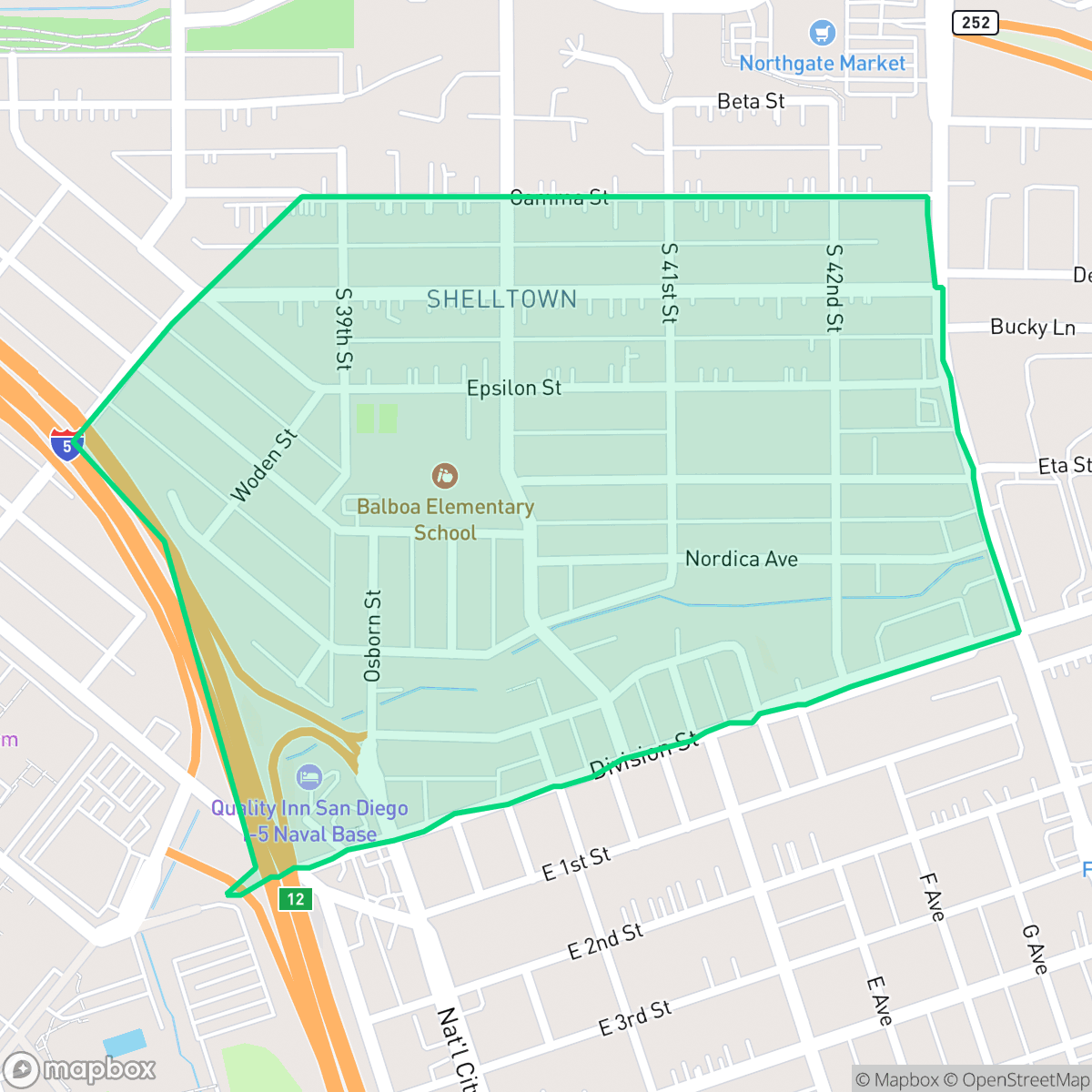
Located in Southeast San Diego, the historic neighborhood of Shelltown owes its name to the prehistoric marine shell fragments found throughout its sandy soil. Developed on an elevated plateau overlooking Naval Base San Diego, the area initially became a favored residential enclave for early naval officers who could see their docked ships from their porches. Most of Shelltown's housing stock, ranging from Craftsman homes to mid-century bungalows, was built between 1920 and 1969. The neighborhood’s rich cultural tapestry is defined by deep Mexican-American roots dating back to the 1910s, alongside a large influx of Filipino-American naval families who settled there starting in the Vietnam War era. Today, Shelltown's vibrant community identity is celebrated through colorful public murals at its main entrances, including a prominent piece on Alpha Street led by local activist and artist Mario Torero.
The neighborhood functions as a dense, low-rise urban environment where community identity is defined by long-standing cultural roots and public art. Local life centers around diverse dining options and a compact street grid that facilitates local movement, although the presence of nearby industrial warehouses and major transit corridors creates a distinct urban atmosphere. According to iHuus data, the area maintains a lively, active vibe that reflects its working-class character and central location within the city.
Prospective residents should consider that the area is best suited for those who prioritize cultural connectivity and proximity to central San Diego over quiet, expansive living. The housing stock consists of tightly packed, modest homes with limited yard space, and the environment is notably impacted by road traffic noise. Educational opportunities are provided by districts currently navigating significant operational and academic transitions, making it important for families to research specific school performance. Overall, the area offers a high-density, accessible lifestyle for those comfortable with the trade-offs of an established, urban-industrial setting.
Neighborhood Scores Across 15 Qualities
Residential properties are closely packed with narrow gaps between structures, resulting in less privacy than the San Diego average. According to iHuus data, many homes feature shared walls or minimal vegetation buffers between neighbors.
Pedestrian movement is easy due to a dense street grid and clear crossings at major intersections. While sidewalks are comprehensive throughout much of the area, the nearby highway serves as a significant barrier to north-south movement, a characteristic that matches the broader San Diego average.
Standard tract housing and high-density mobile home parks define the landscape, which offers less visual variety than the San Diego average. Small yards and boxy rooflines characterize the area, with limited private greenery or pool space visible according to iHuus data.
Public green space for pets is somewhat restricted, as sidewalks lack grassy verges and greenery is primarily found within private fenced yards. While large public parks and school fields are available for walking, the overall accessibility to outdoor pet areas is below the San Diego average.
Residential streetscapes feature a mix of single-family homes and multi-family units with a moderate amount of tree cover. This area is less urbanized than the San Diego average, offering a balance of built structures and neighborhood greenery.
Local social hubs and diverse dining options create a more active atmosphere than the San Diego average. While certain blocks near major highways feature higher activity, much of the area consists of calm suburban streets with accessible community centers and eateries.
Steady sounds from nearby busy streets create a consistent background hum. According to iHuus data, acoustic comfort in Shelltown is slightly higher than the San Diego average.
Air quality in this area fluctuates between acceptable and unhealthy levels. According to iHuus data, these conditions are slightly below the San Diego city average, presenting occasional concerns for sensitive groups.
Residential areas remain largely free of heavy industrial sites, though proximity to major transit corridors and western warehouses may introduce some noise and air quality considerations. This level of industrial proximity is slightly higher than the San Diego average according to iHuus data.
Health insurance enrollment rates in Shelltown are notably below the San Diego city average. According to iHuus data, fewer residents in this area possess medical coverage compared to the broader metropolitan region.
Voting patterns and census indicators show a predominantly liberal leaning that is more pronounced than the San Diego city average.
A balanced mix of young adults, families, and seniors characterizes the area, though the population skews slightly younger than the San Diego average according to iHuus data.
Located within a coastal high-hazard zone, this area is significantly more vulnerable to wave action and flooding than the rest of San Diego. Residents should anticipate elevated or potentially prohibitive flood insurance costs according to iHuus data.
Address-Level Insights for Shelltown


iHuus Neighborhood Intelligence Insights
Get address-level neighborhood insights for Shelltown
- Street-level scores — see how individual blocks compare, not just neighborhood averages
- Micro-zone boundaries — identify quiet pockets, flood boundaries, and walkable clusters before you visit
- 15 dimensions in full — walkability, noise, air quality, school quality, insurance coverage, population age profile, urban/rural index, and more
- Boundary risk alerts — know if your address sits near a block boundary where scores drop, the kind of detail no listing will ever mention
- School insights — individual school ratings and insights, not just district-level data
- Compare before you commit — side-by-side data across neighborhoods, down to block precision
No credit card required
Compare with Any Neighborhood
| Dimension | Shelltown | Adams North |
|---|---|---|
| 🚶 Walkabilityavg 8.58 | ||
| 🔊 Acoustic Comfortavg 3.33 | ||
| 🤫 Privacy Indexavg 4.87 | ||
| 🎨 Visual Appealavg 6.85 | ||
| 🐕 Dog Friendlinessavg 6.91 | ||
| 🗺️ Urban-Rural Indexavg 6.6 | ||
| ✨ Neighborhood Vibeavg 5.12 | ||
| 🏥 Health Insurance Coverageavg 7.53 | ||
| 🌿 Air Qualityavg 6.36 | ||
| 🏭 Industrial Proximityavg 9.12 | ||
| 🌊 Flood Safetyavg 4.2 | ||
| 🗳️ Ideological Leanavg 8.51 | ||
| 👥 Population Age Profileavg 4.8 | ||
| 🔥 Fire Safetyavg 0.61 | ||
| 🏫 School Quality |
Shelltown Rankings
School Districts Serving Shelltown
School Insights for Shelltown
Below average outcomes; significant attendance and academic challenges.
School Insights
See what's really behind every school rating near Shelltown
- Individual school ratings — each school's own score with outcome context, not just a district average
- Enrollment & class size data — student-to-teacher ratio and how it compares to the state average
- Full demographics breakdown — ethnicity and gender composition for every school in the enrollment zone
- Every school in the district — all schools within the enrollment boundary ranked by rating, not just the closest one
- Grade levels & benchmarks — elementary through high school, with below/above state-average flags
No credit card required