Serra Mesa, San Diego
Updated · 23,219 residents
Serra Mesa is a quiet, highly walkable San Diego neighborhood defined by its mid-century ranch-style homes and proximity to extensive canyon trail systems. While residents benefit from exceptional access to local healthcare facilities, the area experiences notable noise from nearby highways and aviation traffic.
Key Highlights
About Serra Mesa
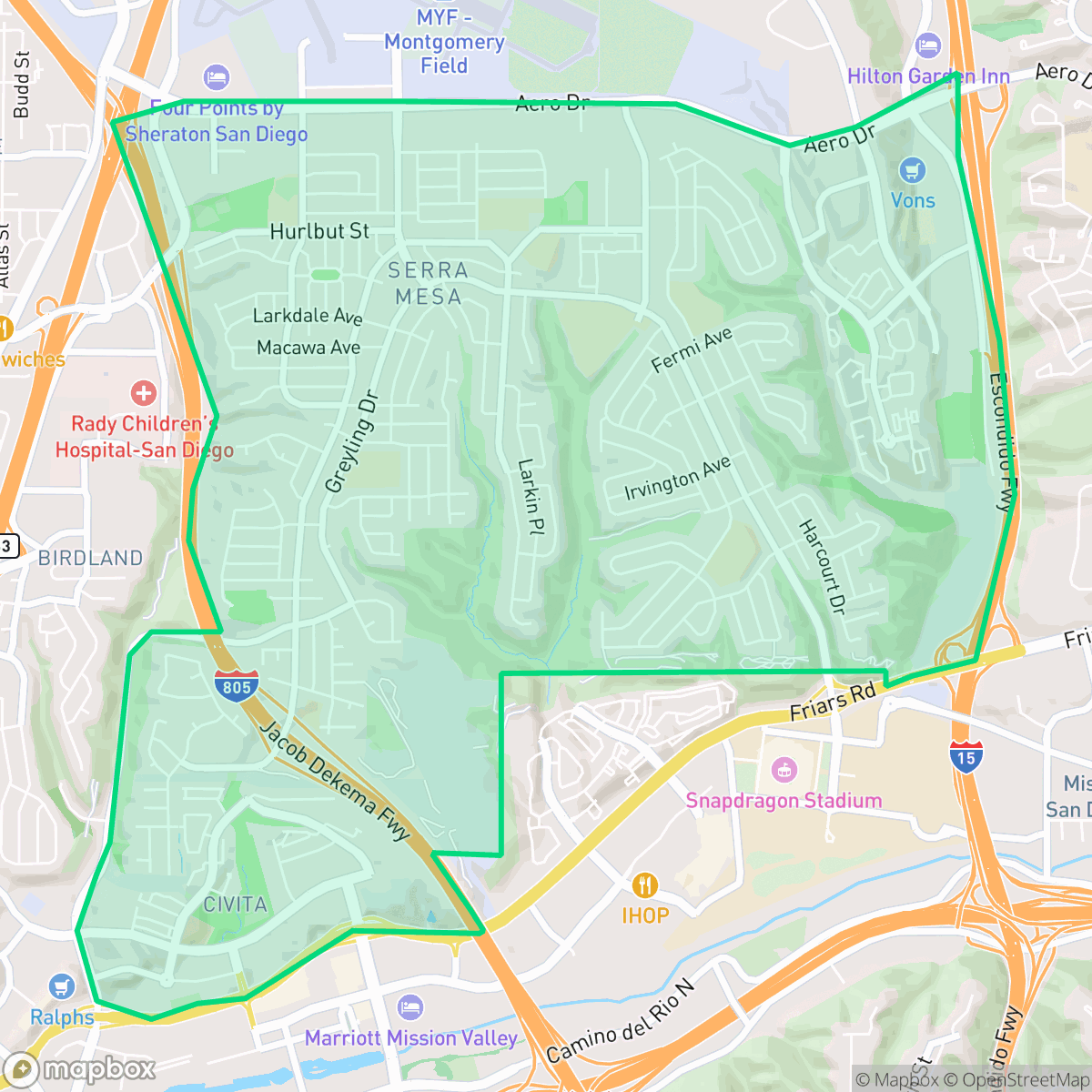
Originally part of the Mission Rancho Lands of San Diego, Serra Mesa transitioned from cattle grazing to modern suburban development after the Korean War. In the early 1950s, the U.S. Navy built the Cabrillo Heights housing project, sparking a decade of rapid tract-home construction. The community comprises distinct subdivisions, including Mission Village and Birdland, the latter of which features streets named exclusively after birds and houses a major medical hub including Rady Children's Hospital. In 1961, a local naming contest unified these tracts under the name "Serra Mesa" in honor of Franciscan friar Junípero Serra. Architecturally dominated by mid-century ranch-style homes, the neighborhood is also defined by its natural geography, bordered by the 84-acre Ruffin Canyon Open Space Preserve.
The area functions as a dense, suburban enclave that prioritizes pedestrian accessibility through a comprehensive network of sidewalks. It is well-regarded for its high rates of health insurance coverage and proximity to major medical centers, including Rady Children's Hospital. The landscape is defined by standard tract housing and a mix of multi-family complexes, with significant natural buffers provided by the Ruffin Canyon Open Space Preserve. According to iHuus data, the neighborhood maintains a consistent suburban character that balances residential density with access to outdoor recreation.
Prospective residents should note that the neighborhood is relatively quiet and remains car-dependent for most daily errands, despite its high walkability score. The acoustic environment is influenced by its central location, with consistent noise levels from regional road traffic and flight paths. While the local school district presents a wide range of academic outcomes, families have access to several highly-rated charter options within the immediate vicinity, making it a diverse choice for various household needs.
Neighborhood Scores Across 15 Qualities
Residential spacing is slightly below the city average due to a mix of closely packed townhomes and apartment complexes. While some areas feature detached houses buffered by natural canyon greenbelts, many residents live in high density units with shared walls or minimal setbacks.
Sidewalks and pedestrian bridges connect many residential areas to retail centers, though major highways and high-traffic arterials can act as significant barriers. This level of accessibility is slightly below the San Diego average.
Residential scenery ranges from affluent pockets featuring large homes and private pools to denser apartment communities and standard tract housing. This mix of spacious estates and multi-family developments matches the city average for visual variety.
Abundant canyon trails and interconnected green buffers provide excellent walking paths for pets. According to iHuus data, these accessible nature preserves and wide residential verges offer more space for outdoor activity than the San Diego average.
Residential pockets and commercial centers are integrated with steep, undeveloped natural canyon systems. This layout provides a balance of dense suburban development and preserved open space that is very similar to the typical San Diego landscape.
Suburban streets and light industrial zones create a primarily quiet atmosphere with a low density of social hubs. Most dining and service options are reachable via car, making the area feel less lively than the San Diego average.
Frequent noise from nearby freeway corridors and transit routes is common here. This level of acoustic disturbance is notably higher than the San Diego average, according to iHuus data.
Air quality in this area fluctuates between acceptable and unhealthy levels, sitting slightly below the San Diego average. Residents sensitive to pollutants may notice occasional periods of concern according to iHuus data.
Residential and retail spaces dominate the landscape, though some areas near major highway interchanges and large warehouses experience increased noise and traffic. According to iHuus data, the neighborhood remains slightly more exposed to industrial-related noise and logistics activity than the San Diego average.
Health insurance access is very high among residents, notably surpassing the San Diego average according to iHuus data.
Voting patterns and census indicators show a predominantly liberal political leaning that is slightly higher than the San Diego average, according to iHuus data.
Residents live alongside a balanced mix of young adults, families, and seniors. According to iHuus data, this demographic distribution is largely consistent with the broader San Diego area.
Flood risk in this area is higher than the San Diego average, though detailed studies are currently unavailable to confirm specific vulnerabilities. According to iHuus data, the lack of a complete FEMA study means residents should remain cautious regarding localized drainage and seasonal runoff.
Wildfire vulnerability is exceptionally high in this area, significantly exceeding the San Diego city average. According to iHuus data, residents should prepare for extreme fire hazards and prioritize maximum protection measures.
Address-Level Insights for Serra Mesa


iHuus Neighborhood Intelligence Insights
Get address-level neighborhood insights for Serra Mesa
- Street-level scores — see how individual blocks compare, not just neighborhood averages
- Micro-zone boundaries — identify quiet pockets, flood boundaries, and walkable clusters before you visit
- 15 dimensions in full — walkability, noise, air quality, school quality, insurance coverage, population age profile, urban/rural index, and more
- Boundary risk alerts — know if your address sits near a block boundary where scores drop, the kind of detail no listing will ever mention
- School insights — individual school ratings and insights, not just district-level data
- Compare before you commit — side-by-side data across neighborhoods, down to block precision
No credit card required
Compare with Any Neighborhood
| Dimension | Serra Mesa | Adams North |
|---|---|---|
| 🚶 Walkabilityavg 8.58 | ||
| 🔊 Acoustic Comfortavg 3.33 | ||
| 🤫 Privacy Indexavg 4.87 | ||
| 🎨 Visual Appealavg 6.85 | ||
| 🐕 Dog Friendlinessavg 6.91 | ||
| 🗺️ Urban-Rural Indexavg 6.6 | ||
| ✨ Neighborhood Vibeavg 5.12 | ||
| 🏥 Health Insurance Coverageavg 7.53 | ||
| 🌿 Air Qualityavg 6.36 | ||
| 🏭 Industrial Proximityavg 9.12 | ||
| 🌊 Flood Safetyavg 4.2 | ||
| 🗳️ Ideological Leanavg 8.51 | ||
| 👥 Population Age Profileavg 4.8 | ||
| 🔥 Fire Safetyavg 0.61 | ||
| 🏫 School Quality |
Serra Mesa Rankings
School Districts Serving Serra Mesa
School Insights for Serra Mesa
Below average outcomes; significant attendance and academic challenges.
School Insights
See what's really behind every school rating near Serra Mesa
- Individual school ratings — each school's own score with outcome context, not just a district average
- Enrollment & class size data — student-to-teacher ratio and how it compares to the state average
- Full demographics breakdown — ethnicity and gender composition for every school in the enrollment zone
- Every school in the district — all schools within the enrollment boundary ranked by rating, not just the closest one
- Grade levels & benchmarks — elementary through high school, with below/above state-average flags
No credit card required