Scripps Ranch, San Diego
Updated · 20,944 residents
Scripps Ranch is a quiet, suburban community defined by its rolling hills, mature eucalyptus groves, and proximity to Miramar Reservoir. While the area offers excellent access to canyon trails and highly-rated schools, residents typically rely on vehicles to reach local commercial hubs.
Key Highlights
About Scripps Ranch
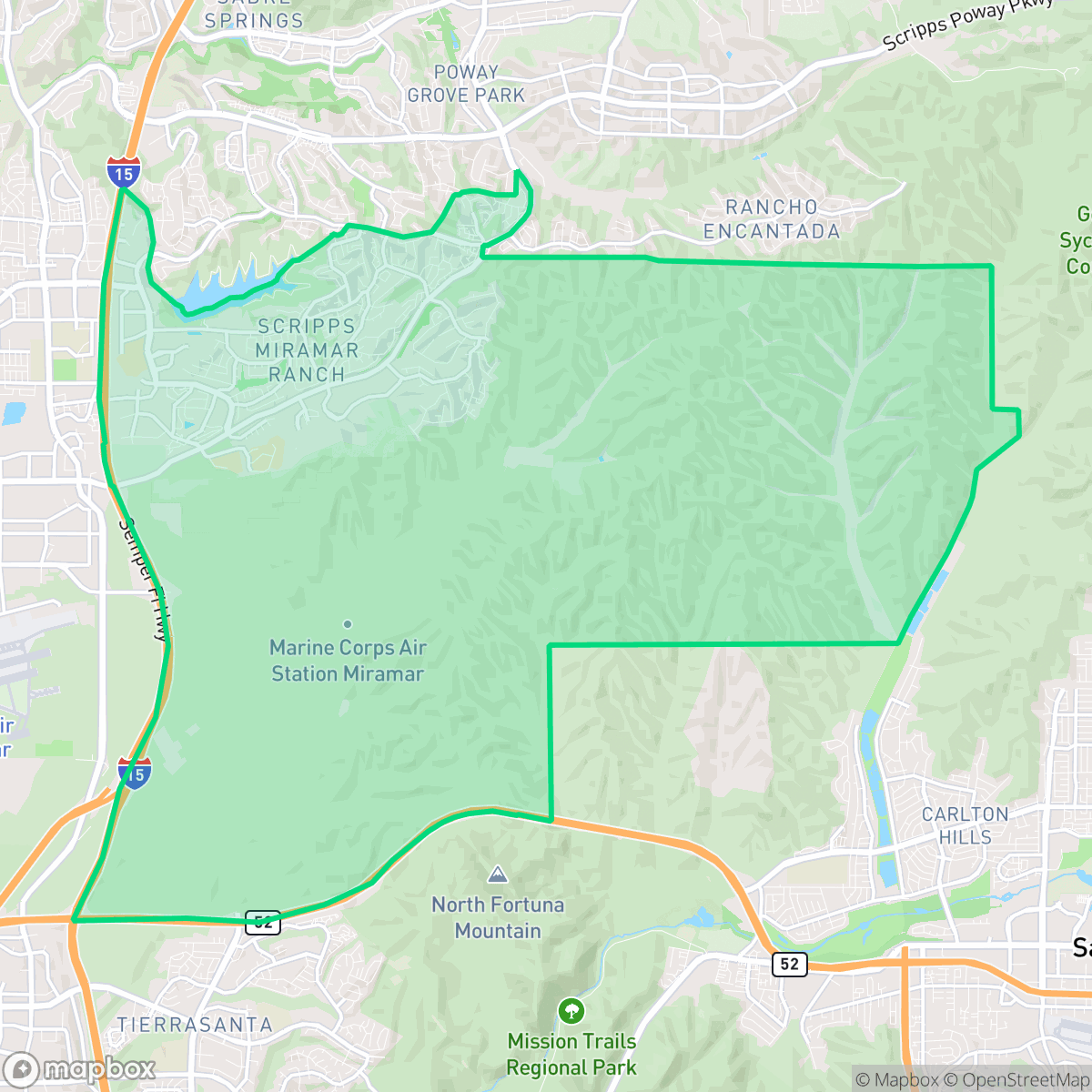
Scripps Ranch originated in 1890 when newspaper publisher E.W. Scripps and his half-sister, philanthropist Ellen Browning Scripps, purchased a barren mesa to establish Miramar Ranch. E.W. Scripps built a sprawling, 47-room mansion inspired by North African and Mediterranean architecture, and planted thousands of eucalyptus and pine trees to transform the dry landscape. Today, these mature eucalyptus groves, especially along Pomerado Road, remain a signature neighborhood landmark. Modern suburban development began in the late 1960s, intentionally preserving the area's "country living" aesthetic and open spaces. Key local landmarks include the Miramar Reservoir, a hub for recreation, and the Scripps Ranch Swim & Racquet Club, located near the original estate site.
The neighborhood functions as a classic suburban residential area, characterized by a mix of tract housing, townhomes, and large apartment complexes. Its landscape is shaped by significant open space and hilly terrain, providing residents with ample opportunities for outdoor activity, particularly along the canyon trails and near the reservoir. According to iHuus data, the area maintains a high standard for health insurance coverage and features a strong educational environment, anchored by the high-performing Poway Unified School District and local institutions like Scripps Ranch High School. The community atmosphere is generally serene, with a visual aesthetic dominated by suburban development and preserved natural buffers.
Living in this area involves specific trade-offs, particularly regarding daily convenience and environmental factors. While the neighborhood provides a peaceful environment, it is notably car-dependent, with limited walkable access to diverse retail or dining options. Residents should be aware of a higher fire safety risk compared to the city average, as well as occasional noise from road traffic. The proximity to utility infrastructure, including water treatment facilities and major transit corridors, is a standard feature of the local landscape. This community is best suited for families and professionals seeking a stable, quiet environment with reliable public schools and immediate access to natural recreation areas.
Neighborhood Scores Across 15 Qualities
Residential spacing varies between detached homes and denser townhome clusters, providing more separation between neighbors than the San Diego average. According to iHuus data, while some areas feature shared walls and close proximity, the neighborhood maintains a balanced mix of private and communal living arrangements.
Sidewalks are available on most residential streets and near central parks, though the nearby freeway acts as a notable barrier to movement. Walking accessibility is slightly lower than the San Diego average due to these major traffic arteries.
Manicured landscaping, large multi-car homes, and high pool density contribute to a visual environment that is more polished than the San Diego average. According to iHuus data, the area features a mix of affluent estates and well-maintained upper-middle-class developments.
Abundant canyon trails and large public parks with green fields provide excellent opportunities for pet owners. Wide sidewalks and connected green buffers make the area significantly more pet-friendly than the San Diego average, according to iHuus data.
Abundant open space and preserved coastal sage scrub canyons provide a more rural atmosphere than most San Diego neighborhoods. Residents will find scattered homes integrated with undeveloped hills and significant natural landscapes according to iHuus data.
Suburban streets and green spaces provide a steady but low-key rhythm of services, though the area feels slightly more tranquil and less commercially active than the San Diego average. Most residents will find a serene environment with limited local amenities, making a car necessary for frequent dining or shopping trips.
Frequent noise from nearby major freeways and transit corridors characterizes the area. According to iHuus data, acoustic comfort levels are slightly lower than the San Diego average.
Air quality remains consistently high with rare instances of elevated readings. This level of cleanliness is notably better than the San Diego city average, according to iHuus data.
Residential life remains undisturbed by heavy industry, as the area lacks warehouses or large-scale manufacturing facilities. This level of industrial separation is consistent with the broader San Diego area.
Health insurance access is exceptionally high among residents, significantly surpassing the San Diego average according to iHuus data.
Political leanings in this area are largely liberal, though the community is slightly less progressive than the San Diego city average according to iHuus data.
Residents live among a balanced demographic of young adults, families, and older individuals, reflecting an age distribution that is nearly identical to the San Diego average.
Property locations within certain zones of the neighborhood fall inside the 100-year floodplain, which may necessitate flood insurance. According to iHuus data, the risk level in this area is higher than the San Diego average.
Significant fire hazards exist within the area, representing a much higher risk level than the San Diego average. Residents should remain vigilant about local mitigation efforts and seasonal wildfire conditions according to iHuus data.
Address-Level Insights for Scripps Ranch


iHuus Neighborhood Intelligence Insights
Get address-level neighborhood insights for Scripps Ranch
- Street-level scores — see how individual blocks compare, not just neighborhood averages
- Micro-zone boundaries — identify quiet pockets, flood boundaries, and walkable clusters before you visit
- 15 dimensions in full — walkability, noise, air quality, school quality, insurance coverage, population age profile, urban/rural index, and more
- Boundary risk alerts — know if your address sits near a block boundary where scores drop, the kind of detail no listing will ever mention
- School insights — individual school ratings and insights, not just district-level data
- Compare before you commit — side-by-side data across neighborhoods, down to block precision
No credit card required
Compare with Any Neighborhood
| Dimension | Scripps Ranch | Adams North |
|---|---|---|
| 🚶 Walkabilityavg 8.58 | ||
| 🔊 Acoustic Comfortavg 3.33 | ||
| 🤫 Privacy Indexavg 4.87 | ||
| 🎨 Visual Appealavg 6.85 | ||
| 🐕 Dog Friendlinessavg 6.91 | ||
| 🗺️ Urban-Rural Indexavg 6.6 | ||
| ✨ Neighborhood Vibeavg 5.12 | ||
| 🏥 Health Insurance Coverageavg 7.53 | ||
| 🌿 Air Qualityavg 6.36 | ||
| 🏭 Industrial Proximityavg 9.12 | ||
| 🌊 Flood Safetyavg 4.2 | ||
| 🗳️ Ideological Leanavg 8.51 | ||
| 👥 Population Age Profileavg 4.8 | ||
| 🔥 Fire Safetyavg 0.61 | ||
| 🏫 School Quality |
Scripps Ranch Rankings
School Districts Serving Scripps Ranch
School Insights for Scripps Ranch
Below average outcomes; significant attendance and academic challenges.
School Insights
See what's really behind every school rating near Scripps Ranch
- Individual school ratings — each school's own score with outcome context, not just a district average
- Enrollment & class size data — student-to-teacher ratio and how it compares to the state average
- Full demographics breakdown — ethnicity and gender composition for every school in the enrollment zone
- Every school in the district — all schools within the enrollment boundary ranked by rating, not just the closest one
- Grade levels & benchmarks — elementary through high school, with below/above state-average flags
No credit card required