San Ysidro, San Diego
Updated · 28,752 residents
San Ysidro is a densely populated border community in San Diego characterized by its close-knit residential layout and proximity to major transit corridors. Residents experience a bustling, urbanized suburban environment where high-density housing and significant road traffic contribute to a lively but notably noisy atmosphere.
Key Highlights
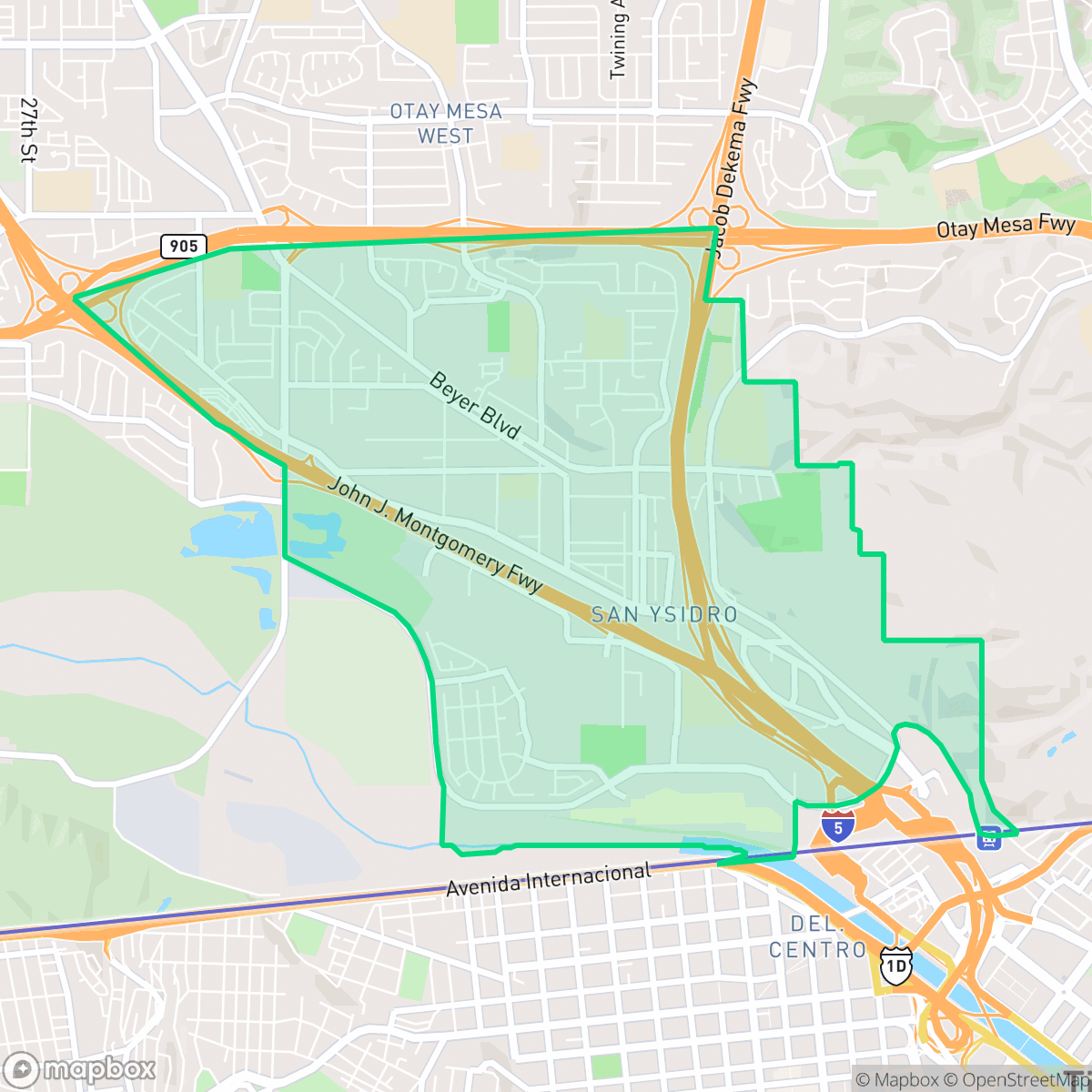
About San Ysidro
Originally part of the 1829 Mexican land grant Rancho Tía Juana, San Ysidro became a U.S. border town following the 1848 Treaty of Guadalupe Hidalgo. In 1909, journalist William E. Smythe established the area as the "Little Landers" colony, a utopian cooperative farming community named after Saint Isidore the Laborer, the patron saint of farmers. Although a catastrophic 1916 flood destroyed the farms, the colony's original street layout and historic Craftsman bungalows remain. San Ysidro subsequently evolved into a bustling border hub, housing workers from Tijuana's 1920s entertainment boom. Notable landmarks include the 1931 historic Customs House and the George Belcher homestead, the neighborhood's oldest surviving structure. Annexed by San Diego in 1957, San Ysidro retains a vibrant, binational cultural identity shaped by decades of cross-border commerce.
The neighborhood functions as a primary gateway to the international border, featuring a mix of high-density multi-family housing, mobile home parks, and commercial warehouse zones. Its landscape reflects a highly urbanized suburban character with limited open space and tightly packed residential structures, resulting in a lower privacy index. Despite the density, the area maintains a functional sidewalk network that supports local pedestrian movement, though the presence of major freeway interchanges and industrial corridors creates significant barriers to quiet, leisurely walking.
Prospective residents should note that the neighborhood faces challenges with acoustic comfort due to high levels of road traffic noise. While it offers a unique binational cultural identity, the local school landscape remains stratified, with significant performance gaps across the various districts serving the area. According to iHuus data, the community is best suited for those who prioritize proximity to major transit routes and a vibrant, high-energy environment over expansive private yards or quiet, secluded residential streets.
Neighborhood Scores Across 15 Qualities
Residential structures are frequently tightly packed with minimal distance between neighbors, resulting in lower privacy than the San Diego average. Many housing units feature shared walls or very small gaps between buildings, according to iHuus data.
Pedestrian access is generally reliable within residential grids, though large highway interchanges and major arterials create significant barriers for crossing the area. While sidewalk networks are present, the neighborhood is less walkable than the San Diego average due to these fragmented pathways and high-traffic infrastructure.
Residential views consist primarily of dense, uniform tract housing and multi-family complexes with small yards. This level of visual variety and greenery is lower than the San Diego average.
Public parks and accessible green verges are available in certain pockets, though the neighborhood offers fewer continuous walking spaces for dogs than the San Diego average. According to iHuus data, options range from large central wetlands to denser urban areas with limited public greenery.
Mixed residential and commercial development characterizes this area, which aligns with the city average for urbanization. Residents will encounter a variety of high-density housing tracts, large retail structures, and industrial infrastructure alongside some natural wetlands.
Primarily defined by industrial and suburban landscapes, this area offers a subdued atmosphere with limited social activity. Most daily amenities and dining options require a vehicle, as the neighborhood lacks the vibrant commercial density found elsewhere in San Diego.
Constant sound from nearby freeways and railroad tracks makes this a loud area. According to iHuus data, acoustic comfort is significantly lower than the San Diego average.
Air quality in this area fluctuates between acceptable and unhealthy levels, sitting slightly below the San Diego average. Sensitive individuals may experience occasional concern during certain periods according to iHuus data.
Large warehouses, distribution centers, and proximity to major highway corridors introduce more noise and truck traffic than is typical for the San Diego area. While heavy industrial hazards are largely absent, residents may experience higher levels of ambient noise from nearby commercial logistics hubs.
Health insurance accessibility is lower than the San Diego average. According to iHuus data, a significant portion of the population lacks coverage, which may impact local access to certain medical services.
Voting patterns and census indicators show a distinctly liberal leaning that is more pronounced than the San Diego average, according to iHuus data.
A balanced demographic of young adults, families, and seniors resides here, reflecting a distribution similar to the broader San Diego area according to iHuus data.
Significant flood risk exists here due to the area's location within a designated floodplain. According to iHuus data, this vulnerability is much higher than the San Diego average and may necessitate flood insurance.
Extreme fire hazards are present in this area, which is slightly higher than the San Diego average. Residents should be aware of significant wildfire risks and ensure they are prepared with maximum protection measures.
Address-Level Insights for San Ysidro


iHuus Neighborhood Intelligence Insights
Get address-level neighborhood insights for San Ysidro
- Street-level scores — see how individual blocks compare, not just neighborhood averages
- Micro-zone boundaries — identify quiet pockets, flood boundaries, and walkable clusters before you visit
- 15 dimensions in full — walkability, noise, air quality, school quality, insurance coverage, population age profile, urban/rural index, and more
- Boundary risk alerts — know if your address sits near a block boundary where scores drop, the kind of detail no listing will ever mention
- School insights — individual school ratings and insights, not just district-level data
- Compare before you commit — side-by-side data across neighborhoods, down to block precision
No credit card required
Compare with Any Neighborhood
| Dimension | San Ysidro | Adams North |
|---|---|---|
| 🚶 Walkabilityavg 8.58 | ||
| 🔊 Acoustic Comfortavg 3.33 | ||
| 🤫 Privacy Indexavg 4.87 | ||
| 🎨 Visual Appealavg 6.85 | ||
| 🐕 Dog Friendlinessavg 6.91 | ||
| 🗺️ Urban-Rural Indexavg 6.6 | ||
| ✨ Neighborhood Vibeavg 5.12 | ||
| 🏥 Health Insurance Coverageavg 7.53 | ||
| 🌿 Air Qualityavg 6.36 | ||
| 🏭 Industrial Proximityavg 9.12 | ||
| 🌊 Flood Safetyavg 4.2 | ||
| 🗳️ Ideological Leanavg 8.51 | ||
| 👥 Population Age Profileavg 4.8 | ||
| 🔥 Fire Safetyavg 0.61 | ||
| 🏫 School Quality |
San Ysidro Rankings
School Districts Serving San Ysidro
School Insights for San Ysidro
Below average outcomes; significant attendance and academic challenges.
School Insights
See what's really behind every school rating near San Ysidro
- Individual school ratings — each school's own score with outcome context, not just a district average
- Enrollment & class size data — student-to-teacher ratio and how it compares to the state average
- Full demographics breakdown — ethnicity and gender composition for every school in the enrollment zone
- Every school in the district — all schools within the enrollment boundary ranked by rating, not just the closest one
- Grade levels & benchmarks — elementary through high school, with below/above state-average flags
No credit card required