Sabre Springs, San Diego
Updated · 10,485 residents
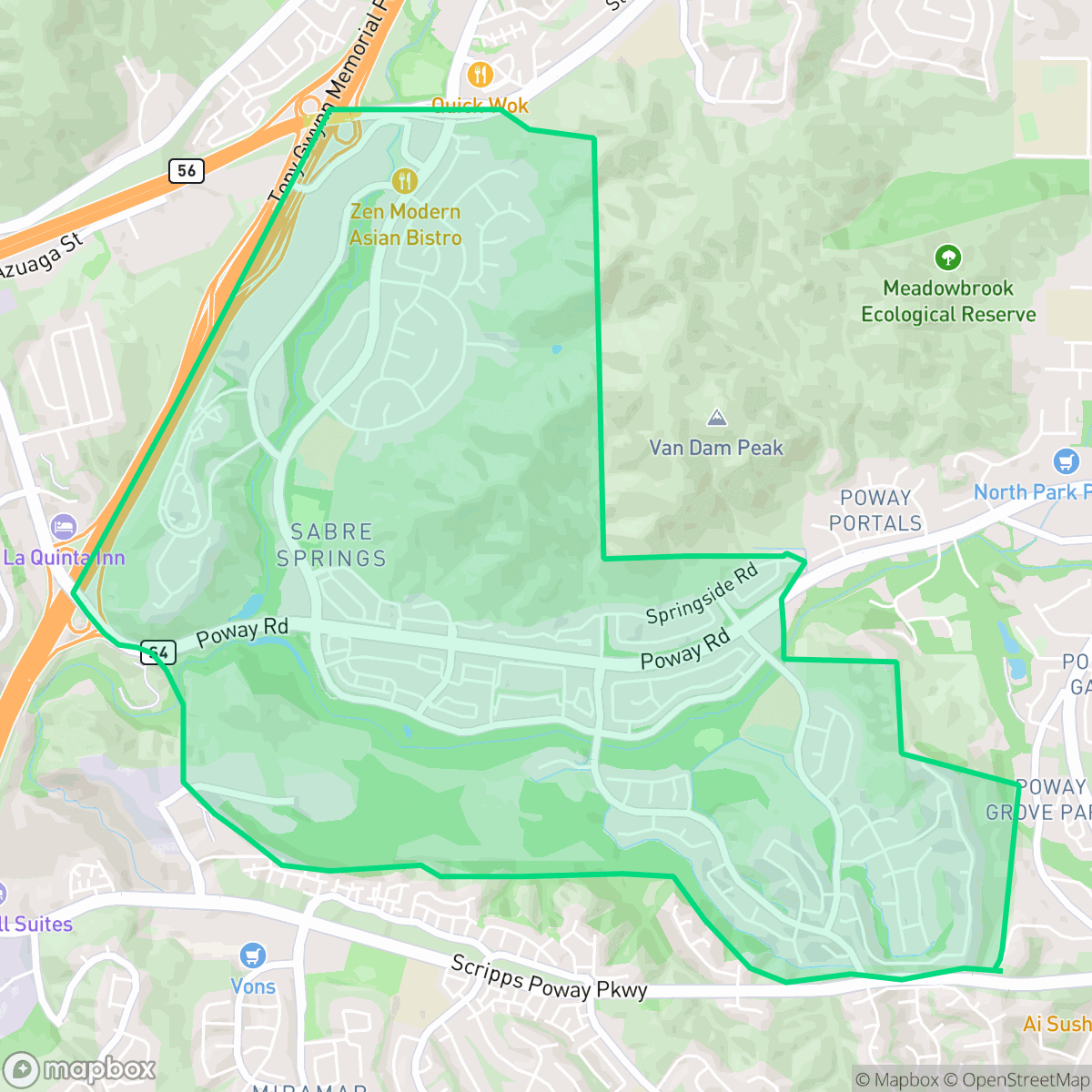
Sabre Springs is a master-planned community in northeastern San Diego characterized by dense residential clusters and immediate access to expansive nature preserves. While the area offers high walkability and excellent air quality, residents experience moderate road noise and a quiet, car-oriented atmosphere with limited local commercial activity.
Key Highlights
About Sabre Springs
Before its modern development, the Sabre Springs area of northeastern San Diego was home to three distinct Native American cultures—the San Dieguito, La Jolla, and Northern Diegueño—with prehistoric village sites situated along Chicarita and Peñasquitos Creeks. Following the Spanish era, the land was utilized for cattle and sheep ranching. In the 20th century, a major portion of the area belonged to the family of legendary San Diego swimmer Florence Chadwick, the first woman to swim the English Channel in both directions. Later owned by the Sabre Petroleum Corporation, the land transitioned into a master-planned community under the 1982 Sabre Springs Community Plan. Developed primarily by Pardee Homes starting in 1985, the neighborhood is bisected by Poway Road and features a prominent business park hosting major employers like General Atomics.
The neighborhood functions as a suburban transition zone, balancing dense residential townhome and apartment clusters with vast, hilly open spaces. Its layout prioritizes connectivity to local nature trails, making it a preferred location for dog owners and those who value outdoor recreation. The area maintains a consistent aesthetic through its uniform tract housing and community-focused shared amenities, such as swimming pools, which define the daily living experience for many of its residents.
Prospective residents should note that the area is primarily a quiet, residential environment with limited social or nightlife options, often requiring travel for broader entertainment. While the neighborhood benefits from high air quality and strong health insurance coverage, it faces challenges with road traffic noise from nearby highways and a high risk of fire. It is well-suited for families seeking access to top-rated schools like Creekside Elementary and individuals who prioritize a calm, suburban lifestyle over an active urban scene.
Neighborhood Scores Across 15 Qualities
Residential spacing varies between detached homes and denser multi-family units, providing slightly more separation than the San Diego average. According to iHuus data, some areas feature closely packed townhomes with minimal buffer between neighbors.
Pedestrian paths and continuous sidewalks connect residential complexes to local commercial plazas. This level of connectivity is slightly above the San Diego average, though crossing larger arterial roads requires utilizing controlled intersections.
Manicured landscaping, large homes, and private pools characterize much of the area, making the visual environment more polished than the San Diego average. According to iHuus data, the neighborhood features a mix of expansive estates and well-maintained multi-family communities with shared amenities.
Immediate access to large hilly nature preserves and canyon trails provides significantly more space for dogs than the typical San Diego neighborhood. Wide street verges and community parks offer ample opportunities for walking and exercise according to iHuus data.
Vast undeveloped hillsides and open land provide a more spacious, semi-rural atmosphere than most San Diego neighborhoods. According to iHuus data, residential clusters here transition directly into natural landscapes, offering more greenery than the city average.
Low-density residential pockets and vast open spaces define this area, which offers a much calmer rhythm than the San Diego average. Most daily needs and dining options require a vehicle, as the neighborhood lacks a concentrated commercial core.
Frequent noise from nearby major freeways and transit corridors is a notable characteristic here. According to iHuus data, acoustic comfort levels are lower than the San Diego average.
Air quality remains consistently clean with very few instances of pollution. According to iHuus data, the air in this area is notably fresher than the San Diego average.
No warehouses, industrial facilities, or hazardous sites are present within the area. This neighborhood offers a strictly residential and recreational environment that is even more free of industrial presence than the San Diego average.
Health insurance accessibility is strong in this area, sitting slightly above the San Diego average according to iHuus data.
Political leanings in this area are primarily liberal, though the neighborhood presents a more moderate ideological profile than the San Diego average.
Residents live in a community with a balanced distribution of young adults, families, and older individuals. This age profile aligns closely with the average seen across San Diego.
Flood risk levels in this area are currently difficult to assess because FEMA has not finished a detailed study for the neighborhood. According to iHuus data, the level of risk is roughly comparable to the San Diego city average.
High fire hazards characterize this area, representing a significantly greater danger than the average San Diego neighborhood. Residents should maintain rigorous wildfire preparedness and mitigation measures according to iHuus data.
Address-Level Insights for Sabre Springs


iHuus Neighborhood Intelligence Insights
Get address-level neighborhood insights for Sabre Springs
- Street-level scores — see how individual blocks compare, not just neighborhood averages
- Micro-zone boundaries — identify quiet pockets, flood boundaries, and walkable clusters before you visit
- 15 dimensions in full — walkability, noise, air quality, school quality, insurance coverage, population age profile, urban/rural index, and more
- Boundary risk alerts — know if your address sits near a block boundary where scores drop, the kind of detail no listing will ever mention
- School insights — individual school ratings and insights, not just district-level data
- Compare before you commit — side-by-side data across neighborhoods, down to block precision
No credit card required
Compare with Any Neighborhood
| Dimension | Sabre Springs | Adams North |
|---|---|---|
| 🚶 Walkabilityavg 8.58 | ||
| 🔊 Acoustic Comfortavg 3.33 | ||
| 🤫 Privacy Indexavg 4.87 | ||
| 🎨 Visual Appealavg 6.85 | ||
| 🐕 Dog Friendlinessavg 6.91 | ||
| 🗺️ Urban-Rural Indexavg 6.6 | ||
| ✨ Neighborhood Vibeavg 5.12 | ||
| 🏥 Health Insurance Coverageavg 7.53 | ||
| 🌿 Air Qualityavg 6.36 | ||
| 🏭 Industrial Proximityavg 9.12 | ||
| 🌊 Flood Safetyavg 4.2 | ||
| 🗳️ Ideological Leanavg 8.51 | ||
| 👥 Population Age Profileavg 4.8 | ||
| 🔥 Fire Safetyavg 0.61 | ||
| 🏫 School Quality |
Sabre Springs Rankings
School Districts Serving Sabre Springs
School Insights for Sabre Springs
Below average outcomes; significant attendance and academic challenges.
School Insights
See what's really behind every school rating near Sabre Springs
- Individual school ratings — each school's own score with outcome context, not just a district average
- Enrollment & class size data — student-to-teacher ratio and how it compares to the state average
- Full demographics breakdown — ethnicity and gender composition for every school in the enrollment zone
- Every school in the district — all schools within the enrollment boundary ranked by rating, not just the closest one
- Grade levels & benchmarks — elementary through high school, with below/above state-average flags
No credit card required