Roseville - Fleet Ridge, San Diego
Updated · 6,097 residents
Roseville-Fleetridge is a highly walkable coastal neighborhood on the Point Loma peninsula known for its blend of maritime heritage and mid-century residential design. Residents benefit from excellent access to local marinas and a quiet, suburban atmosphere that prioritizes residential privacy. While highly desirable, the area experiences notable road traffic noise and requires careful consideration of local school performance.
Key Highlights
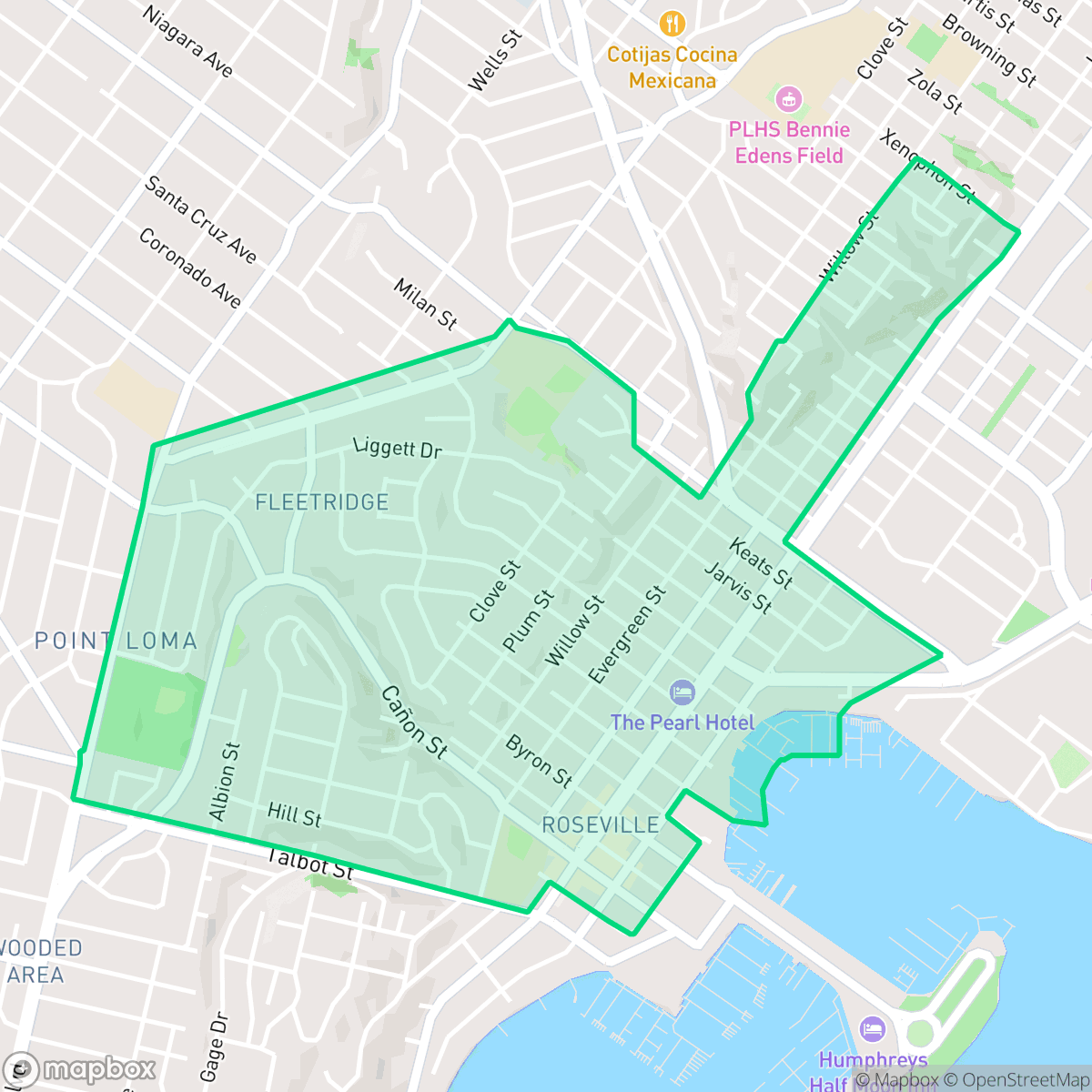
About Roseville - Fleet Ridge
Roseville-Fleetridge, located on San Diego's Point Loma peninsula, unites two historically distinct areas. Roseville, the oldest settled part of Point Loma, was established in 1866 by German Jewish pioneer Louis Rose as an independent waterfront town. By the late 19th century, it evolved into a bustling maritime enclave nicknamed "Tunaville" due to its thriving Portuguese and Italian fishing communities. This heritage endures at St. Agnes Catholic Church, home to the Festa do Espírito Santo, San Diego's oldest continuous ethnic festival, celebrated since 1910. Conversely, the hilly residential area of Fleetridge was developed between 1950 and 1955 by David Fleet. Designed with winding streets to maximize panoramic bay views, Fleetridge is celebrated for its mid-century ranch-style and custom-built homes, offering an architectural contrast to Roseville’s historic grid.
The neighborhood offers a distinct coastal living experience characterized by a high walkability score and significant visual appeal. According to iHuus data, the area is free from industrial hazards, making it a clean and attractive environment for residents who value well-manicured properties and proximity to the water. The landscape transitions from a dense grid of sidewalks and local commercial corridors to elevated residential streets that provide expansive bay views. This combination of maritime charm and suburban stability creates a unique setting that remains well-connected to the broader San Diego region while maintaining a distinct local identity.
Prospective residents should consider a few key trade-offs, including the acoustic environment, where road traffic contributes to a higher-than-average noise level. While the neighborhood boasts high rates of health insurance coverage, families should evaluate the local school options, as performance ratings within the San Diego City Unified School District vary significantly between individual institutions. Additionally, the area faces specific environmental risks, including low fire safety ratings, which are important factors for long-term planning. Overall, this community is well-suited for professionals and families who prioritize a walkable lifestyle and scenic coastal access over absolute acoustic silence.
Neighborhood Scores Across 15 Qualities
Residential spacing offers a moderate level of separation between neighbors, which is higher than the typical San Diego average. Most homes feature fenced yards with limited side-yard buffers, particularly in areas transitioning to multi-unit complexes.
Continuous sidewalks and low-traffic residential loops provide a safe environment for pedestrians. This neighborhood offers a more pedestrian-friendly experience than the San Diego average due to its consistent sidewalk network and ample crossings.
Large homes with well-manicured landscaping and private pools characterize this area. According to iHuus data, the visual quality of the neighborhood is notably higher than the San Diego average.
Large public parks and sports fields provide ample green space for pets. Continuous sidewalks and wide street verges offer safe walking routes that are consistent with the city average.
Residential density remains consistent with the San Diego average, featuring a mix of single-family homes and local recreational facilities. According to iHuus data, the area maintains a classic suburban feel with established neighborhoods and school access.
Local dining and social hubs provide more activity than the typical San Diego area, though many businesses require a short drive. According to iHuus data, the neighborhood features a mix of quiet green spaces and lively pockets of commerce.
Persistent noise from nearby freeway and railroad corridors characterizes this area. According to iHuus data, acoustic comfort in this neighborhood is lower than the San Diego average.
Air quality levels fluctuate between acceptable and unhealthy conditions, sitting slightly below the San Diego city average. Sensitive individuals may experience occasional concerns during certain periods according to iHuus data.
No warehouses, heavy machinery, or industrial hazards are present within the neighborhood. This area maintains a higher level of separation from industrial activity than most of San Diego, according to iHuus data.
Health insurance accessibility is notably higher than the San Diego average, according to iHuus data. This indicates a majority of the local population maintains medical coverage.
Political leanings in this area trend liberal, though the neighborhood is slightly less progressive than the San Diego average according to iHuus data.
A balanced mix of young adults, families, and seniors characterizes this area, reflecting a demographic spread that is very similar to the broader San Diego average.
Flood risk levels in this area remain undetermined because official federal studies are not yet complete; however, the localized risk appears higher than the San Diego average according to iHuus data.
Address-Level Insights for Roseville - Fleet Ridge


iHuus Neighborhood Intelligence Insights
Get address-level neighborhood insights for Roseville - Fleet Ridge
- Street-level scores — see how individual blocks compare, not just neighborhood averages
- Micro-zone boundaries — identify quiet pockets, flood boundaries, and walkable clusters before you visit
- 15 dimensions in full — walkability, noise, air quality, school quality, insurance coverage, population age profile, urban/rural index, and more
- Boundary risk alerts — know if your address sits near a block boundary where scores drop, the kind of detail no listing will ever mention
- School insights — individual school ratings and insights, not just district-level data
- Compare before you commit — side-by-side data across neighborhoods, down to block precision
No credit card required
Compare with Any Neighborhood
| Dimension | Roseville - Fleet Ridge | Adams North |
|---|---|---|
| 🚶 Walkabilityavg 8.58 | ||
| 🔊 Acoustic Comfortavg 3.33 | ||
| 🤫 Privacy Indexavg 4.87 | ||
| 🎨 Visual Appealavg 6.85 | ||
| 🐕 Dog Friendlinessavg 6.91 | ||
| 🗺️ Urban-Rural Indexavg 6.6 | ||
| ✨ Neighborhood Vibeavg 5.12 | ||
| 🏥 Health Insurance Coverageavg 7.53 | ||
| 🌿 Air Qualityavg 6.36 | ||
| 🏭 Industrial Proximityavg 9.12 | ||
| 🌊 Flood Safetyavg 4.2 | ||
| 🗳️ Ideological Leanavg 8.51 | ||
| 👥 Population Age Profileavg 4.8 | ||
| 🔥 Fire Safetyavg 0.61 | ||
| 🏫 School Quality |
Roseville - Fleet Ridge Rankings
School Districts Serving Roseville - Fleet Ridge
School Insights for Roseville - Fleet Ridge
Below average outcomes; significant attendance and academic challenges.
School Insights
See what's really behind every school rating near Roseville - Fleet Ridge
- Individual school ratings — each school's own score with outcome context, not just a district average
- Enrollment & class size data — student-to-teacher ratio and how it compares to the state average
- Full demographics breakdown — ethnicity and gender composition for every school in the enrollment zone
- Every school in the district — all schools within the enrollment boundary ranked by rating, not just the closest one
- Grade levels & benchmarks — elementary through high school, with below/above state-average flags
No credit card required