Rolando, San Diego
Updated · 7,039 residents
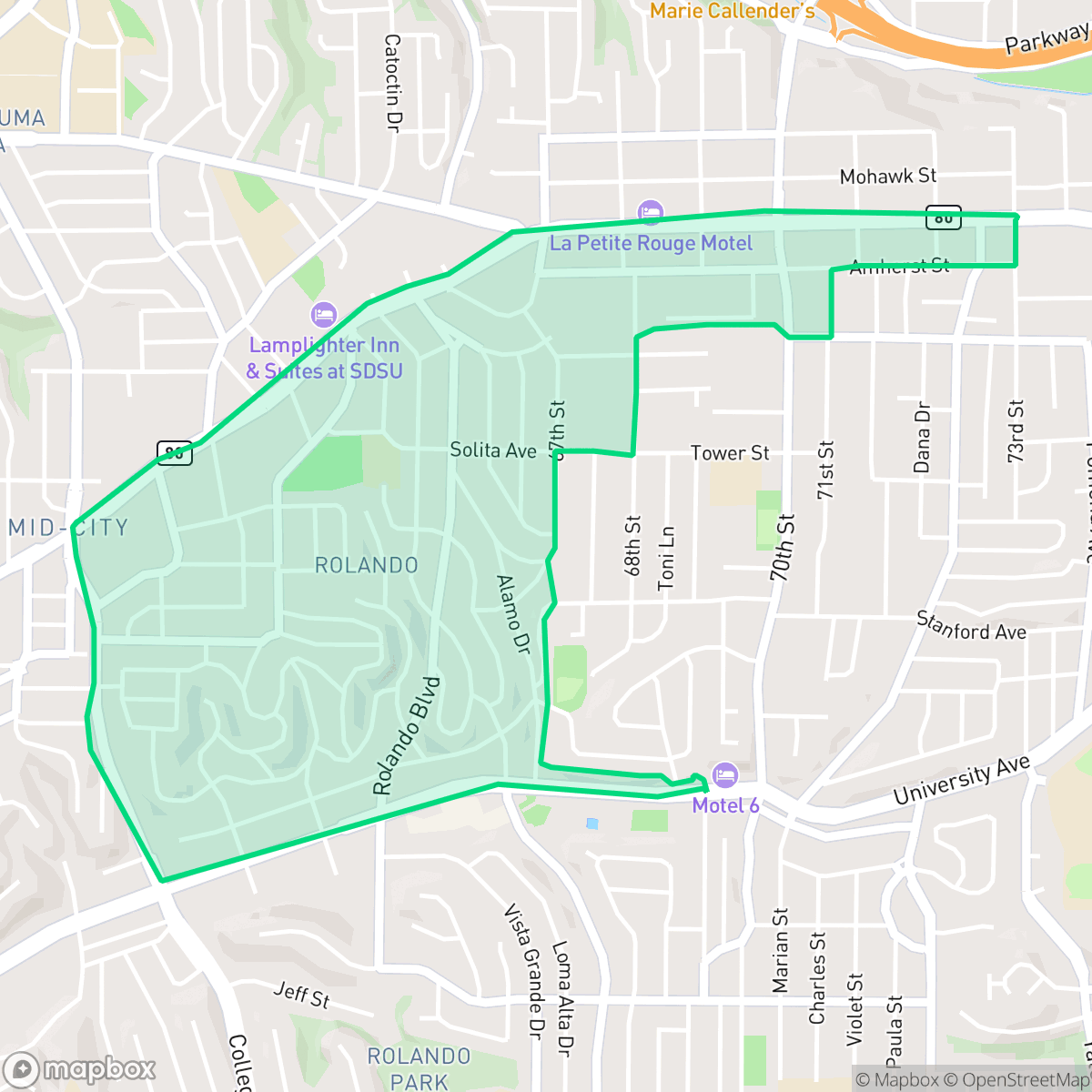
Rolando is a dense, highly walkable neighborhood in San Diego known for its winding streets and historic pedestrian catwalks. While the area offers a vibrant dining scene, residents should expect notable noise levels from road traffic and a high-density suburban environment.
Key Highlights
About Rolando
First laid out in 1926 by the New University Syndicate and designed by landscape architect Theodore Meier, San Diego's Rolando neighborhood was named for its scenic rolling hills. Though initially marketed in the 1920s, development lagged during the Great Depression before booming in the post-World War II era of the 1940s and 1950s. This period populated the area with charming bungalow-style and mid-century modern tract homes. Today, Rolando is highly distinguished by its signature vintage acorn-style lampposts and eight historic pedestrian "catwalks"—public walkways that connect its winding streets. Culturally, the neighborhood holds a unique spot in fast-food history: in 1951, Robert O. Peterson opened the nation's very first Jack in the Box at 63rd Street and El Cajon Boulevard, pioneering the drive-thru intercom system.
The neighborhood functions as a dense suburban enclave characterized by a mix of mid-century bungalow homes, tract housing, and mid-sized apartment complexes. Its grid-based street network and comprehensive sidewalk coverage make it exceptionally accessible for pedestrians, fostering a lively atmosphere supported by a diverse array of local restaurants and cafes. The area maintains a strong sense of community through its unique infrastructure, including public walkways that connect residential blocks, and it remains a hub for residents who prioritize walkability and proximity to urban amenities over expansive private outdoor space.
Prospective residents should consider the trade-offs of this high-density environment, which include a lack of large public parks and a relatively high ambient noise level primarily driven by local road traffic. While the neighborhood is free from heavy industrial hazards, the close proximity of housing units results in limited privacy compared to lower-density areas. The location is best suited for individuals or families who appreciate a bustling, walkable lifestyle and are comfortable with the acoustic realities of a busy suburban setting.
Neighborhood Scores Across 15 Qualities
Residential density is consistent with the city average, featuring a blend of detached homes with yard buffers and more closely spaced multi-unit structures. According to iHuus data, privacy levels vary depending on whether a residence is located in the more suburban areas or near the higher density southern blocks.
Continuous sidewalks and well-connected residential grids make navigating the area on foot easy and safe. According to iHuus data, the connectivity and sidewalk network in Rolando are slightly above the San Diego average.
Residential streets feature a mix of large, manicured homes with private pools and standard multi-family housing. This variety of property types and amenities results in a visual landscape that is roughly in line with the San Diego average.
Public parks and wooded canyons provide decent space for walking pets, though the availability of large green buffers is below the San Diego average. According to iHuus data, many residential areas feature narrow sidewalks and rely more on private yards than expansive public dog parks.
Dense suburban development characterizes this area, featuring a variety of single-family homes and multi-story apartment complexes. This layout is largely consistent with the broader San Diego area.
Local dining clusters and social spots create a noticeably more vibrant atmosphere than the San Diego average. Residents can find a diverse mix of international eateries and community landmarks spread across a balance of suburban streets and green spaces.
Frequent noise from nearby freeway traffic and rail lines makes this area significantly louder than the San Diego average. According to iHuus data, residents may experience consistent auditory disturbances due to the proximity of major transportation corridors.
Air quality levels fluctuate between acceptable and unhealthy, presenting occasional concerns for sensitive groups. According to iHuus data, this neighborhood performs slightly below the San Diego average.
Industrial presence is virtually non-existent, with the area consisting primarily of residential and light commercial zones. According to iHuus data, there are no heavy industrial hazards or large warehouses detected, making the environment comparable to the rest of San Diego in terms of industrial proximity.
Health insurance enrollment among residents is higher than the San Diego average, according to iHuus data. This level of coverage provides a more stable foundation for accessing medical services within the community.
Voting patterns and census indicators show a distinctly progressive leaning that is more pronounced than the San Diego average, according to iHuus data.
Residents live among a balanced distribution of young adults, families, and seniors. This demographic spread is slightly lower than the San Diego average, according to iHuus data.
Flood risk in this area is slightly higher than the San Diego average. According to iHuus data, the lack of a detailed FEMA study means the specific level of risk remains undetermined.
Address-Level Insights for Rolando


iHuus Neighborhood Intelligence Insights
Get address-level neighborhood insights for Rolando
- Street-level scores — see how individual blocks compare, not just neighborhood averages
- Micro-zone boundaries — identify quiet pockets, flood boundaries, and walkable clusters before you visit
- 15 dimensions in full — walkability, noise, air quality, school quality, insurance coverage, population age profile, urban/rural index, and more
- Boundary risk alerts — know if your address sits near a block boundary where scores drop, the kind of detail no listing will ever mention
- School insights — individual school ratings and insights, not just district-level data
- Compare before you commit — side-by-side data across neighborhoods, down to block precision
No credit card required
Compare with Any Neighborhood
| Dimension | Rolando | Adams North |
|---|---|---|
| 🚶 Walkabilityavg 8.58 | ||
| 🔊 Acoustic Comfortavg 3.33 | ||
| 🤫 Privacy Indexavg 4.87 | ||
| 🎨 Visual Appealavg 6.85 | ||
| 🐕 Dog Friendlinessavg 6.91 | ||
| 🗺️ Urban-Rural Indexavg 6.6 | ||
| ✨ Neighborhood Vibeavg 5.12 | ||
| 🏥 Health Insurance Coverageavg 7.53 | ||
| 🌿 Air Qualityavg 6.36 | ||
| 🏭 Industrial Proximityavg 9.12 | ||
| 🌊 Flood Safetyavg 4.2 | ||
| 🗳️ Ideological Leanavg 8.51 | ||
| 👥 Population Age Profileavg 4.8 | ||
| 🔥 Fire Safetyavg 0.61 | ||
| 🏫 School Quality |
Rolando Rankings
School Districts Serving Rolando
School Insights for Rolando
Below average outcomes; significant attendance and academic challenges.
School Insights
See what's really behind every school rating near Rolando
- Individual school ratings — each school's own score with outcome context, not just a district average
- Enrollment & class size data — student-to-teacher ratio and how it compares to the state average
- Full demographics breakdown — ethnicity and gender composition for every school in the enrollment zone
- Every school in the district — all schools within the enrollment boundary ranked by rating, not just the closest one
- Grade levels & benchmarks — elementary through high school, with below/above state-average flags
No credit card required