Ridgeview-Webster, San Diego
Updated · 6,531 residents
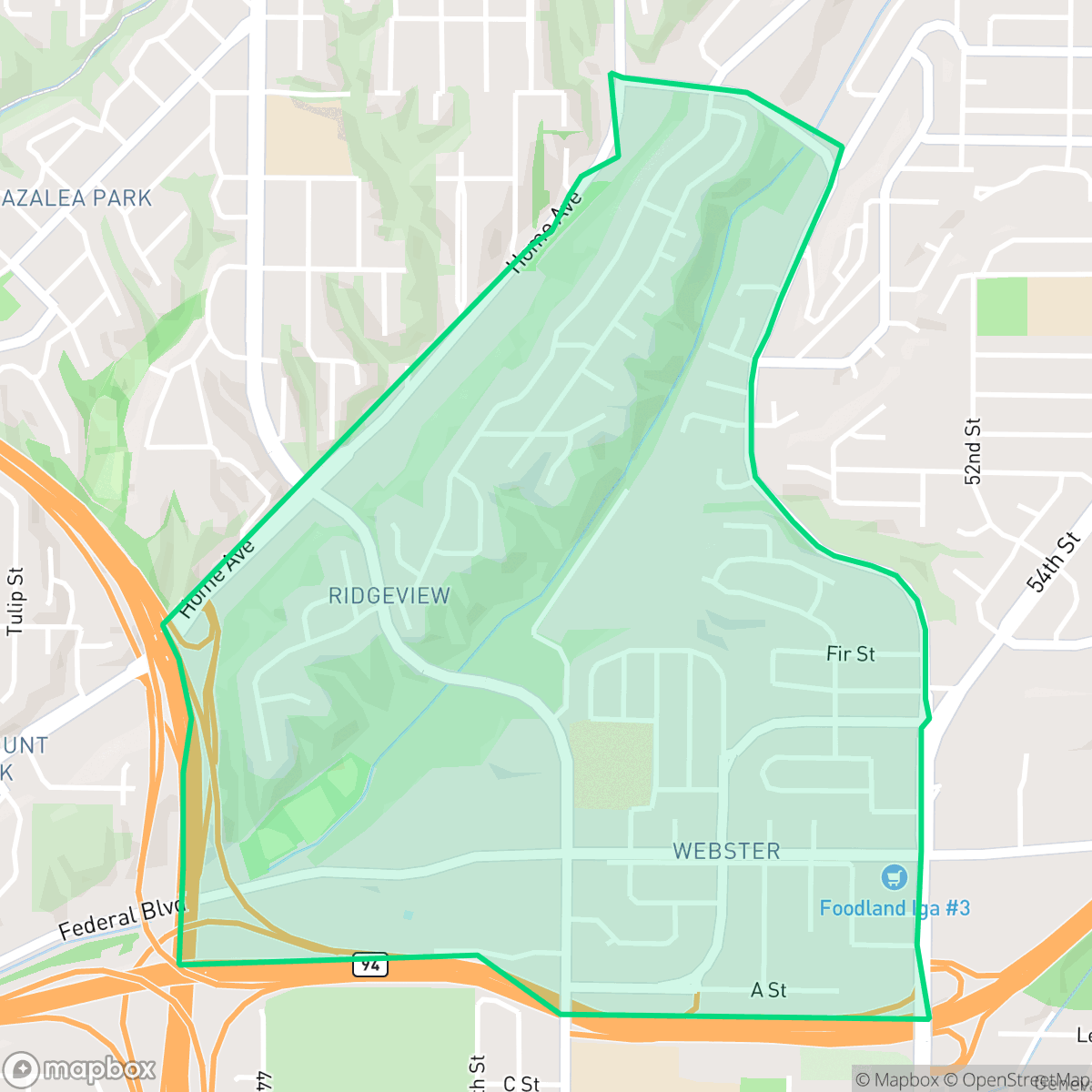
Ridgeview-Webster is a diverse, multicultural enclave in San Diego's Mid-City region defined by its dense suburban layout and integrated natural canyon landscapes. Residents benefit from high walkability and consistent sidewalk access, though the area experiences notable noise levels due to nearby freeway traffic.
Key Highlights
About Ridgeview-Webster
Located in San Diego's Mid-City region, the Ridgeview-Webster neighborhood—originally known as Imig Park—developed during the post-World War II housing boom. Residential subdivision began around 1950 with the Arnold Park tract, led by developer O.D. Arnold and Sons. The project transformed the area's hilly terrain, grading it to construct modest, single-family homes in the Postwar Minimal architectural style. These affordable homes initially attracted working-class families, many of whom commuted to San Diego's burgeoning aerospace and industrial sectors. In 1956, the construction of Webster Elementary School established a central community hub. While early residents were predominantly white, the neighborhood underwent a rapid demographic shift in the late 1960s. Today, Ridgeview-Webster is recognized as a highly diverse, multicultural enclave with strong community ties.
The neighborhood functions as a dense suburban community where residential blocks meet natural canyon buffers. The landscape is characterized by a mix of single-family homes and institutional spaces, creating a distinct suburban feel that integrates with the local topography. Residents enjoy a high level of walkability, with structured grids and continuous sidewalks that facilitate pedestrian movement throughout the area.
While the area offers strong community ties, prospective residents should note the acoustic environment, as road traffic contributes to higher noise levels than the city average. The neighborhood is well-served by local educational institutions, including the highly-rated Webster Elementary School. It remains a suitable location for those prioritizing accessibility and a multicultural atmosphere over absolute quiet or luxury amenities.
Neighborhood Scores Across 15 Qualities
Residential spacing is somewhat varied, ranging from densely packed clusters to canyon-facing lots that offer more separation. According to iHuus data, the level of privacy is slightly higher than the San Diego average.
Residential streets feature consistent sidewalks and safe crossings, though large highway interchanges and wide arterials can create significant barriers for pedestrians. While the neighborhood offers convenient access for many trips, walkability is slightly below the San Diego average due to these fragmented transit corridors.
Residential scenery ranges from large homes with private pools to denser, uniform tract housing. This visual variety is slightly below the San Diego average according to iHuus data.
Natural canyon areas and connected sidewalks provide ample opportunities for walking dogs. According to iHuus data, these amenities make the area nearly as pet-friendly as the rest of San Diego.
Residential layouts feature a mix of single-family homes and apartment complexes integrated with significant natural canyon buffers. This landscape provides a slightly more open, semi-rural feel compared to the typical San Diego urban average.
Residential streets and light industrial zones create a subdued atmosphere with fewer social hubs than the San Diego average. Most dining and community services are limited in density and often require a vehicle to reach.
Frequent traffic and transit noise from nearby freeways and rail lines characterize the area, resulting in acoustic levels that are higher than the San Diego average.
Air quality in this area fluctuates between acceptable and unhealthy levels, presenting occasional concerns for sensitive groups. According to iHuus data, the air quality is slightly lower than the San Diego average.
Primarily composed of residential, educational, and light commercial zones, this area lacks heavy warehouses or hazardous industrial sites. According to iHuus data, the neighborhood maintains a level of industrial separation that is slightly higher than the San Diego average.
Health insurance access among residents is below the San Diego average. According to iHuus data, a significant portion of the local population lacks coverage.
Voting patterns and census indicators show a much more liberal leaning than the San Diego average. According to iHuus data, this area is characterized by deeply progressive political tendencies.
Residents live alongside a balanced variety of young adults, families, and older populations. This demographic spread is slightly more varied than the typical San Diego age profile, according to iHuus data.
Located within a designated flood zone, this area faces a higher risk of inundation than much of San Diego. According to iHuus data, property owners in this neighborhood should prepare for potential flood insurance requirements.
Address-Level Insights for Ridgeview-Webster


iHuus Neighborhood Intelligence Insights
Get address-level neighborhood insights for Ridgeview-Webster
- Street-level scores — see how individual blocks compare, not just neighborhood averages
- Micro-zone boundaries — identify quiet pockets, flood boundaries, and walkable clusters before you visit
- 15 dimensions in full — walkability, noise, air quality, school quality, insurance coverage, population age profile, urban/rural index, and more
- Boundary risk alerts — know if your address sits near a block boundary where scores drop, the kind of detail no listing will ever mention
- School insights — individual school ratings and insights, not just district-level data
- Compare before you commit — side-by-side data across neighborhoods, down to block precision
No credit card required
Compare with Any Neighborhood
| Dimension | Ridgeview-Webster | Adams North |
|---|---|---|
| 🚶 Walkabilityavg 8.58 | ||
| 🔊 Acoustic Comfortavg 3.33 | ||
| 🤫 Privacy Indexavg 4.87 | ||
| 🎨 Visual Appealavg 6.85 | ||
| 🐕 Dog Friendlinessavg 6.91 | ||
| 🗺️ Urban-Rural Indexavg 6.6 | ||
| ✨ Neighborhood Vibeavg 5.12 | ||
| 🏥 Health Insurance Coverageavg 7.53 | ||
| 🌿 Air Qualityavg 6.36 | ||
| 🏭 Industrial Proximityavg 9.12 | ||
| 🌊 Flood Safetyavg 4.2 | ||
| 🗳️ Ideological Leanavg 8.51 | ||
| 👥 Population Age Profileavg 4.8 | ||
| 🔥 Fire Safetyavg 0.61 | ||
| 🏫 School Quality |
Ridgeview-Webster Rankings
School Districts Serving Ridgeview-Webster
School Insights for Ridgeview-Webster
Below average outcomes; significant attendance and academic challenges.
School Insights
See what's really behind every school rating near Ridgeview-Webster
- Individual school ratings — each school's own score with outcome context, not just a district average
- Enrollment & class size data — student-to-teacher ratio and how it compares to the state average
- Full demographics breakdown — ethnicity and gender composition for every school in the enrollment zone
- Every school in the district — all schools within the enrollment boundary ranked by rating, not just the closest one
- Grade levels & benchmarks — elementary through high school, with below/above state-average flags
No credit card required