Redwood Village, San Diego
Updated · 5,013 residents
Redwood Village is a quiet, mid-century residential neighborhood in San Diego characterized by a dense suburban layout and consistent sidewalk networks. While the area maintains a calm atmosphere, residents experience moderate road traffic noise and a mix of single-family homes and apartment complexes. According to iHuus data, it offers a walkable environment with convenient access to local retail hubs and community-managed green spaces.
Key Highlights
About Redwood Village
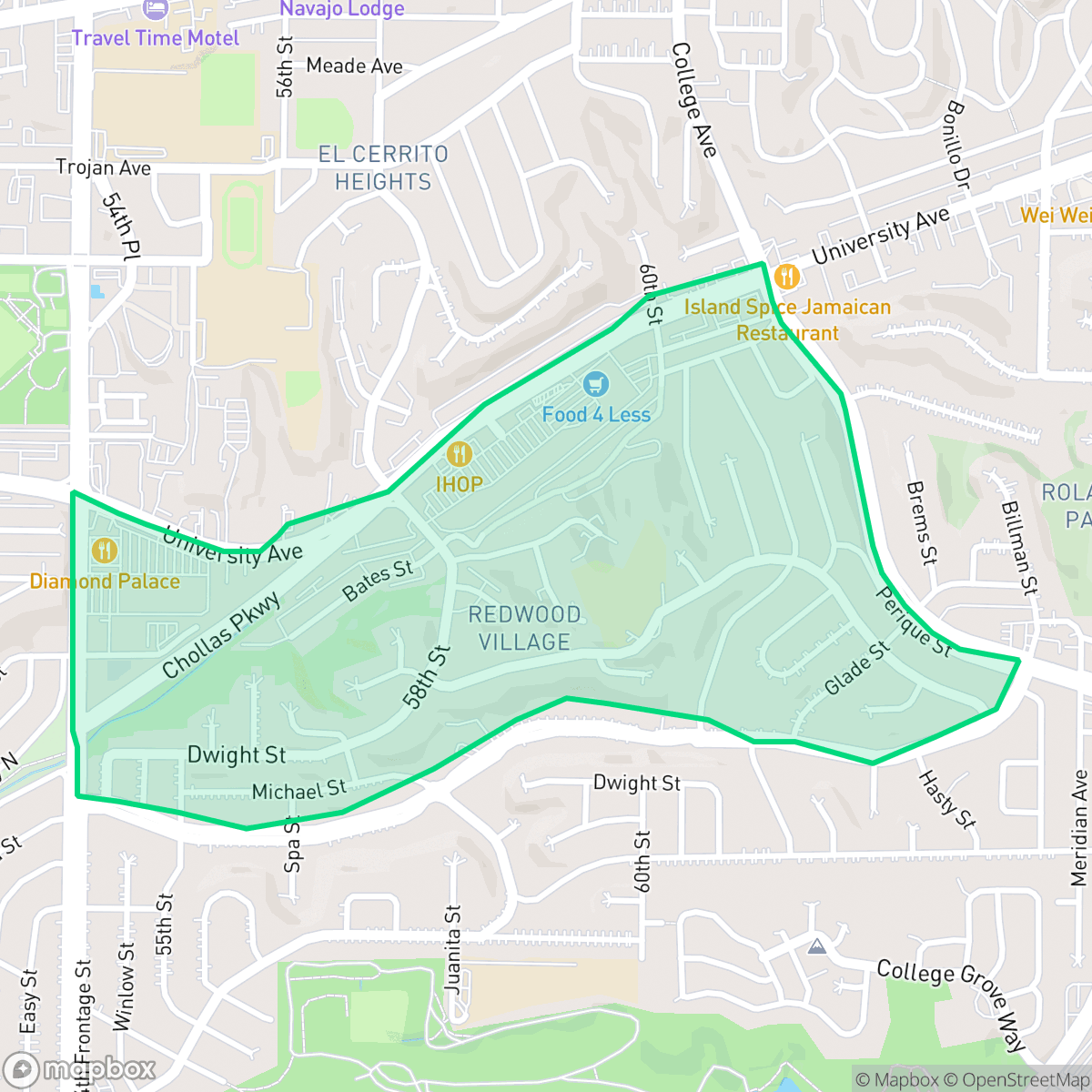
Located in San Diego's Mid-City region, Redwood Village was established as one of the city's early suburbs along its west-to-east transit corridors prior to the construction of Interstate 8. Historically known as Darnall, residents voted to officially rename the neighborhood to Redwood Village on June 7, 2007. The neighborhood is primarily residential, featuring a high concentration of well-established mid-century single-family homes and apartment complexes built between 1940 and 1969. A key local landmark is the Redwood Village Community Water-Wise Garden, located at 58th and Day Street. This drought-tolerant mini-park was transformed in November 2007 from an illegal dumping ground into a community-maintained space through a collaborative effort of local residents, Mark Twain High School students, and volunteers.
Redwood Village is located in the Mid-City region of San Diego, offering a blend of post-war residential architecture and modern apartment living. The layout features a mix of housing types, from established single-family homes to larger complexes, all connected by a reliable network of sidewalks. Daily life is centered around local commercial strips and neighborhood amenities, such as the community-maintained gardens that define the area's commitment to local engagement. The neighborhood provides a functional, suburban environment that balances residential density with essential retail access.
Prospective residents should note that the area is a dense suburban environment with limited privacy between homes. While the neighborhood is generally quiet, road traffic contributes to a moderate noise level, and the proximity to commercial hubs means residents live near light industrial infrastructure, including warehouses and utility substations. It is well-suited for those who prioritize walkability and an established community feel over expansive private yards, though individuals should be aware of the specific environmental risks like flood and fire vulnerability noted in iHuus data.
Neighborhood Scores Across 15 Qualities
Residential spacing is slightly higher than the San Diego average, offering a mix of multi-family complexes and single-family homes with moderate buffers between neighbors. According to iHuus data, some areas feature denser layouts with shared walls, while others provide more separation between structures.
Continuous sidewalk networks and safe crossings throughout residential blocks and the local shopping center make for easy pedestrian travel. This level of accessibility is very similar to the average found across San Diego.
Standard tract housing and mid-density apartments create a consistent visual landscape across the area. The neighborhood features uniform rooflines and small yards, which is slightly below the San Diego average for visual variety.
Accessible walking paths and nearby parkland provide consistent opportunities for exercise. Residents have access to continuous sidewalks and nearby lake access, making the area slightly more accommodating for pets than the San Diego average.
Suburban development dominates the area, featuring a blend of single-family homes, apartment complexes, and commercial hubs. This landscape offers slightly more open space than the typical San Diego urban environment.
Residential streets and light industrial zones provide a subdued atmosphere with a steady but low-density flow of local dining and services. This level of activity is slightly below the city average, offering a more tranquil environment than more densely populated San Diego hubs.
Local traffic from a nearby busy street creates a persistent background noise, though levels remain more tranquil than the San Diego average.
Air quality in this area fluctuates between acceptable and unhealthy levels, appearing slightly lower than the San Diego average. Sensitive individuals may experience occasional concerns during certain periods, according to iHuus data.
Industrial presence is minimal, consisting mostly of light commercial structures and occasional warehouses along southern arterial roads. This area remains slightly more residential than the San Diego average, with no significant heavy industrial hazards detected according to iHuus data.
Health insurance access among residents is lower than the San Diego average, according to iHuus data.
Voting patterns and census indicators show a predominantly liberal political leaning that is more pronounced than the San Diego average. Residents may find a community culture aligned with progressive values, according to iHuus data.
Residents live alongside a balanced mix of young adults, families, and seniors. According to iHuus data, the age distribution is slightly more concentrated toward middle-aged and older demographics than the San Diego average.
Properties in this area are located within a designated floodplain, meaning the risk of flooding is significantly higher than the San Diego average. Residents should be aware that flood insurance is typically required for homes in this zone according to iHuus data.
Address-Level Insights for Redwood Village


iHuus Neighborhood Intelligence Insights
Get address-level neighborhood insights for Redwood Village
- Street-level scores — see how individual blocks compare, not just neighborhood averages
- Micro-zone boundaries — identify quiet pockets, flood boundaries, and walkable clusters before you visit
- 15 dimensions in full — walkability, noise, air quality, school quality, insurance coverage, population age profile, urban/rural index, and more
- Boundary risk alerts — know if your address sits near a block boundary where scores drop, the kind of detail no listing will ever mention
- School insights — individual school ratings and insights, not just district-level data
- Compare before you commit — side-by-side data across neighborhoods, down to block precision
No credit card required
Compare with Any Neighborhood
| Dimension | Redwood Village | Adams North |
|---|---|---|
| 🚶 Walkabilityavg 8.58 | ||
| 🔊 Acoustic Comfortavg 3.33 | ||
| 🤫 Privacy Indexavg 4.87 | ||
| 🎨 Visual Appealavg 6.85 | ||
| 🐕 Dog Friendlinessavg 6.91 | ||
| 🗺️ Urban-Rural Indexavg 6.6 | ||
| ✨ Neighborhood Vibeavg 5.12 | ||
| 🏥 Health Insurance Coverageavg 7.53 | ||
| 🌿 Air Qualityavg 6.36 | ||
| 🏭 Industrial Proximityavg 9.12 | ||
| 🌊 Flood Safetyavg 4.2 | ||
| 🗳️ Ideological Leanavg 8.51 | ||
| 👥 Population Age Profileavg 4.8 | ||
| 🔥 Fire Safetyavg 0.61 | ||
| 🏫 School Quality |
Redwood Village Rankings
School Districts Serving Redwood Village
School Insights for Redwood Village
Below average outcomes; significant attendance and academic challenges.
School Insights
See what's really behind every school rating near Redwood Village
- Individual school ratings — each school's own score with outcome context, not just a district average
- Enrollment & class size data — student-to-teacher ratio and how it compares to the state average
- Full demographics breakdown — ethnicity and gender composition for every school in the enrollment zone
- Every school in the district — all schools within the enrollment boundary ranked by rating, not just the closest one
- Grade levels & benchmarks — elementary through high school, with below/above state-average flags
No credit card required