Rancho Penasquitos, San Diego
Updated · 52,170 residents
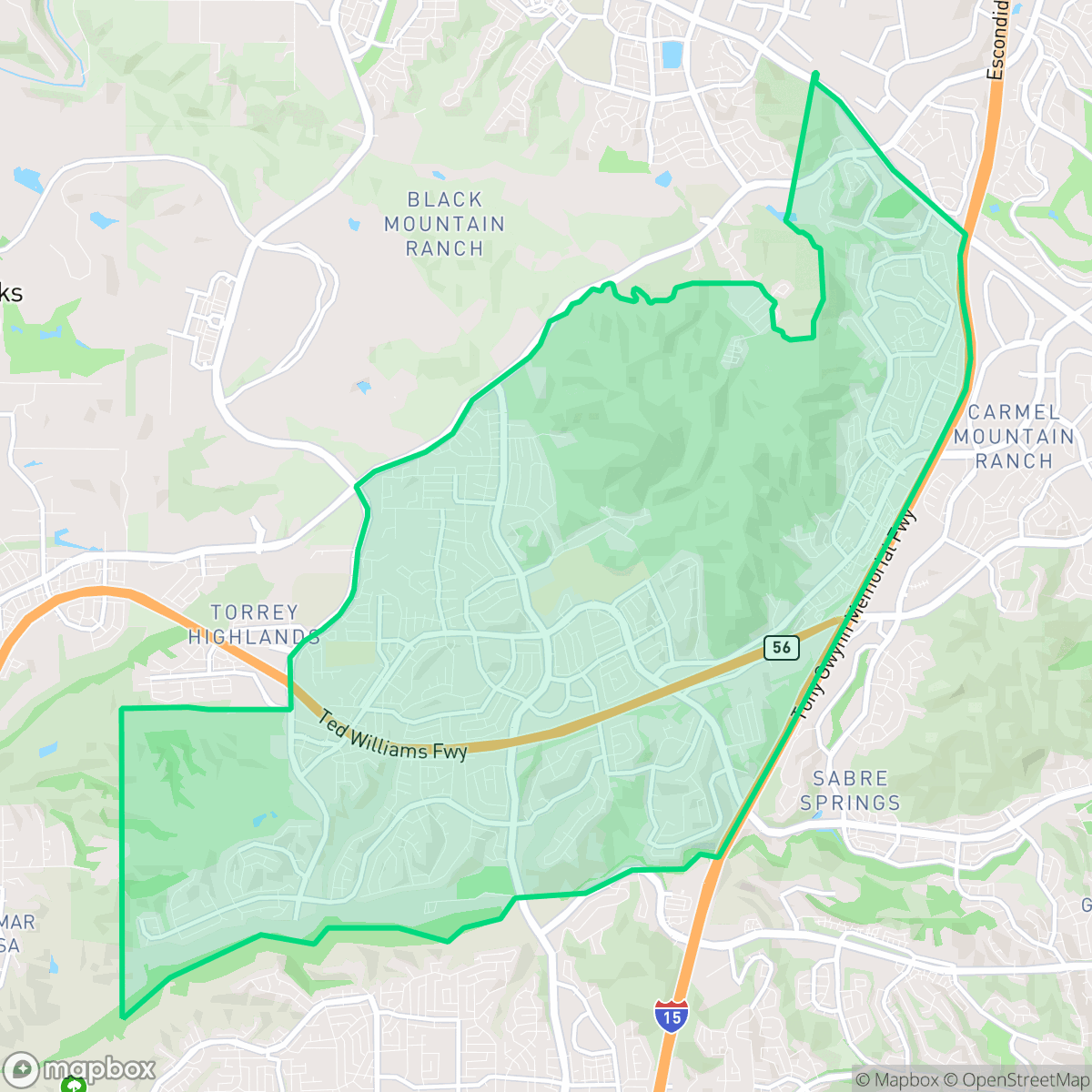
Rancho Penasquitos is a suburban San Diego community defined by its proximity to the Los Penasquitos Canyon Preserve and a concentration of high-performing schools. The neighborhood features a dense residential layout with highly walkable streets and consistent, well-maintained landscaping.
Key Highlights
About Rancho Penasquitos
Named for the first Mexican land grant in San Diego County (1823), Rancho Santa Maria de Los Peñasquitos (“little cliffs”) is a suburban community steeped in history. Long before Spanish colonization, the region was home to the Kumeyaay settlement of Awil Nyawa. In the mid-19th century, the rancho served as a vital way station for the San Antonio-San Diego Mail Line. Notable local landmarks include the historic Johnson-Taylor Adobe, San Diego County's second-oldest colonial structure, and the 1910 Mohnike Adobe. The area transitioned from a century of cattle ranching to a modern suburb starting in 1962, when developer Irvin Kahn acquired the land for a planned community, leading to its annexation by San Diego in 1964. Today, the neighborhood’s character is defined by its preservation of open space, abutting the scenic Los Peñasquitos Canyon Preserve.
This community is characterized by its quiet, suburban atmosphere and a strong emphasis on residential living, featuring a mix of detached single-family homes and well-connected sidewalk networks. Residents benefit from significant access to natural open spaces, including expansive canyon trails that support outdoor recreation and dog walking. The area is served by several top-rated schools, making it a stable environment for families seeking academic consistency and a peaceful, green-focused lifestyle.
While the neighborhood offers high walkability for its type, the limited density of local commercial centers means that most daily errands require a vehicle. Prospective residents should note that noise levels are influenced by nearby major traffic arteries, and the region requires awareness of fire safety protocols. It is an ideal choice for those who value proximity to nature and educational excellence over immediate access to urban retail or nightlife.
Neighborhood Scores Across 15 Qualities
Residential spacing offers a moderate level of separation, providing more privacy than the typical San Diego neighborhood. According to iHuus data, the area features a mix of closely packed suburban homes and detached houses with canyon buffers.
Continuous sidewalk networks and clear pedestrian crossings make much of the area accessible on foot, slightly surpassing the San Diego average. While residential streets are well-connected, certain sections are bisected by high-speed arterial roads and the freeway.
Large, well-maintained homes with private pools and professional landscaping characterize this area, which offers a more polished aesthetic than the San Diego average. According to iHuus data, the neighborhood features expansive properties with significant curb appeal.
Extensive canyon trails and large public parks provide significant space for pets. According to iHuus data, the abundance of connected green spaces and wide street verges makes this area more accommodating for dog owners than much of San Diego.
Expansive open lands and undeveloped canyon hillsides provide a more rural feel than much of San Diego. Residents benefit from a landscape where suburban housing is frequently integrated with significant natural green spaces and preserved buffers.
A serene, low-density environment prevails with significant open space and a steady residential rhythm. While some pockets offer diverse dining options, the overall level of commercial activity and social density is below the city average.
Frequent noise from nearby freeway corridors and railroad tracks characterizes the area. According to iHuus data, acoustic comfort in this neighborhood is slightly lower than the San Diego average.
Air quality remains consistently high with rare instances of elevated readings, representing a cleaner environment than the San Diego average according to iHuus data.
Industrial activity and warehouses are absent from this area, which provides a purely residential and recreational environment that is even cleaner of heavy industry than the San Diego average. According to iHuus data, the landscape is composed strictly of residential, retail, and parkland without any detected hazardous sites or large-scale logistics hubs.
Health insurance access is more prevalent here than in the rest of San Diego, according to iHuus data. Residents benefit from a high rate of coverage compared to the city average.
Political leanings in this area tend toward the liberal side, though the community is less progressive than the San Diego average according to iHuus data.
Residents live alongside a balanced mix of young professionals, families, and seniors. This demographic spread is very similar to the broader San Diego area according to iHuus data.
Significant portions of the area fall within a designated floodplain, making flood insurance a typical requirement for properties here. This level of risk is notably higher than the average found across San Diego.
Extreme fire hazards are present in this area, representing a risk level that is higher than the San Diego average. According to iHuus data, residents should prioritize maximum protection measures and emergency preparedness.
Address-Level Insights for Rancho Penasquitos


iHuus Neighborhood Intelligence Insights
Get address-level neighborhood insights for Rancho Penasquitos
- Street-level scores — see how individual blocks compare, not just neighborhood averages
- Micro-zone boundaries — identify quiet pockets, flood boundaries, and walkable clusters before you visit
- 15 dimensions in full — walkability, noise, air quality, school quality, insurance coverage, population age profile, urban/rural index, and more
- Boundary risk alerts — know if your address sits near a block boundary where scores drop, the kind of detail no listing will ever mention
- School insights — individual school ratings and insights, not just district-level data
- Compare before you commit — side-by-side data across neighborhoods, down to block precision
No credit card required
Compare with Any Neighborhood
| Dimension | Rancho Penasquitos | Adams North |
|---|---|---|
| 🚶 Walkabilityavg 8.58 | ||
| 🔊 Acoustic Comfortavg 3.33 | ||
| 🤫 Privacy Indexavg 4.87 | ||
| 🎨 Visual Appealavg 6.85 | ||
| 🐕 Dog Friendlinessavg 6.91 | ||
| 🗺️ Urban-Rural Indexavg 6.6 | ||
| ✨ Neighborhood Vibeavg 5.12 | ||
| 🏥 Health Insurance Coverageavg 7.53 | ||
| 🌿 Air Qualityavg 6.36 | ||
| 🏭 Industrial Proximityavg 9.12 | ||
| 🌊 Flood Safetyavg 4.2 | ||
| 🗳️ Ideological Leanavg 8.51 | ||
| 👥 Population Age Profileavg 4.8 | ||
| 🔥 Fire Safetyavg 0.61 | ||
| 🏫 School Quality |
Rancho Penasquitos Rankings
School Districts Serving Rancho Penasquitos
School Insights for Rancho Penasquitos
Below average outcomes; significant attendance and academic challenges.
School Insights
See what's really behind every school rating near Rancho Penasquitos
- Individual school ratings — each school's own score with outcome context, not just a district average
- Enrollment & class size data — student-to-teacher ratio and how it compares to the state average
- Full demographics breakdown — ethnicity and gender composition for every school in the enrollment zone
- Every school in the district — all schools within the enrollment boundary ranked by rating, not just the closest one
- Grade levels & benchmarks — elementary through high school, with below/above state-average flags
No credit card required