Rancho Bernardo, San Diego
Updated · 38,763 residents
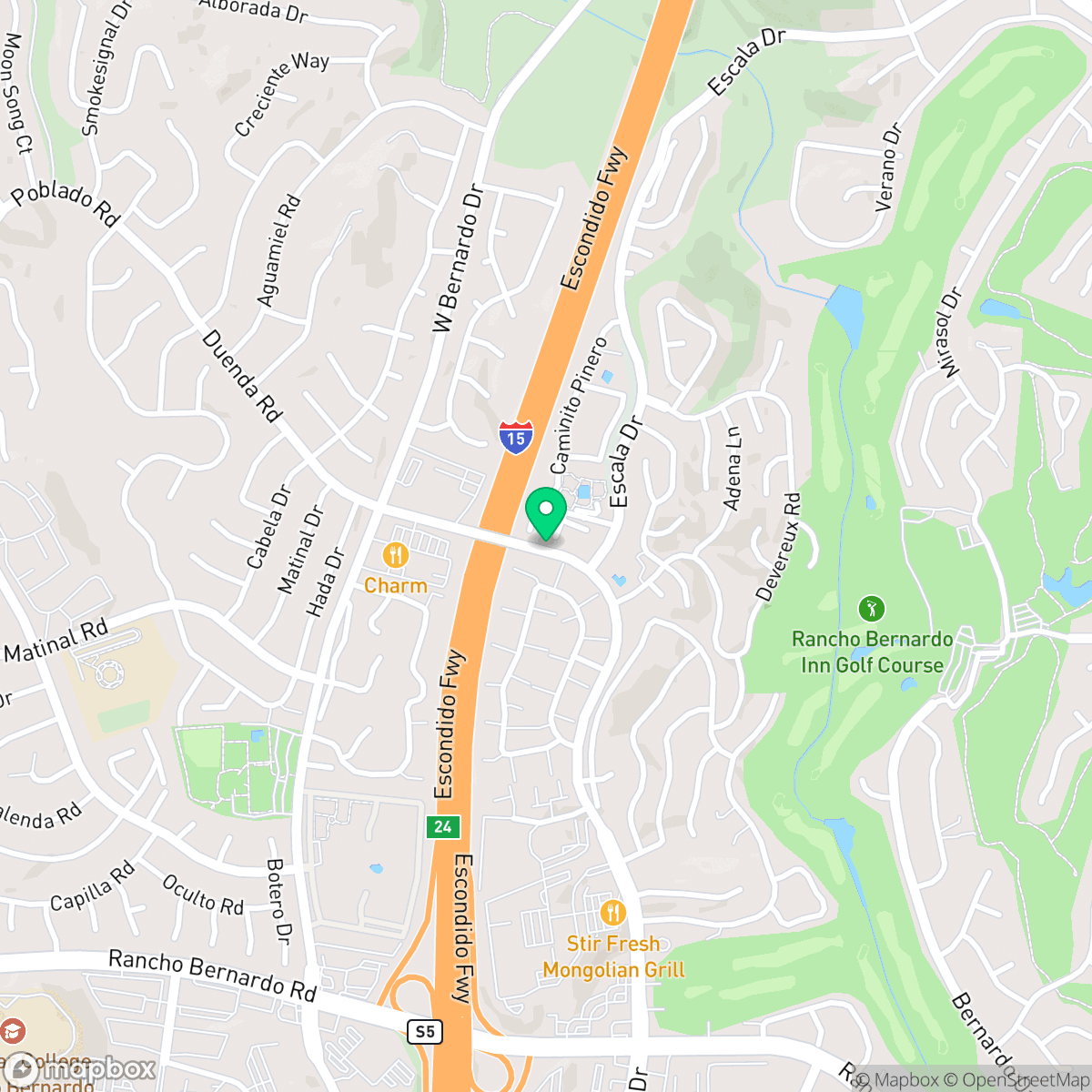
Rancho Bernardo is an affluent, master-planned community defined by its manicured suburban landscape and proximity to expansive green canyons. While the area offers high-quality schools and a quiet, pedestrian-friendly environment, residents typically rely on vehicles for daily errands due to the sparse commercial density.
Key Highlights
About Rancho Bernardo
Originally inhabited by the Kumeyaay people, the San Diego neighborhood of Rancho Bernardo traces its modern history to the 17,763-acre Rancho San Bernardo Mexican land grant, awarded in 1842 to English sea captain Joseph Snook. For over a century, the region remained a rural stopover for travelers and a prominent stock-raising ranch. In 1961, the Daley family sold the land, prompting its annexation by the city of San Diego. Developed by Harry Summers and W.R. Hawn, it became one of the nation’s pioneering master-planned communities, beginning with the Seven Oaks neighborhood. Rancho Bernardo’s rich cultural character is anchored by local landmarks like the Rancho Bernardo Inn, established in 1963, and the historic Bernardo Winery. Founded in 1889, the winery is Southern California’s oldest continuously operating winery, surviving Prohibition by producing sacramental wine and olive oil.
The neighborhood features a mix of single-family homes and multi-unit complexes, characterized by distinctive clay tile roofs and well-maintained landscaping. It is primarily residential with significant recreational space, including golf courses and trails that support a high quality of life. The area maintains a calm atmosphere, bolstered by high health insurance coverage and excellent air quality, making it a stable environment for families and professionals alike. The presence of top-tier educational institutions, such as Rancho Bernardo High, further cements its reputation as a desirable location for long-term residency.
While the community boasts high walkability within its residential pockets, the commercial landscape remains spread out, often requiring vehicle travel for daily needs. The acoustic environment is influenced by nearby road traffic, though the lack of industrial activity ensures a peaceful living experience. This neighborhood is best suited for those prioritizing safety, access to high-performing schools, and a quiet, suburban lifestyle over the convenience of a dense urban core.
Neighborhood Scores Across 15 Qualities
Residential layouts vary from tightly packed townhomes to detached houses with canyon buffers, offering more separation between neighbors than the San Diego average. According to iHuus data, most properties maintain a moderate buffer between structures.
Well-defined sidewalk networks and quiet residential cul-de-sacs offer safe walking conditions, though major arterial roads and freeways can segment certain areas. This level of connectivity is slightly below the San Diego average.
Upscale residential features, such as large homes with private pools and well-maintained landscaping, make the area's visual landscape notably more polished than the San Diego average. According to iHuus data, the presence of clay tile roofs and proximity to golf courses further enhances the aesthetic quality of many neighborhoods within the area.
Large canyons and integrated golf course fairways offer extensive walking space for pets. According to iHuus data, the abundance of connected green spaces and wide, traffic-safe paths makes this area more dog friendly than the San Diego average.
Residential pockets feature frequent open land and woodland interspersed with dense suburban developments. This landscape provides more greenery and scattered natural areas than the typical San Diego urban layout.
Suburban streets and green spaces provide a steady, calm pace of life that is slightly more subdued than the city average. While various dining and service options are available, many daily errands will require a car due to the low-density, spread-out layout.
Steady traffic sounds from nearby busy streets are present throughout the area. According to iHuus data, the acoustic environment is slightly more active than the San Diego average.
Air quality remains consistently high with infrequent periods of poor visibility or pollution. According to iHuus data, these conditions are notably better than the average found throughout San Diego.
Industrial activity is virtually nonexistent in this area, offering a landscape composed exclusively of residential, recreational, and professional office uses. According to iHuus data, this lack of warehouse or logistics infrastructure is even more pronounced here than in the rest of San Diego.
Health insurance access is exceptionally high among residents, significantly surpassing the San Diego average according to iHuus data.
Political views in this area are split fairly evenly between conservative and liberal leanings. This distribution is notably more moderate than the more heavily partisan lean found across the city average.
Residents live among a diverse range of age groups, including young professionals, families, and seniors. This demographic spread is more varied than the average found across San Diego, according to iHuus data.
Flood risk levels are higher than the San Diego average, though specific risk levels remain undetermined due to a lack of detailed FEMA studies for this area. According to iHuus data, residents should remain aware of potential vulnerabilities during heavy rain events.
Extreme fire hazards exist within this area, which presents a risk level slightly higher than the San Diego average. Residents should remain vigilant regarding local fire safety protocols and vegetation management.
Address-Level Insights for Rancho Bernardo


iHuus Neighborhood Intelligence Insights
Get address-level neighborhood insights for Rancho Bernardo
- Street-level scores — see how individual blocks compare, not just neighborhood averages
- Micro-zone boundaries — identify quiet pockets, flood boundaries, and walkable clusters before you visit
- 15 dimensions in full — walkability, noise, air quality, school quality, insurance coverage, population age profile, urban/rural index, and more
- Boundary risk alerts — know if your address sits near a block boundary where scores drop, the kind of detail no listing will ever mention
- School insights — individual school ratings and insights, not just district-level data
- Compare before you commit — side-by-side data across neighborhoods, down to block precision
No credit card required
Compare with Any Neighborhood
| Dimension | Rancho Bernardo | Adams North |
|---|---|---|
| 🚶 Walkabilityavg 8.58 | ||
| 🔊 Acoustic Comfortavg 3.33 | ||
| 🤫 Privacy Indexavg 4.87 | ||
| 🎨 Visual Appealavg 6.85 | ||
| 🐕 Dog Friendlinessavg 6.91 | ||
| 🗺️ Urban-Rural Indexavg 6.6 | ||
| ✨ Neighborhood Vibeavg 5.12 | ||
| 🏥 Health Insurance Coverageavg 7.53 | ||
| 🌿 Air Qualityavg 6.36 | ||
| 🏭 Industrial Proximityavg 9.12 | ||
| 🌊 Flood Safetyavg 4.2 | ||
| 🗳️ Ideological Leanavg 8.51 | ||
| 👥 Population Age Profileavg 4.8 | ||
| 🔥 Fire Safetyavg 0.61 | ||
| 🏫 School Quality |
Rancho Bernardo Rankings
School Districts Serving Rancho Bernardo
School Insights for Rancho Bernardo
Below average outcomes; significant attendance and academic challenges.
School Insights
See what's really behind every school rating near Rancho Bernardo
- Individual school ratings — each school's own score with outcome context, not just a district average
- Enrollment & class size data — student-to-teacher ratio and how it compares to the state average
- Full demographics breakdown — ethnicity and gender composition for every school in the enrollment zone
- Every school in the district — all schools within the enrollment boundary ranked by rating, not just the closest one
- Grade levels & benchmarks — elementary through high school, with below/above state-average flags
No credit card required