Point Loma Heights, San Diego
Updated · 17,736 residents
Point Loma Heights is a dense, highly walkable community on the Point Loma peninsula known for its diverse architectural mix of Spanish bungalows and mid-century residences. While the area offers convenient access to local dining and parks, residents often experience significant noise from nearby road traffic and aviation.
Key Highlights
About Point Loma Heights
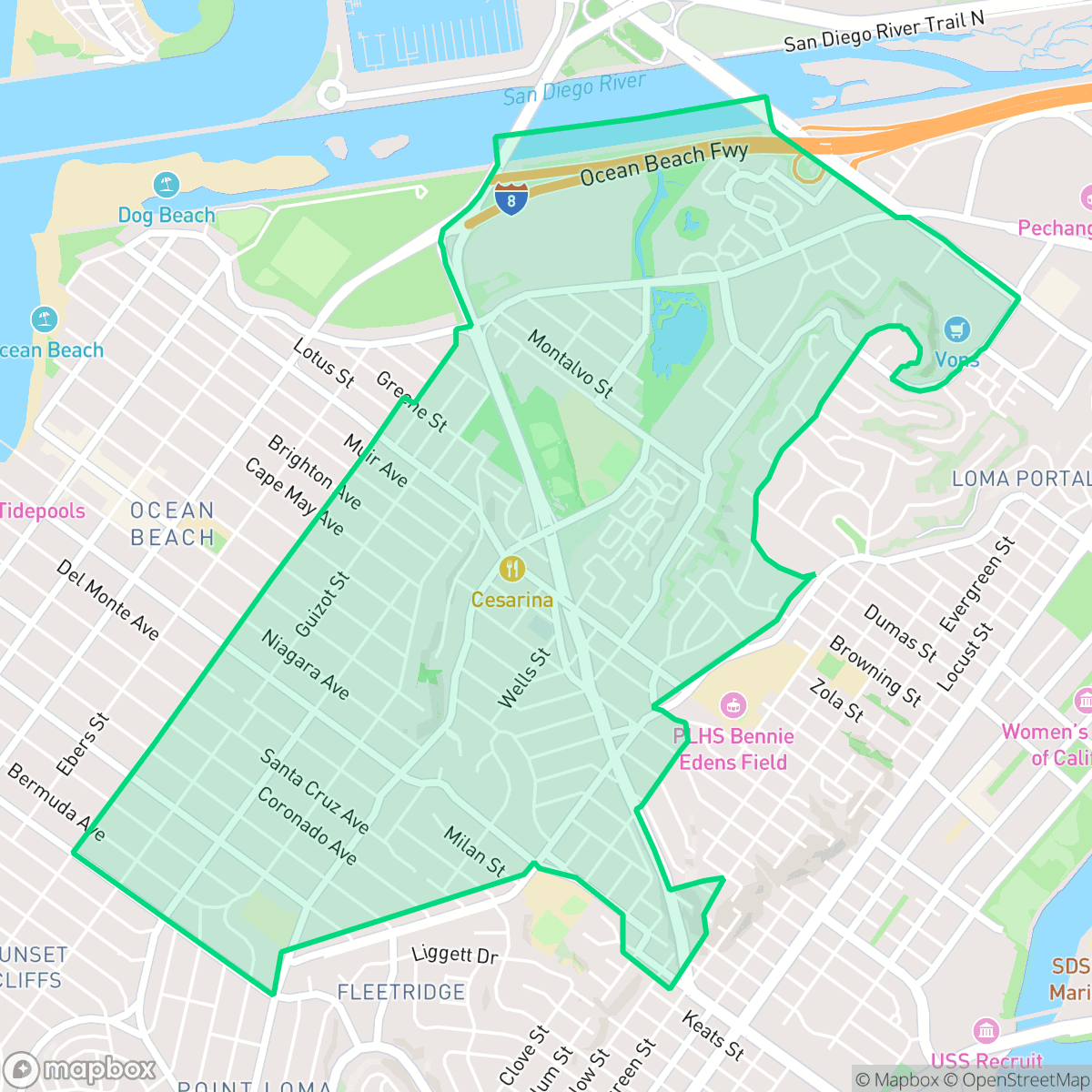
Point Loma Heights is a historic, largely residential neighborhood on San Diego’s Point Loma peninsula, bounded by the San Diego River, Nimitz Boulevard, and Froude Street. Subdivision development began in the early 20th century, spurred by a 1909 electric rail line and the paving of Chatsworth Boulevard. The neighborhood comprises distinct subdivisions, including Loma Palisades, Loma Alta, Point Loma Highlands, and Ocean Beach Highlands. Its architectural character is defined by 1920s and 1930s Spanish Eclectic bungalows—such as the historic Thomas H. and Lena L. Thornton House—alongside mid-century modern residences and postwar ranch homes. Commercial activity centers around Voltaire Street and West Point Loma Boulevard, while Catalina Boulevard serves as a primary residential corridor, preserving the neighborhood's transition from an early suburban tract to a laid-back coastal community.
The neighborhood functions as a dense suburban enclave that balances residential comfort with proximity to coastal amenities. Its streetscape features a consistent grid pattern that supports high walkability, allowing residents to easily navigate between residential blocks and local commercial corridors. The architectural landscape remains varied, blending historic bungalows with later postwar ranch developments, which creates a distinct visual identity that distinguishes the area from neighboring coastal districts.
Prospective residents should note that the area exhibits high housing density, resulting in limited privacy between properties and shared fence lines. Acoustic comfort is a notable challenge due to the combination of road traffic and local aviation activity. Despite these factors, the neighborhood remains an appealing choice for those who prioritize pedestrian access to local services and an established, community-oriented environment over complete seclusion.
Neighborhood Scores Across 15 Qualities
Residential spacing in this area is consistent with the San Diego average, featuring a mix of detached single-family homes with moderate side yards and denser multi-unit complexes. Privacy levels vary depending on the specific street, as some larger estates offer significant buffers while other areas feature closely packed structures with minimal setbacks.
Comprehensive sidewalk networks and frequent marked crossings make navigating the neighborhood on foot easy. This level of walkability sits above the San Diego average, particularly due to the dense grid and connected coastal paths identified in iHuus data.
Large homes with well-maintained grounds and private pools characterize much of the area. This level of visual quality and property scale sits above the San Diego average, according to iHuus data.
Abundant green spaces and large nature preserves provide excellent opportunities for pet exercise. While the area features many wide paths and accessible parks, the overall dog friendliness is slightly below the San Diego average.
Residential patterns consist of a dense suburban fabric featuring a mix of single-family homes and multi-unit complexes. This built environment is consistent with the overall density found across San Diego.
A mix of quiet residential streets and lively social hubs provides a moderate level of activity that is slightly higher than the San Diego average. While various dining and leisure spots are scattered throughout the area, many businesses remain separated by suburban blocks and green spaces.
Frequent noise from nearby transit corridors and flight paths makes this area louder than the San Diego average. According to iHuus data, residents may experience consistent auditory disturbances from heavy traffic and aircraft movement.
Air quality levels are generally acceptable, though residents may encounter occasional periods of diminished air quality that is slightly below the San Diego average. According to iHuus data, these fluctuations may cause periodic concern for sensitive groups.
Industrial presence is virtually non-existent in this area, offering a cleaner environment than the San Diego average. According to iHuus data, the landscape is composed entirely of residential and light commercial zones with no detectable heavy industry or warehouses.
Health insurance enrollment among residents is notably higher than the San Diego average, according to iHuus data.
Political leanings in this area align closely with the broader San Diego metropolitan area, featuring a liberal majority with a small opposing presence.
Residents live alongside a balanced mix of young professionals, families, and seniors. This demographic spread is very similar to the broader San Diego area according to iHuus data.
Residual flood risk exists within certain areas of the neighborhood, though safety levels remain notably higher than the San Diego average. According to iHuus data, some properties are located within a designated floodplain.
Address-Level Insights for Point Loma Heights


iHuus Neighborhood Intelligence Insights
Get address-level neighborhood insights for Point Loma Heights
- Street-level scores — see how individual blocks compare, not just neighborhood averages
- Micro-zone boundaries — identify quiet pockets, flood boundaries, and walkable clusters before you visit
- 15 dimensions in full — walkability, noise, air quality, school quality, insurance coverage, population age profile, urban/rural index, and more
- Boundary risk alerts — know if your address sits near a block boundary where scores drop, the kind of detail no listing will ever mention
- School insights — individual school ratings and insights, not just district-level data
- Compare before you commit — side-by-side data across neighborhoods, down to block precision
No credit card required
Compare with Any Neighborhood
| Dimension | Point Loma Heights | Adams North |
|---|---|---|
| 🚶 Walkabilityavg 8.58 | ||
| 🔊 Acoustic Comfortavg 3.33 | ||
| 🤫 Privacy Indexavg 4.87 | ||
| 🎨 Visual Appealavg 6.85 | ||
| 🐕 Dog Friendlinessavg 6.91 | ||
| 🗺️ Urban-Rural Indexavg 6.6 | ||
| ✨ Neighborhood Vibeavg 5.12 | ||
| 🏥 Health Insurance Coverageavg 7.53 | ||
| 🌿 Air Qualityavg 6.36 | ||
| 🏭 Industrial Proximityavg 9.12 | ||
| 🌊 Flood Safetyavg 4.2 | ||
| 🗳️ Ideological Leanavg 8.51 | ||
| 👥 Population Age Profileavg 4.8 | ||
| 🔥 Fire Safetyavg 0.61 | ||
| 🏫 School Quality |
Point Loma Heights Rankings
School Districts Serving Point Loma Heights
School Insights for Point Loma Heights
Below average outcomes; significant attendance and academic challenges.
School Insights
See what's really behind every school rating near Point Loma Heights
- Individual school ratings — each school's own score with outcome context, not just a district average
- Enrollment & class size data — student-to-teacher ratio and how it compares to the state average
- Full demographics breakdown — ethnicity and gender composition for every school in the enrollment zone
- Every school in the district — all schools within the enrollment boundary ranked by rating, not just the closest one
- Grade levels & benchmarks — elementary through high school, with below/above state-average flags
No credit card required