Palm City, San Diego
Updated · 5,209 residents
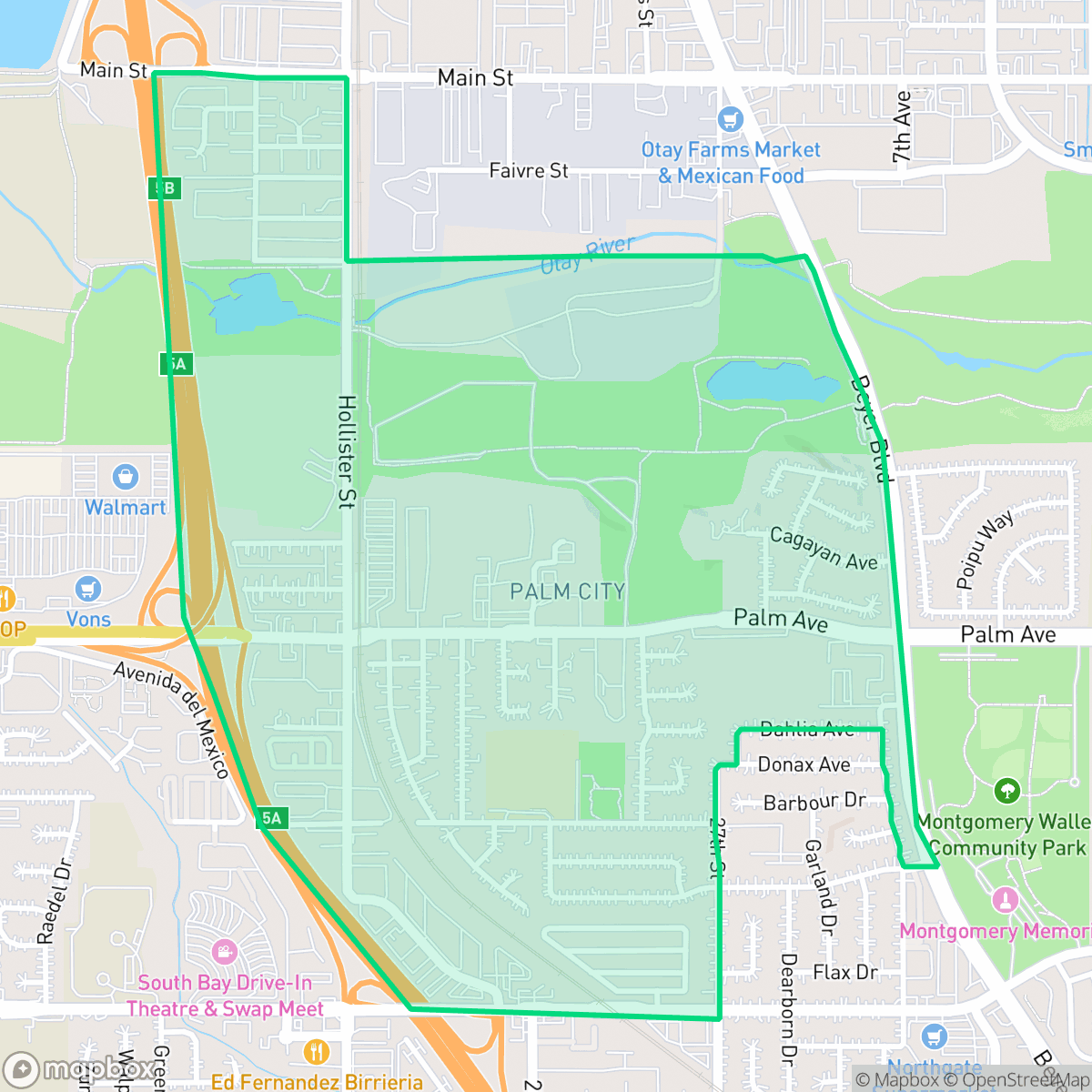
Palm City is a dense, suburban community in southern San Diego defined by a mix of tract housing, mobile home parks, and light industrial infrastructure. While the neighborhood offers local green space at Sunnyslope Park, residents should expect significant road noise and a car-dependent environment.
Key Highlights
About Palm City
Originally part of the 1833 Mexican land grant Rancho Melijo, Palm City in southern San Diego emerged as a distinct community in 1914, named for the iconic palms lining Palm Avenue. In the 1880s, aviation pioneer John J. Montgomery tested early gliders at the nearby Fruitland Ranch. By 1913, the neighborhood served as the terminus for the Mexico & San Diego Railway. During the Mexican Civil War, the U.S. Army established Camp Lawrence J. Hearn here to secure the border. Historically a farming hub, Palm City was home to Japanese American agriculturalists like the Iguchi brothers. Following World War II, the neighborhood became a key settlement area for returning Japanese Americans before being annexed by San Diego in 1957.
The area functions as a dense suburban landscape, blending residential pockets with logistics and utility-focused land use. It features a variety of housing types, including single-family homes and apartment clusters, situated near major transportation corridors. According to iHuus data, the community maintains a moderate level of walkability, though the presence of large surface lots and highway bisection often limits pedestrian movement. The neighborhood provides essential services and local dining options, creating a functional, if utilitarian, living environment.
Prospective residents should note that the area experiences high levels of ambient road noise, which is a primary factor in the local acoustic environment. The neighborhood faces specific challenges regarding environmental safety, including low scores for flood and fire risk, and it is best suited for those prioritizing proximity to regional transit routes and affordable suburban housing. While school options vary significantly by district, families have access to local facilities like Sunnyslope Elementary. The area remains a practical choice for commuters who value a central location within the South Bay region.
Neighborhood Scores Across 15 Qualities
Housing layouts vary between closely spaced apartment clusters and single-family homes with small yards. According to iHuus data, privacy levels are roughly comparable to the San Diego average.
Pedestrian infrastructure is generally consistent with marked crosswalks on residential streets; however, the presence of a major highway and large surface parking lots makes the area less walkable than the San Diego average.
Standard tract housing and mobile home parks define the visual landscape, which lacks the architectural variety found in the San Diego average. Residential lots are characterized by uniform rooflines and modest yards according to iHuus data.
Abundant grassy fields and wide walking paths offer ample space for pets, making this area more dog friendly than the San Diego average. Large public parks and accessible turf in residential courtyards provide plenty of opportunities for outdoor activity.
This area features a blend of residential clusters and industrial patches, mirroring the general urban-rural balance found across San Diego. Residents will encounter a variety of settings ranging from dense suburban housing to open land and commercial zones.
Local activity is characterized by a steady, subdued pace of life with a mix of residential streets and light industrial uses. According to iHuus data, the level of daily vibrancy is slightly lower than the San Diego average, as many essential services remain car-dependent.
Persistent noise from nearby freeways and rail lines makes this area significantly louder than the San Diego average. According to iHuus data, residents should expect frequent acoustic disturbances throughout the day.
Air quality in this area fluctuates between acceptable and unhealthy levels, presenting occasional concerns for sensitive groups. According to iHuus data, these conditions are slightly lower than the San Diego average.
Heavy industrial activity is largely absent, though residents may encounter some noise and traffic from nearby logistics warehouses and utility staging areas. This level of industrial proximity is notably lower than the San Diego city average.
Health insurance coverage among residents is relatively high, though it remains slightly below the San Diego city average according to iHuus data.
Voting patterns and census indicators in Palm City reflect a predominantly liberal political leaning that is more pronounced than the San Diego average, according to iHuus data.
Residents will find a diverse demographic spread across various life stages, mirroring the general population distribution found throughout San Diego. According to iHuus data, the area lacks a heavy concentration of any single age group, offering a stable mix of young adults, families, and seniors.
Coastal high-hazard zones with significant wave action put this area at a much higher risk of flooding than the San Diego average. Residents should expect elevated or potentially prohibitive flood insurance costs according to iHuus data.
Extreme fire hazards are present in this area, which represents a slightly higher level of risk than the San Diego average. Residents should prioritize maximum protection measures and remain vigilant regarding local fire safety protocols.
Address-Level Insights for Palm City


iHuus Neighborhood Intelligence Insights
Get address-level neighborhood insights for Palm City
- Street-level scores — see how individual blocks compare, not just neighborhood averages
- Micro-zone boundaries — identify quiet pockets, flood boundaries, and walkable clusters before you visit
- 15 dimensions in full — walkability, noise, air quality, school quality, insurance coverage, population age profile, urban/rural index, and more
- Boundary risk alerts — know if your address sits near a block boundary where scores drop, the kind of detail no listing will ever mention
- School insights — individual school ratings and insights, not just district-level data
- Compare before you commit — side-by-side data across neighborhoods, down to block precision
No credit card required
Compare with Any Neighborhood
| Dimension | Palm City | Adams North |
|---|---|---|
| 🚶 Walkabilityavg 8.58 | ||
| 🔊 Acoustic Comfortavg 3.33 | ||
| 🤫 Privacy Indexavg 4.87 | ||
| 🎨 Visual Appealavg 6.85 | ||
| 🐕 Dog Friendlinessavg 6.91 | ||
| 🗺️ Urban-Rural Indexavg 6.6 | ||
| ✨ Neighborhood Vibeavg 5.12 | ||
| 🏥 Health Insurance Coverageavg 7.53 | ||
| 🌿 Air Qualityavg 6.36 | ||
| 🏭 Industrial Proximityavg 9.12 | ||
| 🌊 Flood Safetyavg 4.2 | ||
| 🗳️ Ideological Leanavg 8.51 | ||
| 👥 Population Age Profileavg 4.8 | ||
| 🔥 Fire Safetyavg 0.61 | ||
| 🏫 School Quality |
Palm City Rankings
School Districts Serving Palm City
School Insights for Palm City
Below average outcomes; significant attendance and academic challenges.
School Insights
See what's really behind every school rating near Palm City
- Individual school ratings — each school's own score with outcome context, not just a district average
- Enrollment & class size data — student-to-teacher ratio and how it compares to the state average
- Full demographics breakdown — ethnicity and gender composition for every school in the enrollment zone
- Every school in the district — all schools within the enrollment boundary ranked by rating, not just the closest one
- Grade levels & benchmarks — elementary through high school, with below/above state-average flags
No credit card required