Pacific Beach, San Diego
Updated · 28,974 residents
Pacific Beach is a highly walkable coastal community defined by its dense residential grid and immediate access to the Pacific Ocean. Residents enjoy a lively atmosphere with diverse dining and entertainment options, though the area is characterized by tightly packed housing and limited privacy.
Key Highlights
About Pacific Beach
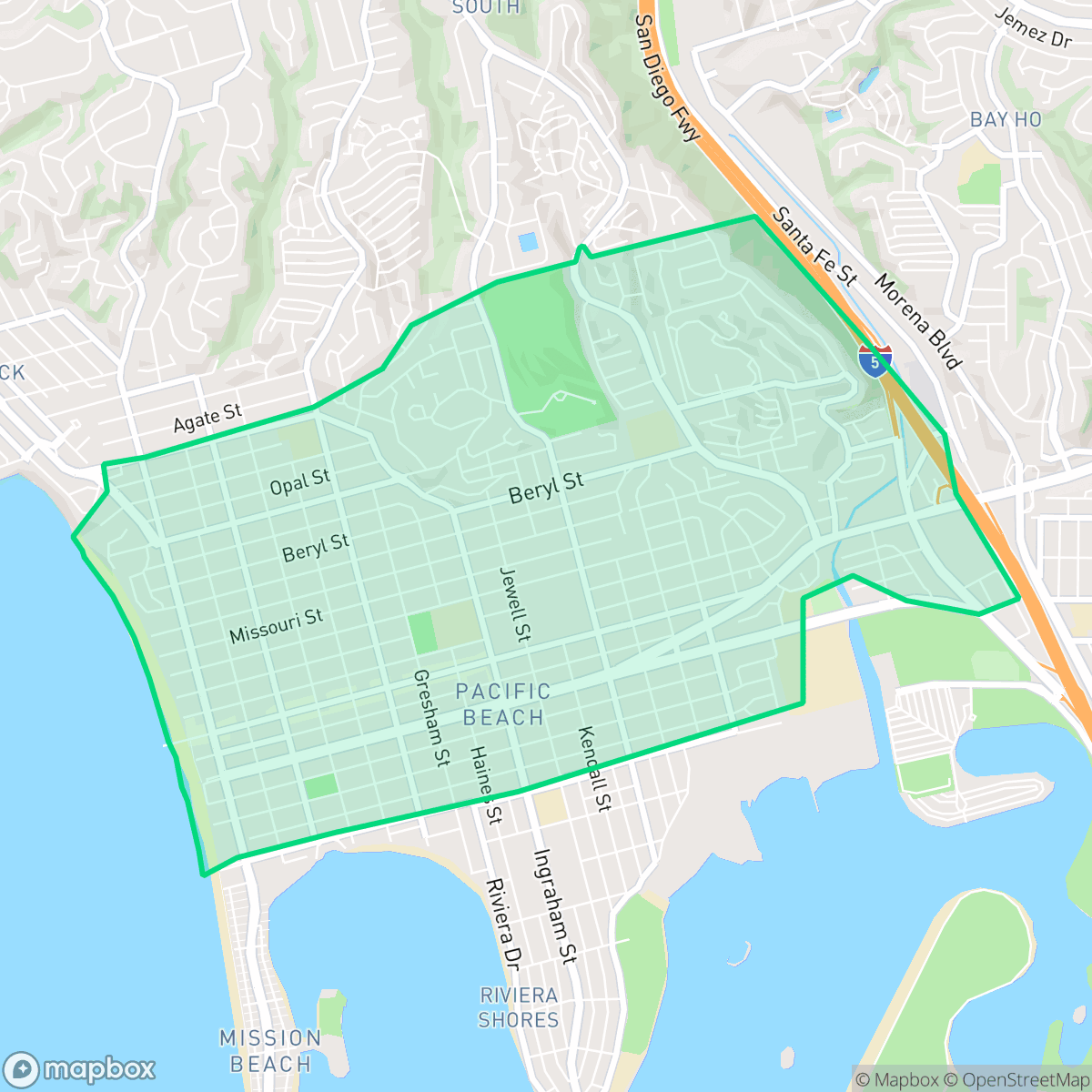
Founded during the 1887 real estate boom, Pacific Beach (locally "PB") began as a quiet college town centered around the San Diego College of Letters. Following a late-1890s economic collapse, the neighborhood transitioned into an agricultural hub, briefly earning fame as the "Lemon Capital of the World". By the mid-20th century, PB transformed into a lively seaside community. Its coastal character is anchored by landmarks like the historic Crystal Pier—established in 1927 with its signature over-the-water cottages—and Tourmaline Surf Park, a legendary haven for local surf culture. The neighborhood’s vibrant commercial heart runs along Garnet Avenue and Mission Boulevard, while its residential streets, many named after precious stones like Turquoise and Diamond, are bordered to the north by Kate Sessions Park, named for the pioneering San Diego botanist.
The neighborhood functions as a dense, energetic coastal hub where most daily errands can be completed on foot. Its layout consists of a well-defined grid system with consistent sidewalks and crosswalks, facilitating easy movement between residential blocks and the popular commercial corridors along Garnet Avenue and Mission Boulevard. The area maintains a high level of activity, supported by a variety of local restaurants, cafes, and proximity to the coastline. While the visual appeal is bolstered by high-value coastal real estate and modern residential structures, the environment is notably urban in its configuration.
Living in the area involves specific trade-offs, particularly regarding personal space and acoustic comfort. Due to the high density, homes are often situated less than 10 meters apart, which results in limited privacy compared to more suburban districts. According to iHuus data, the neighborhood maintains an average noise level of 57 decibels, largely attributed to road traffic. The area is well-suited for those who prioritize walkability and a social, beach-oriented lifestyle over quiet, expansive private yards. Families are also served by high-performing local institutions, including Sessions Elementary and Pacific Beach Middle, though residents should remain aware of the broader financial and operational challenges facing the San Diego City Unified School District.
Neighborhood Scores Across 15 Qualities
Close proximity between buildings and shared walls are common, particularly in the western residential blocks. According to iHuus data, this density results in a lower level of privacy compared to the San Diego average.
Pedestrian access is excellent due to a dense grid of continuous sidewalks and frequent crosswalks. According to iHuus data, this area offers superior walkability compared to the San Diego average, featuring a dedicated beachfront boardwalk and well-defined paths throughout both residential and commercial zones.
Premium coastal real estate and modern structures with private amenities contribute to a visual landscape that is more aesthetically pleasing than the San Diego average. Many properties feature high-value architecture, such as rooftop decks and well-maintained landscaping, particularly near the waterfront.
Access to beach areas and central public parks provides reliable walking options, although the availability of wide, grassy street verges is slightly below the San Diego average. According to iHuus data, many residential pockets rely more on private yards than expansive public greenbelts.
Primarily composed of a dense coastal grid, this area features a mix of multi-story apartments and bungalows that is slightly more urban than the San Diego average. According to iHuus data, the landscape is characterized by significant grey infrastructure and a concentrated residential footprint.
Frequent movement and a high concentration of dining and social hubs create a much more active atmosphere than the San Diego average. According to iHuus data, this coastal area features a dense mix of local cafes, taco shops, and wellness services that drive constant neighborhood activity.
Steady sounds from nearby busy streets are present throughout the area. According to iHuus data, acoustic levels are noticeably higher than the San Diego average.
Air quality in this area fluctuates between acceptable and unhealthy levels, which may pose occasional concerns for sensitive groups. According to iHuus data, conditions here are slightly below the San Diego city average.
Industrial activity and warehouses are entirely absent from this area, providing a landscape comprised solely of residential, recreational, and light commercial zones. According to iHuus data, this neighborhood is even more free of industrial hazards than the San Diego average.
Health insurance accessibility is notably higher than the San Diego average, according to iHuus data. Most residents in this area have access to medical coverage.
Political leanings in this area are predominantly liberal, which is slightly more pronounced than the San Diego average according to iHuus data.
A diverse range of age groups resides here, including young professionals, families, and seniors. This demographic spread is largely in line with the broader San Diego area according to iHuus data.
Some residual flood risk exists within this area due to its location in the 500-year floodplain, though safety levels remain notably higher than the San Diego city average according to iHuus data.
Extreme fire hazards present a significant danger in this area. According to iHuus data, the risk level here is considerably higher than the San Diego average.
Address-Level Insights for Pacific Beach


iHuus Neighborhood Intelligence Insights
Get address-level neighborhood insights for Pacific Beach
- Street-level scores — see how individual blocks compare, not just neighborhood averages
- Micro-zone boundaries — identify quiet pockets, flood boundaries, and walkable clusters before you visit
- 15 dimensions in full — walkability, noise, air quality, school quality, insurance coverage, population age profile, urban/rural index, and more
- Boundary risk alerts — know if your address sits near a block boundary where scores drop, the kind of detail no listing will ever mention
- School insights — individual school ratings and insights, not just district-level data
- Compare before you commit — side-by-side data across neighborhoods, down to block precision
No credit card required
Compare with Any Neighborhood
| Dimension | Pacific Beach | Adams North |
|---|---|---|
| 🚶 Walkabilityavg 8.58 | ||
| 🔊 Acoustic Comfortavg 3.33 | ||
| 🤫 Privacy Indexavg 4.87 | ||
| 🎨 Visual Appealavg 6.85 | ||
| 🐕 Dog Friendlinessavg 6.91 | ||
| 🗺️ Urban-Rural Indexavg 6.6 | ||
| ✨ Neighborhood Vibeavg 5.12 | ||
| 🏥 Health Insurance Coverageavg 7.53 | ||
| 🌿 Air Qualityavg 6.36 | ||
| 🏭 Industrial Proximityavg 9.12 | ||
| 🌊 Flood Safetyavg 4.2 | ||
| 🗳️ Ideological Leanavg 8.51 | ||
| 👥 Population Age Profileavg 4.8 | ||
| 🔥 Fire Safetyavg 0.61 | ||
| 🏫 School Quality |
Pacific Beach Rankings
School Districts Serving Pacific Beach
School Insights for Pacific Beach
Below average outcomes; significant attendance and academic challenges.
School Insights
See what's really behind every school rating near Pacific Beach
- Individual school ratings — each school's own score with outcome context, not just a district average
- Enrollment & class size data — student-to-teacher ratio and how it compares to the state average
- Full demographics breakdown — ethnicity and gender composition for every school in the enrollment zone
- Every school in the district — all schools within the enrollment boundary ranked by rating, not just the closest one
- Grade levels & benchmarks — elementary through high school, with below/above state-average flags
No credit card required