Otay Mesa, San Diego
Updated · 4,273 residents
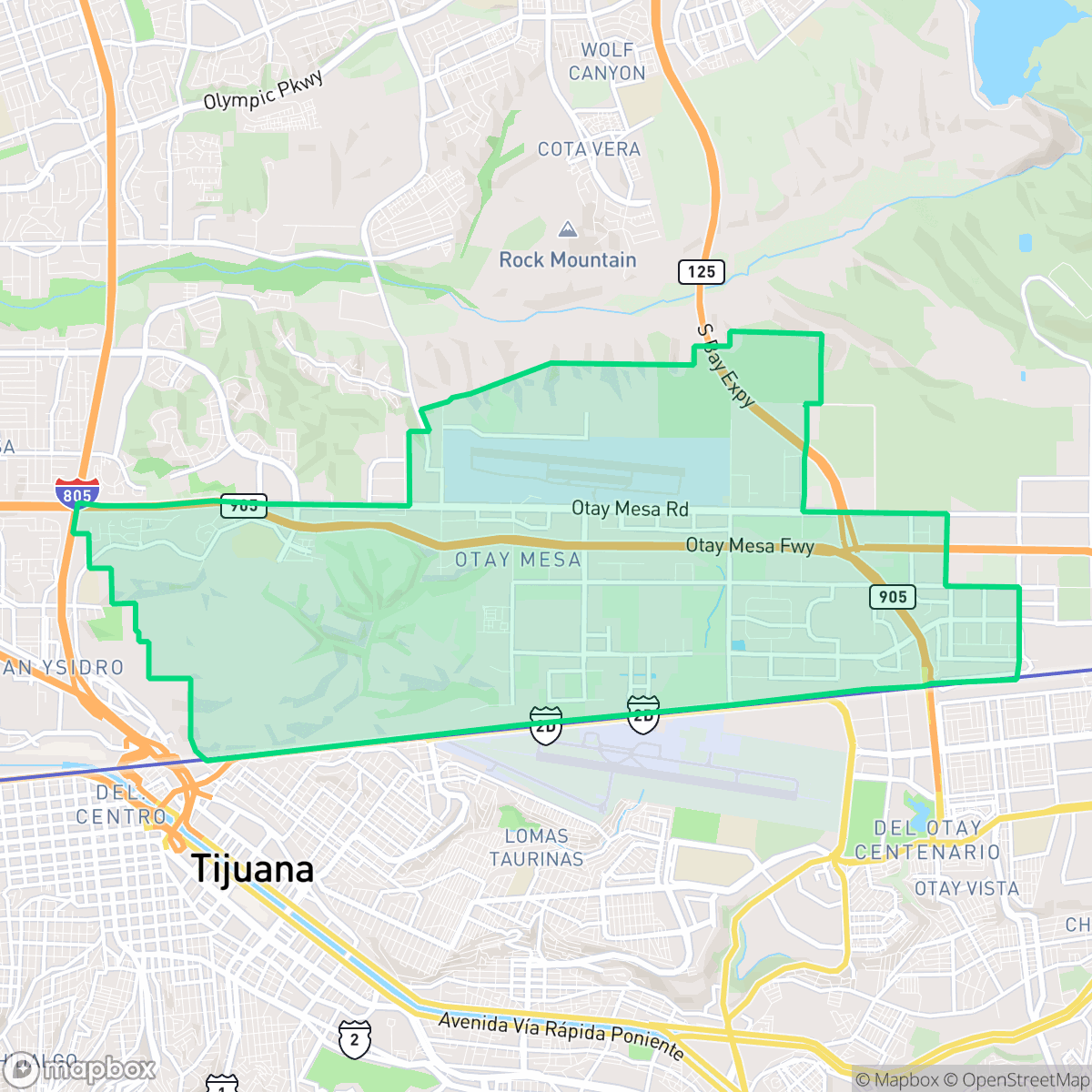
Otay Mesa serves as a primary industrial and logistics gateway for San Diego, defined by its large-scale warehouse infrastructure and international trade connectivity. The area is a car-dependent environment with significant open space, offering a distinct industrial character rather than a traditional residential neighborhood feel.
Key Highlights
About Otay Mesa
Named after the Kumeyaay word for "brushy" or "big," Otay Mesa originated in the late 19th century as a rural, dry-farming community centered around the Alta School and St. John’s Lutheran Church. The neighborhood holds a prominent place in aviation history; in 1883, pioneer John J. Montgomery conducted the Western Hemisphere’s first successful controlled glider flights from its western rim. During World War II, the military established East Field (later Brown Field Municipal Airport) for pilot training. Following its 1957 annexation by San Diego and the subsequent opening of the Otay Mesa Port of Entry, the area transitioned from agriculture to a major industrial and commercial hub. Today, this binational gateway is defined by its bustling international trade, industrial parks, and the innovative Cross Border Xpress (CBX), which directly links the neighborhood to Tijuana International Airport.
The neighborhood functions primarily as a logistics and commercial center, dominated by expansive warehouses, freight corridors, and the operational infrastructure of Brown Field Municipal Airport. According to iHuus data, the landscape is characterized by a high density of industrial activity, massive parking footprints, and significant paved logistics yards. While large portions of the area remain undeveloped scrubland, the built environment is strictly functional, prioritizing industrial efficiency over traditional commercial or social density.
Residents in this area face a car-dependent lifestyle with limited local amenities and high levels of ambient noise from heavy truck traffic and aviation operations. The neighborhood presents a challenging acoustic environment, though it offers superior flood safety compared to other parts of the city. It is best suited for individuals who prioritize proximity to major logistics hubs or international border crossings over walkability and quiet, suburban comforts.
Neighborhood Scores Across 15 Qualities
Residential spacing is relatively mixed, though some areas feature tightly packed housing with minimal buffers between neighbors. According to iHuus data, privacy levels are roughly in line with the San Diego average.
Sidewalks are present within residential grids, but heavy industrial traffic and large freeways create significant barriers for pedestrians. This level of walkability is notably lower than the San Diego average due to the lack of continuous paths in certain areas.
Standard tract housing and apartment complexes characterize the landscape, though the visual variety is slightly lower than the San Diego average. While some areas feature tidy yards and pools, other pockets exhibit higher density and unpaved patches according to iHuus data.
Public parks and green verges are scarce in this area, making it less dog friendly than the San Diego average. Most residents rely on private yards for pets since sidewalks and streets lack accessible greenery.
Large expanses of open scrubland and undeveloped terrain characterize this area, making it more rural than the typical San Diego neighborhood. While massive industrial warehouses and airport infrastructure are present, significant portions of the landscape remain open and sparsely populated according to iHuus data.
Low business density and extensive industrial warehouses create a quiet, functional atmosphere that is less lively than the San Diego average. Most daily errands and dining options require a vehicle due to the sparse, spread-out nature of local services.
Frequent noise from nearby airport runways and heavy rail infrastructure makes this area significantly louder than most San Diego neighborhoods, according to iHuus data.
Air quality levels fluctuate between acceptable and unhealthy periods, representing a slightly lower standard than the San Diego average. Sensitive individuals may experience occasional concern during certain days, according to iHuus data.
Significant noise and traffic from large-scale logistics hubs, airport operations, and freight terminals are prevalent throughout the area. According to iHuus data, this neighborhood has a higher concentration of industrial activity and heavy vehicle traffic than the San Diego average.
Health insurance access is more prevalent here than the San Diego average, according to iHuus data. Most residents in this area have access to medical coverage.
Voting patterns and census indicators show a strong liberal leaning, which is slightly more pronounced than the San Diego average according to iHuus data.
A diverse mix of young adults, families, and older residents characterizes the area, representing a demographic spread that is slightly lower than the San Diego average. According to iHuus data, this variety provides a stable community composition without a heavy concentration in any single age group.
Flood risk in this area is considered moderate because FEMA has not yet completed a detailed study for this specific location. According to iHuus data, the level of uncertainty regarding flood safety is slightly higher than the San Diego average.
Significant fire hazards are present in this area, representing a risk level that is notably higher than the San Diego average. Residents should remain aware of enhanced mitigation requirements according to iHuus data.
Address-Level Insights for Otay Mesa


iHuus Neighborhood Intelligence Insights
Get address-level neighborhood insights for Otay Mesa
- Street-level scores — see how individual blocks compare, not just neighborhood averages
- Micro-zone boundaries — identify quiet pockets, flood boundaries, and walkable clusters before you visit
- 15 dimensions in full — walkability, noise, air quality, school quality, insurance coverage, population age profile, urban/rural index, and more
- Boundary risk alerts — know if your address sits near a block boundary where scores drop, the kind of detail no listing will ever mention
- School insights — individual school ratings and insights, not just district-level data
- Compare before you commit — side-by-side data across neighborhoods, down to block precision
No credit card required
Compare with Any Neighborhood
| Dimension | Otay Mesa | Adams North |
|---|---|---|
| 🚶 Walkabilityavg 8.58 | ||
| 🔊 Acoustic Comfortavg 3.33 | ||
| 🤫 Privacy Indexavg 4.87 | ||
| 🎨 Visual Appealavg 6.85 | ||
| 🐕 Dog Friendlinessavg 6.91 | ||
| 🗺️ Urban-Rural Indexavg 6.6 | ||
| ✨ Neighborhood Vibeavg 5.12 | ||
| 🏥 Health Insurance Coverageavg 7.53 | ||
| 🌿 Air Qualityavg 6.36 | ||
| 🏭 Industrial Proximityavg 9.12 | ||
| 🌊 Flood Safetyavg 4.2 | ||
| 🗳️ Ideological Leanavg 8.51 | ||
| 👥 Population Age Profileavg 4.8 | ||
| 🔥 Fire Safetyavg 0.61 | ||
| 🏫 School Quality |
Otay Mesa Rankings
School Districts Serving Otay Mesa
School Insights for Otay Mesa
Below average outcomes; significant attendance and academic challenges.
School Insights
See what's really behind every school rating near Otay Mesa
- Individual school ratings — each school's own score with outcome context, not just a district average
- Enrollment & class size data — student-to-teacher ratio and how it compares to the state average
- Full demographics breakdown — ethnicity and gender composition for every school in the enrollment zone
- Every school in the district — all schools within the enrollment boundary ranked by rating, not just the closest one
- Grade levels & benchmarks — elementary through high school, with below/above state-average flags
No credit card required