Old Town, San Diego
Updated · 1,119 residents
Old Town is a historic cultural hub defined by its colonial architecture and lively social atmosphere. While the area offers a distinct sense of place, residents often experience significant noise from nearby transit and flight paths, alongside inconsistent pedestrian infrastructure.
Key Highlights
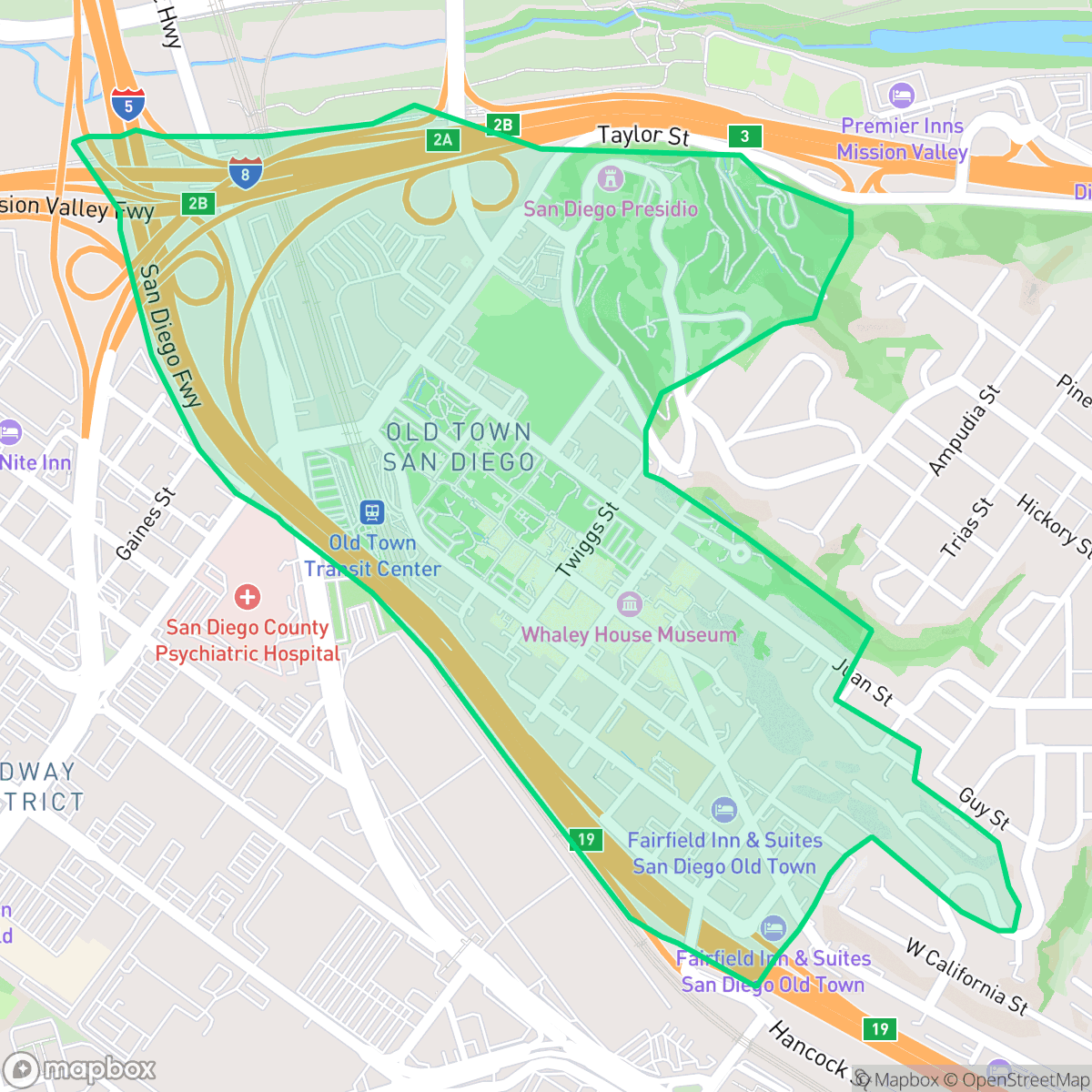
About Old Town
Old Town San Diego is celebrated as the 'Birthplace of California,' marking the site of the first permanent Spanish settlement in the state, established in 1769 on Presidio Hill. The neighborhood preserves the area's transition from Spanish colonial rule to Mexican governance, defined by its distinct adobe architecture dating from the 1820s to the 1870s. Key landmarks include the Old Town San Diego State Historic Park, which protects original and reconstructed sites like the Casa de Estudillo and the historic Whaley House. Originally the commercial and social hub of San Diego, the area maintained its prominence until the city center shifted toward the waterfront in the late 19th century. Today, Old Town remains a vital cultural center, honoring its indigenous Kumeyaay roots and Mexican-American heritage through preserved historic structures, traditional plazas, and local celebrations.
The neighborhood functions as a vibrant social center, characterized by a diverse demographic mix that spans young adults, families, and seniors. It maintains a strongly liberal ideological leaning and provides a consistent, active energy through its local dining and community hubs. The visual character remains standard for the region, blending historical preservation with modern urban density.
Prospective residents should weigh the area's cultural appeal against specific livability trade-offs. According to iHuus data, acoustic comfort is limited due to constant noise from heavy rail and airport operations, and pedestrian access is restricted by inconsistent sidewalk availability. While health insurance coverage is high, the neighborhood faces a higher than average flood risk and operates within a school district currently navigating significant budget and operational challenges. It is best suited for those who prioritize proximity to cultural landmarks and an active social environment over a quiet, highly walkable residential setting.
Neighborhood Scores Across 15 Qualities
Residential spacing is varied with some buffers between neighbors, representing a level of privacy consistent with the San Diego average.
Pedestrian infrastructure is inconsistent, with sidewalks present only on one side of many streets. This level of walkability is notably lower than the San Diego average according to iHuus data.
Visual aesthetics in this area are consistent with the broader San Diego average. The landscape features a mix of historic charm and standard urban density according to iHuus data.
Access to connected green spaces and wide, low-traffic paths provides reliable walking options for pets. According to iHuus data, the availability of these amenities is roughly in line with the city average.
Industrial zones and heavy infrastructure characterize much of the area, though the landscape remains comparable to the broader San Diego average. Large warehouses and highway interchanges create a dense, paved environment alongside residential clusters.
A noticeable concentration of social and local hubs creates a more active atmosphere than the San Diego average. While diverse dining and community spots provide steady energy, much of the area remains car-dependent due to the proximity of industrial corridors and major highways.
Constant noise from nearby heavy rail and airport operations makes this area significantly less quiet than the San Diego average. According to iHuus data, acoustic comfort is extremely limited due to the proximity of major transit and flight paths.
Air quality fluctuates between acceptable and unhealthy levels, often presenting occasional concerns for sensitive groups. According to iHuus data, this level of air quality is slightly lower than the San Diego city average.
Heavy industrial activity is notably absent from the area, consisting instead of light commercial spaces and mixed-use zones. This lack of large-scale manufacturing or logistics hubs makes the neighborhood much quieter regarding industrial traffic than the San Diego average.
Health insurance access among residents is slightly above the San Diego city average, according to iHuus data.
Voting patterns and census indicators show a predominantly liberal leaning that is more pronounced than the San Diego average, according to iHuus data.
Residents live alongside a balanced mix of young adults, families, and seniors. According to iHuus data, this demographic spread is more varied than the typical age distribution found across San Diego.
Flood risk levels in this area are higher than the San Diego average, though current assessments remain inconclusive due to incomplete federal studies. Residents should remain aware of potential vulnerabilities during heavy rain events according to iHuus data.
Address-Level Insights for Old Town


iHuus Neighborhood Intelligence Insights
Get address-level neighborhood insights for Old Town
- Street-level scores — see how individual blocks compare, not just neighborhood averages
- Micro-zone boundaries — identify quiet pockets, flood boundaries, and walkable clusters before you visit
- 15 dimensions in full — walkability, noise, air quality, school quality, insurance coverage, population age profile, urban/rural index, and more
- Boundary risk alerts — know if your address sits near a block boundary where scores drop, the kind of detail no listing will ever mention
- School insights — individual school ratings and insights, not just district-level data
- Compare before you commit — side-by-side data across neighborhoods, down to block precision
No credit card required
Compare with Any Neighborhood
| Dimension | Old Town | Adams North |
|---|---|---|
| 🚶 Walkabilityavg 8.58 | ||
| 🔊 Acoustic Comfortavg 3.33 | ||
| 🤫 Privacy Indexavg 4.87 | ||
| 🎨 Visual Appealavg 6.85 | ||
| 🐕 Dog Friendlinessavg 6.91 | ||
| 🗺️ Urban-Rural Indexavg 6.6 | ||
| ✨ Neighborhood Vibeavg 5.12 | ||
| 🏥 Health Insurance Coverageavg 7.53 | ||
| 🌿 Air Qualityavg 6.36 | ||
| 🏭 Industrial Proximityavg 9.12 | ||
| 🌊 Flood Safetyavg 4.2 | ||
| 🗳️ Ideological Leanavg 8.51 | ||
| 👥 Population Age Profileavg 4.8 | ||
| 🔥 Fire Safetyavg 0.61 | ||
| 🏫 School Quality |
Old Town Rankings
School Districts Serving Old Town
School Insights for Old Town
Below average outcomes; significant attendance and academic challenges.
School Insights
See what's really behind every school rating near Old Town
- Individual school ratings — each school's own score with outcome context, not just a district average
- Enrollment & class size data — student-to-teacher ratio and how it compares to the state average
- Full demographics breakdown — ethnicity and gender composition for every school in the enrollment zone
- Every school in the district — all schools within the enrollment boundary ranked by rating, not just the closest one
- Grade levels & benchmarks — elementary through high school, with below/above state-average flags
No credit card required