Ocean Crest, San Diego
Updated · 12,880 residents
Ocean Crest is a modern, master-planned community in southern San Diego known for its Spanish-style architecture and proximity to scenic open canyons. The area offers high walkability with continuous sidewalk networks and dog-friendly trails, though it remains a quiet, suburban enclave with limited local commercial activity.
Key Highlights
About Ocean Crest
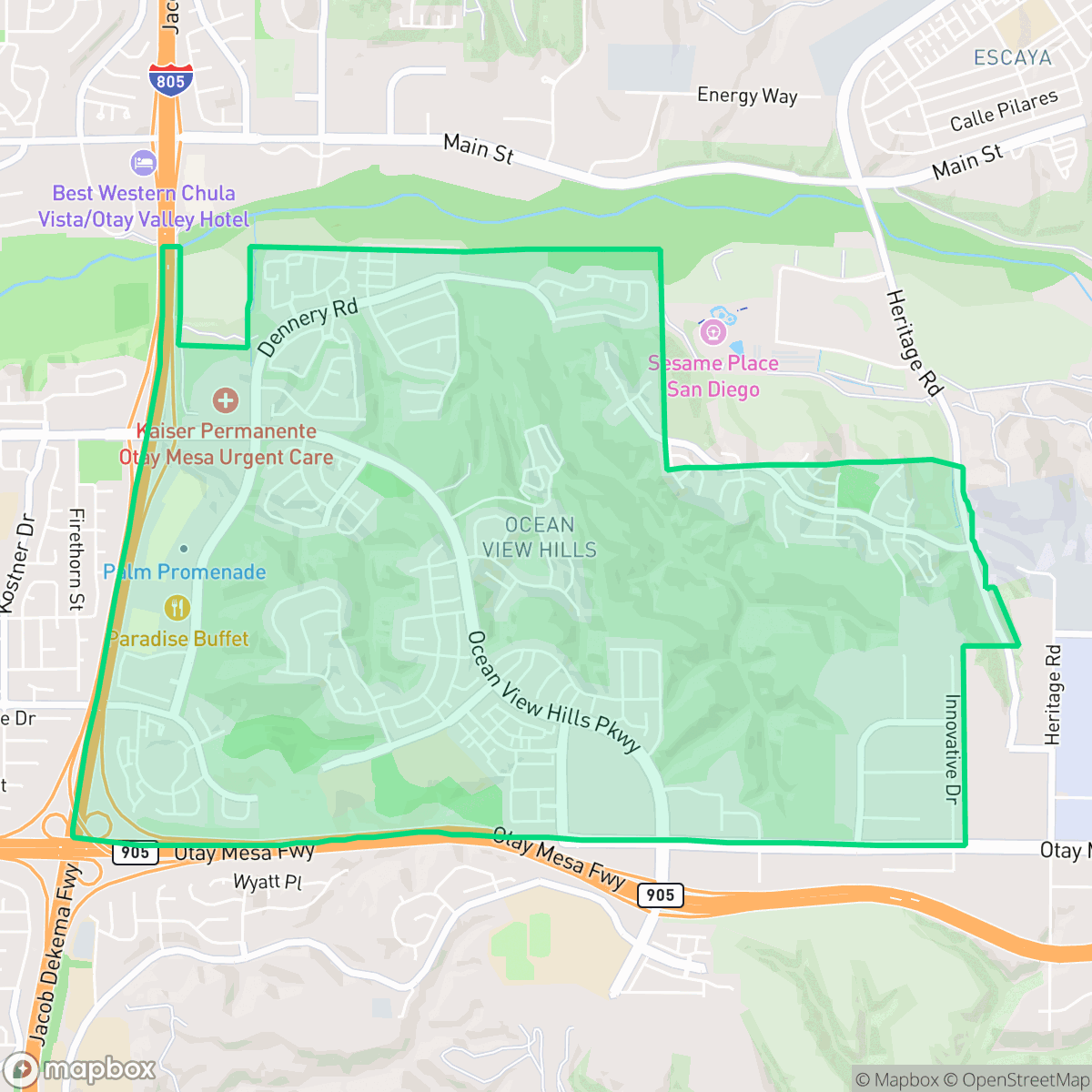
Ocean Crest (often referred to interchangeably with Ocean View Hills) is a modern suburban neighborhood in southern San Diego, annexed from San Diego County in 1957. Prior to its formal residential development, the rugged, canyon-carved area was colloquially known as "the Pits" and served as a popular local haven for off-road vehicles and bonfires. Residential construction did not begin in earnest until approximately 1998, transforming the rural landscape into a master-planned community. Today, the neighborhood's picturesque streets are characterized by Spanish and West Coast-style architecture, featuring distinctive red-tile roofs and white stucco exteriors. Positioned near the Mexican border, Ocean Crest has evolved into a diverse residential enclave with a notable cultural blend, particularly defined by its large Mexican and Filipino-American populations.
The neighborhood serves as a residential hub characterized by contemporary single-family homes, many of which feature private pools and manicured landscapes. Its layout integrates dense suburban tracts with natural topographical features, providing residents with access to local green spaces and the well-regarded Ocean View Hills school. The community maintains a distinct cultural blend, benefiting from its strategic position near the Mexican border and a focus on family-oriented living.
Prospective residents should note that the area experiences significant noise levels, largely due to aviation traffic, which impacts overall acoustic comfort. While the neighborhood provides a safe and well-maintained environment, it faces higher-than-average risks regarding fire and flood safety. Daily life here is best suited for those who prioritize a quiet, suburban atmosphere over proximity to dense commercial districts, as local amenities are primarily focused on convenience rather than nightlife or high-density retail.
Neighborhood Scores Across 15 Qualities
Residential spacing provides a moderate level of separation between neighbors, which is slightly higher than the San Diego average. While some areas feature closely situated homes, proximity to open canyons helps increase the sense of buffer between properties.
Continuous sidewalks and clear pedestrian crossings connect residential areas to nearby commercial hubs, though the large freeway acts as a significant barrier to movement. While pedestrian infrastructure is strong, the overall ease of walking is slightly below the San Diego average according to iHuus data.
Manicured landscaping, large contemporary homes, and private pools contribute to a visual profile that is more polished than the San Diego average. According to iHuus data, the area features many high-end amenities such as solar panels and expansive driveways.
Natural canyons and wide green verges provide ample space for pet exercise. According to iHuus data, these connected trails and safe walking paths offer more dog-friendly infrastructure than the San Diego average.
Open land and woodland are common here, providing a more semi-rural atmosphere than the typical San Diego residential area. This landscape features scattered homes and significant adjacent open space according to iHuus data.
Low density and significant open space create a tranquil environment, though the area lacks a distinct commercial character. Most daily activities require a vehicle due to the scarcity of local businesses compared to the San Diego average.
Persistent noise from nearby transit corridors, such as major freeways or rail lines, makes this area significantly louder than the San Diego average. According to iHuus data, residents can expect frequent acoustic disturbances throughout the day.
Air quality in this area fluctuates between acceptable and unhealthy levels on certain days. According to iHuus data, conditions are slightly lower than the San Diego average, which may cause occasional concern for sensitive groups.
Industrial activity is minimal in this area, consisting mostly of residential streets and occasional light commercial zones. This neighborhood lacks the heavy warehouse and logistics hubs found more frequently elsewhere in San Diego, according to iHuus data.
Health insurance access is exceptionally high in this area, significantly surpassing the San Diego average according to iHuus data.
Political leanings in this area align closely with the broader San Diego landscape. Residents will find a community with a significant liberal majority and a slight presence of opposing views.
A balanced demographic of young professionals, families, and seniors characterizes the area. This age distribution is largely comparable to the broader San Diego area, according to iHuus data.
Flood risk levels in this area are slightly higher than the San Diego average; however, because FEMA has not completed a detailed study for this specific location, the exact vulnerability remains undetermined according to iHuus data.
Fire hazard levels in Ocean Crest are significantly higher than the San Diego average. Residents should be aware of increased wildfire risks and the need for enhanced property mitigation measures according to iHuus data.
Address-Level Insights for Ocean Crest


iHuus Neighborhood Intelligence Insights
Get address-level neighborhood insights for Ocean Crest
- Street-level scores — see how individual blocks compare, not just neighborhood averages
- Micro-zone boundaries — identify quiet pockets, flood boundaries, and walkable clusters before you visit
- 15 dimensions in full — walkability, noise, air quality, school quality, insurance coverage, population age profile, urban/rural index, and more
- Boundary risk alerts — know if your address sits near a block boundary where scores drop, the kind of detail no listing will ever mention
- School insights — individual school ratings and insights, not just district-level data
- Compare before you commit — side-by-side data across neighborhoods, down to block precision
No credit card required
Compare with Any Neighborhood
| Dimension | Ocean Crest | Adams North |
|---|---|---|
| 🚶 Walkabilityavg 8.58 | ||
| 🔊 Acoustic Comfortavg 3.33 | ||
| 🤫 Privacy Indexavg 4.87 | ||
| 🎨 Visual Appealavg 6.85 | ||
| 🐕 Dog Friendlinessavg 6.91 | ||
| 🗺️ Urban-Rural Indexavg 6.6 | ||
| ✨ Neighborhood Vibeavg 5.12 | ||
| 🏥 Health Insurance Coverageavg 7.53 | ||
| 🌿 Air Qualityavg 6.36 | ||
| 🏭 Industrial Proximityavg 9.12 | ||
| 🌊 Flood Safetyavg 4.2 | ||
| 🗳️ Ideological Leanavg 8.51 | ||
| 👥 Population Age Profileavg 4.8 | ||
| 🔥 Fire Safetyavg 0.61 | ||
| 🏫 School Quality |
Ocean Crest Rankings
School Districts Serving Ocean Crest
School Insights for Ocean Crest
Below average outcomes; significant attendance and academic challenges.
School Insights
See what's really behind every school rating near Ocean Crest
- Individual school ratings — each school's own score with outcome context, not just a district average
- Enrollment & class size data — student-to-teacher ratio and how it compares to the state average
- Full demographics breakdown — ethnicity and gender composition for every school in the enrollment zone
- Every school in the district — all schools within the enrollment boundary ranked by rating, not just the closest one
- Grade levels & benchmarks — elementary through high school, with below/above state-average flags
No credit card required