Ocean Beach, San Diego
Updated · 10,905 residents
Ocean Beach is a highly walkable coastal enclave defined by its dense residential grid and vibrant, independent commercial scene. While the area offers immediate access to the shoreline and a strong sense of community, residents should expect tightly packed housing with limited privacy and notable noise levels from nearby traffic and aviation.
Key Highlights
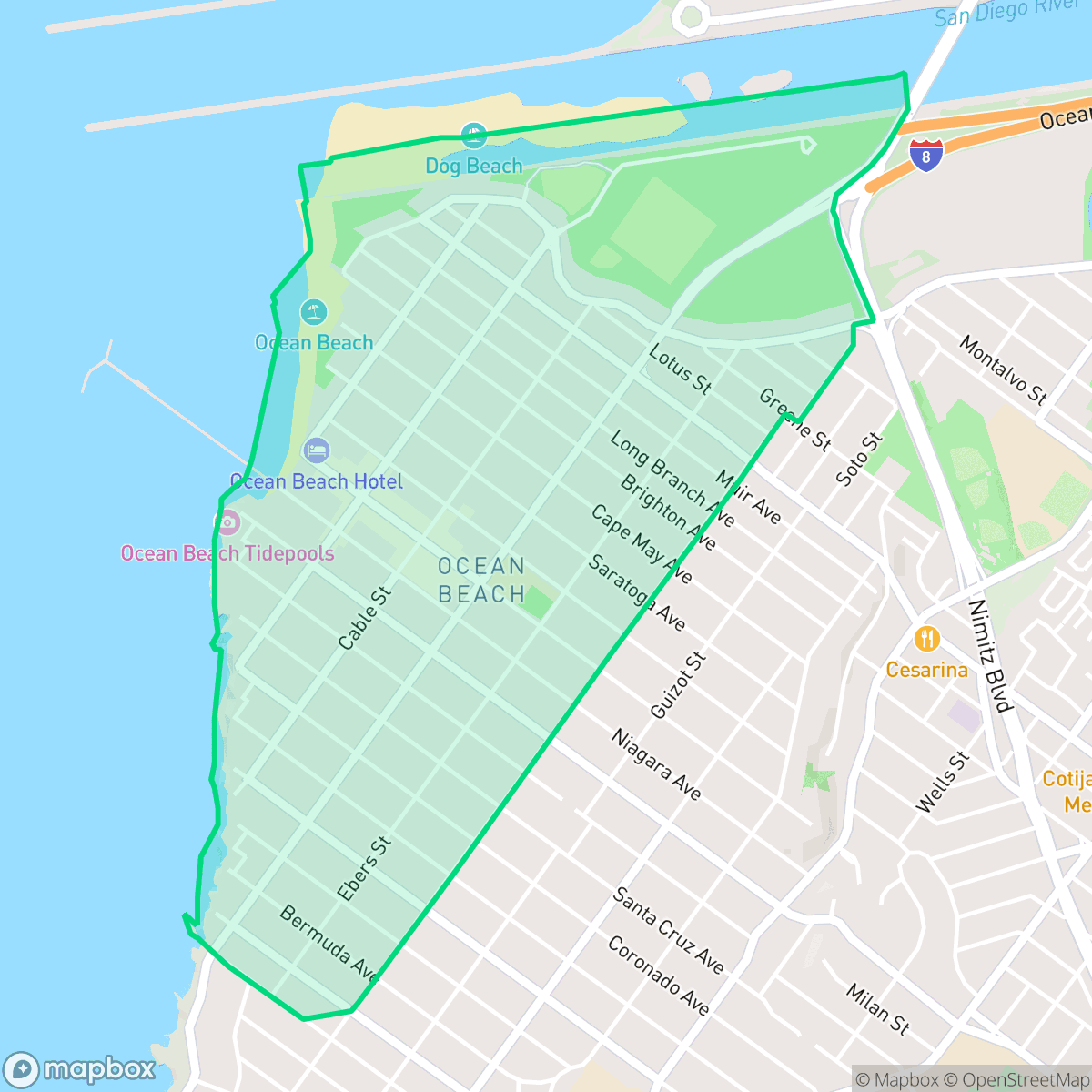
About Ocean Beach
Founded in 1887 by developers Billy Carlson and Albert Higgins, Ocean Beach (originally Mussel Beach) in San Diego began as a resort town. Early attractions included the Cliff House hotel and the short-lived Wonderland Amusement Park (1913–1916). The neighborhood preserves its architectural heritage through the Ocean Beach Cottage Emerging Historic District, featuring Craftsman bungalows built between 1887 and 1931, alongside landmarks like the 1925 Mission Revival Strand Theater. By the late 1960s, Ocean Beach evolved into the "Haight-Ashbury of San Diego," fostering a strong counterculture, surf scene, and anti-establishment activism. This free-spirited identity persists along Newport Avenue, the main thoroughfare defined by independent, local businesses. Key modern landmarks include the 1,971-foot Ocean Beach Pier—the West Coast’s longest concrete pier—and the historic, leash-free Dog Beach.
The area functions as a dense, low-rise urban grid where the majority of daily needs are met within walking distance. Newport Avenue serves as the social and commercial heart, hosting a variety of local dining options and independent businesses that contribute to a lively, non-corporate atmosphere. According to iHuus data, the neighborhood achieves a perfect walkability score, making it ideal for those who prefer to navigate their surroundings on foot or by bicycle. Prospective residents should weigh these benefits against the realities of high-density living. Homes are frequently situated in close proximity with shared walls or narrow gaps, resulting in reduced acoustic and visual privacy. The ambient environment is characterized by consistent noise from road traffic and regional aviation, and the area faces challenges regarding flood and fire safety. Despite these trade-offs, the neighborhood remains a preferred choice for individuals seeking a high-energy, community-focused lifestyle with excellent access to public green spaces and the Pacific Ocean.
Neighborhood Scores Across 15 Qualities
Residential structures are closely positioned with minimal buffers between neighbors. According to iHuus data, this level of density is higher than the San Diego average, often resulting in shared fence lines and narrow gaps between homes.
Pedestrian access is exceptional due to a dense street grid, continuous sidewalks, and dedicated coastal paths. According to iHuus data, the area offers significantly more connectivity and safer crossings than the San Diego average.
Streetscapes range from affluent coastal properties with private pools to denser, standard beach town housing. According to iHuus data, the overall visual variety in Ocean Beach is slightly below the San Diego average.
Access to expansive beach areas and large coastal parks provides ample space for pets. While sidewalk verges can be narrow in some residential blocks, the overall area is comparable to the city average for pet-friendly infrastructure.
Residential areas consist of a dense coastal grid with low-to-mid rise buildings and significant public green space. This urban density is roughly in line with the city average, according to iHuus data.
Social hubs and diverse dining options create a more active atmosphere than the San Diego average. While some coastal blocks remain quiet and suburban, there is a noticeable concentration of local cafes and nightlife throughout the area according to iHuus data.
Persistent noise from nearby heavy transit corridors and rail lines makes this area louder than much of San Diego. Residents may experience frequent disturbances from nearby freeway and railroad traffic according to iHuus data.
Air quality in this area fluctuates between acceptable and unhealthy levels on certain days. According to iHuus data, these conditions are slightly lower than the San Diego city average, which may cause occasional concern for sensitive groups.
Industrial activity is entirely absent from this area, which consists only of residential and light commercial zones. This lack of heavy industry or warehouses makes the neighborhood even clearer of industrial hazards than the San Diego average, according to iHuus data.
Health insurance access is exceptionally high among residents, significantly exceeding the San Diego city average according to iHuus data.
Voting patterns and census indicators reflect a community that is more liberal than the San Diego average. According to iHuus data, the area maintains a distinctly progressive political identity.
Residents experience a balanced demographic mix of young professionals, families, and seniors. According to iHuus data, this age distribution is very similar to the broader San Diego area.
Flood risk levels are slightly higher than the San Diego average, though precise assessments remain unavailable due to incomplete federal studies. Residents should remain aware of potential vulnerabilities during extreme weather events according to iHuus data.
Address-Level Insights for Ocean Beach


iHuus Neighborhood Intelligence Insights
Get address-level neighborhood insights for Ocean Beach
- Street-level scores — see how individual blocks compare, not just neighborhood averages
- Micro-zone boundaries — identify quiet pockets, flood boundaries, and walkable clusters before you visit
- 15 dimensions in full — walkability, noise, air quality, school quality, insurance coverage, population age profile, urban/rural index, and more
- Boundary risk alerts — know if your address sits near a block boundary where scores drop, the kind of detail no listing will ever mention
- School insights — individual school ratings and insights, not just district-level data
- Compare before you commit — side-by-side data across neighborhoods, down to block precision
No credit card required
Compare with Any Neighborhood
| Dimension | Ocean Beach | Adams North |
|---|---|---|
| 🚶 Walkabilityavg 8.58 | ||
| 🔊 Acoustic Comfortavg 3.33 | ||
| 🤫 Privacy Indexavg 4.87 | ||
| 🎨 Visual Appealavg 6.85 | ||
| 🐕 Dog Friendlinessavg 6.91 | ||
| 🗺️ Urban-Rural Indexavg 6.6 | ||
| ✨ Neighborhood Vibeavg 5.12 | ||
| 🏥 Health Insurance Coverageavg 7.53 | ||
| 🌿 Air Qualityavg 6.36 | ||
| 🏭 Industrial Proximityavg 9.12 | ||
| 🌊 Flood Safetyavg 4.2 | ||
| 🗳️ Ideological Leanavg 8.51 | ||
| 👥 Population Age Profileavg 4.8 | ||
| 🔥 Fire Safetyavg 0.61 | ||
| 🏫 School Quality |
Ocean Beach Rankings
School Districts Serving Ocean Beach
School Insights for Ocean Beach
Below average outcomes; significant attendance and academic challenges.
School Insights
See what's really behind every school rating near Ocean Beach
- Individual school ratings — each school's own score with outcome context, not just a district average
- Enrollment & class size data — student-to-teacher ratio and how it compares to the state average
- Full demographics breakdown — ethnicity and gender composition for every school in the enrollment zone
- Every school in the district — all schools within the enrollment boundary ranked by rating, not just the closest one
- Grade levels & benchmarks — elementary through high school, with below/above state-average flags
No credit card required