North Park, San Diego
Updated · 38,275 residents
North Park is a highly walkable urban neighborhood defined by its dense grid, vibrant social atmosphere, and proximity to canyon open spaces. Residents enjoy easy access to local cafes and eateries, though the area experiences significant traffic noise and limited privacy due to closely spaced housing.
Key Highlights
About North Park
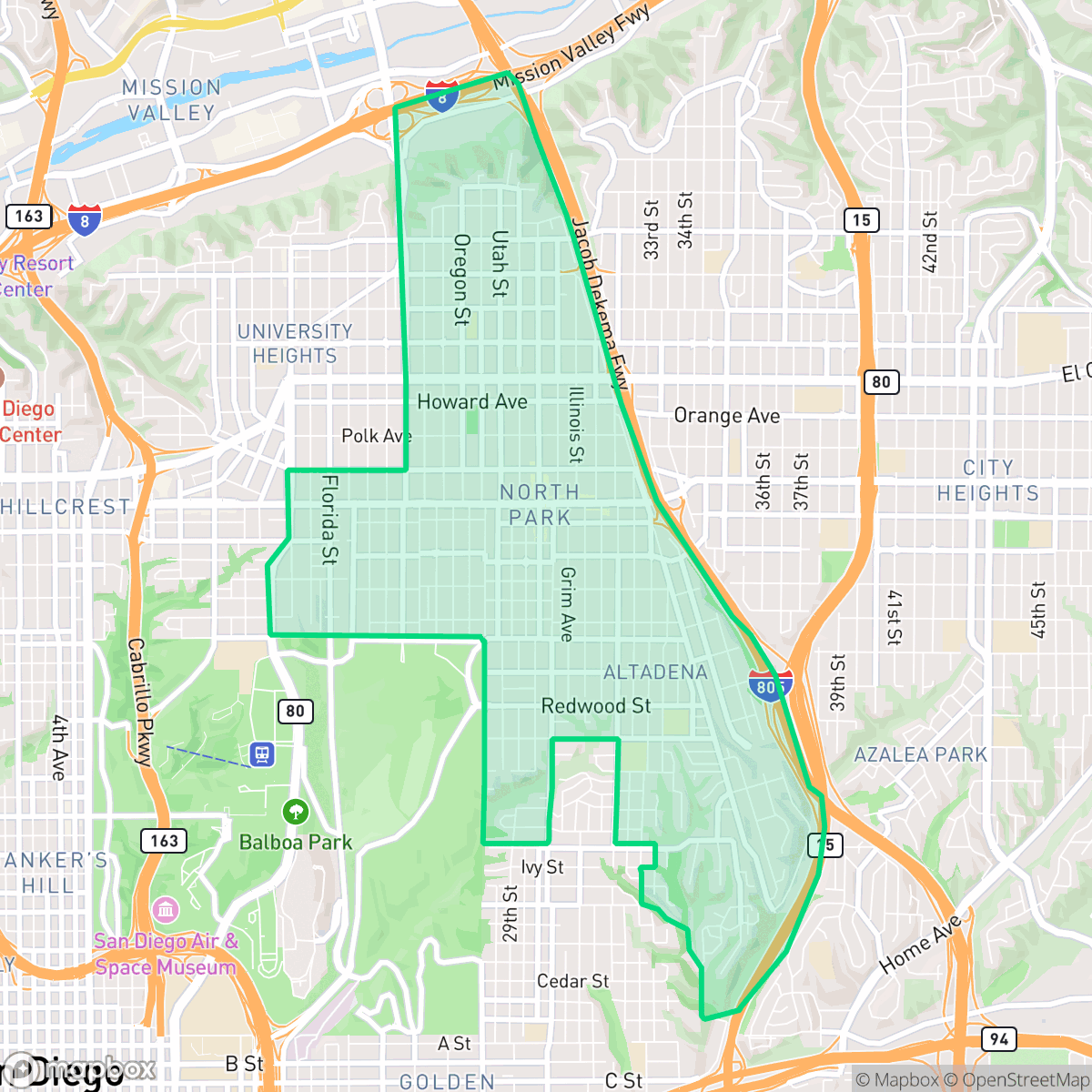
North Park originated in 1893 when James Monroe Hartley purchased 40 acres northeast of Balboa Park for a lemon grove. Following the failure of the grove due to water scarcity, the area was subdivided into a residential suburb, with development accelerating after 1907 due to the expansion of San Diego’s streetcar system. The intersection of 30th Street and University Avenue emerged as the neighborhood's commercial heart, anchored by the 1912 Stevens and Hartley building. North Park is renowned for its architectural diversity, particularly its collection of Craftsman bungalows and California bungalows, notably within the Dryden Historic District. The neighborhood also features landmark structures like the 1928 North Park Theatre and the 1931 Egyptian-style Masonic Temple. Today, it is recognized for its vibrant arts scene, including the Ray Street Arts District, and its historic status as a premier urban village.
North Park serves as an energetic urban hub where a dense, pedestrian-friendly street grid meets the natural respite of nearby canyons. The community maintains a strongly liberal political climate and hosts a diverse population ranging from families to young professionals. Residents benefit from excellent access to health insurance and a complete absence of heavy industrial activity, fostering a landscape dominated by light commercial and residential uses.
Living in this neighborhood requires navigating specific urban trade-offs, including frequent traffic noise and limited residential privacy caused by minimal building setbacks. While the area offers significant social opportunities, potential residents should be aware of high fire safety risks and the fluctuating air quality conditions noted by iHuus data. Educational options fall under the San Diego City Unified School District, which provides a mix of high-performing academic clusters alongside ongoing operational and budgetary challenges.
Neighborhood Scores Across 15 Qualities
Residential structures are often closely packed with shared walls or minimal setbacks, resulting in less personal privacy than the San Diego average. According to iHuus data, many homes feature narrow gaps between buildings or rely on bordering canyons for separation.
Extensive sidewalk networks and frequent crosswalks make navigating the area on foot highly efficient. This dense, pedestrian-friendly layout provides easier access to local amenities than the San Diego average, according to iHuus data.
Uniform rooflines and dense multi-family housing characterize the area. Most residential lots feature small yards and shared amenities, making the visual variety slightly below the San Diego average according to iHuus data.
Canyon-side trails and central public parks provide reliable walking paths, though some dense urban blocks offer limited green space. This level of accessibility for pets is slightly below the San Diego average, according to iHuus data.
Streetscapes consist of a dense low-rise grid where residential lots and commercial buildings are balanced by nearby canyon open spaces. This environment is slightly less developed than the San Diego average, offering a blend of high-density urban pockets and suburban greenery.
Frequent social hubs and a diverse array of dining options create a lively atmosphere that is notably more active than the city average. While some areas offer a steady rhythm of local cafes and eateries, other pockets remain quieter and more residential.
Frequent sounds from nearby transit corridors and heavy traffic are common here. According to iHuus data, acoustic comfort is slightly below the city average due to proximity to major roadways and rail lines.
Air quality in this area fluctuates between acceptable and unhealthy levels, appearing slightly lower than the San Diego city average. Sensitive groups should monitor local conditions during periods of poor air quality, according to iHuus data.
Residential and light commercial uses dominate the landscape, offering a notable absence of warehouses or industrial hazards compared to the city average. According to iHuus data, the area remains free of heavy industrial facilities and large-scale manufacturing sites.
Health insurance coverage levels among North Park residents are slightly higher than the San Diego city average. According to iHuus data, most inhabitants have access to comprehensive medical coverage.
Voting patterns and census indicators reveal a highly progressive political climate that is notably more liberal than the San Diego average.
A balanced demographic of young professionals, families, and older residents characterizes the area. This age distribution is consistent with the average across San Diego.
Flood risk levels in this area are comparable to the rest of San Diego, though precise assessments are currently unavailable due to incomplete federal studies. Residents should remain aware that official flood maps for this specific neighborhood have not yet been fully updated.
Extreme fire hazards are present in this area, representing a risk level that is higher than the San Diego average. Residents should be aware of heightened fire safety requirements and emergency preparedness needs according to iHuus data.
Address-Level Insights for North Park


iHuus Neighborhood Intelligence Insights
Get address-level neighborhood insights for North Park
- Street-level scores — see how individual blocks compare, not just neighborhood averages
- Micro-zone boundaries — identify quiet pockets, flood boundaries, and walkable clusters before you visit
- 15 dimensions in full — walkability, noise, air quality, school quality, insurance coverage, population age profile, urban/rural index, and more
- Boundary risk alerts — know if your address sits near a block boundary where scores drop, the kind of detail no listing will ever mention
- School insights — individual school ratings and insights, not just district-level data
- Compare before you commit — side-by-side data across neighborhoods, down to block precision
No credit card required
Compare with Any Neighborhood
| Dimension | North Park | Adams North |
|---|---|---|
| 🚶 Walkabilityavg 8.58 | ||
| 🔊 Acoustic Comfortavg 3.33 | ||
| 🤫 Privacy Indexavg 4.87 | ||
| 🎨 Visual Appealavg 6.85 | ||
| 🐕 Dog Friendlinessavg 6.91 | ||
| 🗺️ Urban-Rural Indexavg 6.6 | ||
| ✨ Neighborhood Vibeavg 5.12 | ||
| 🏥 Health Insurance Coverageavg 7.53 | ||
| 🌿 Air Qualityavg 6.36 | ||
| 🏭 Industrial Proximityavg 9.12 | ||
| 🌊 Flood Safetyavg 4.2 | ||
| 🗳️ Ideological Leanavg 8.51 | ||
| 👥 Population Age Profileavg 4.8 | ||
| 🔥 Fire Safetyavg 0.61 | ||
| 🏫 School Quality |
North Park Rankings
School Districts Serving North Park
School Insights for North Park
Below average outcomes; significant attendance and academic challenges.
School Insights
See what's really behind every school rating near North Park
- Individual school ratings — each school's own score with outcome context, not just a district average
- Enrollment & class size data — student-to-teacher ratio and how it compares to the state average
- Full demographics breakdown — ethnicity and gender composition for every school in the enrollment zone
- Every school in the district — all schools within the enrollment boundary ranked by rating, not just the closest one
- Grade levels & benchmarks — elementary through high school, with below/above state-average flags
No credit card required