North Island Naval Air Station, San Diego
Updated · 1,963 residents
North Island Naval Air Station is a quiet, spacious military enclave on the Coronado peninsula known for its significant aviation history. While the area offers high spatial privacy and expansive open landscapes, residents experience frequent noise from active flight operations and limited local commercial amenities.
Key Highlights
About North Island Naval Air Station
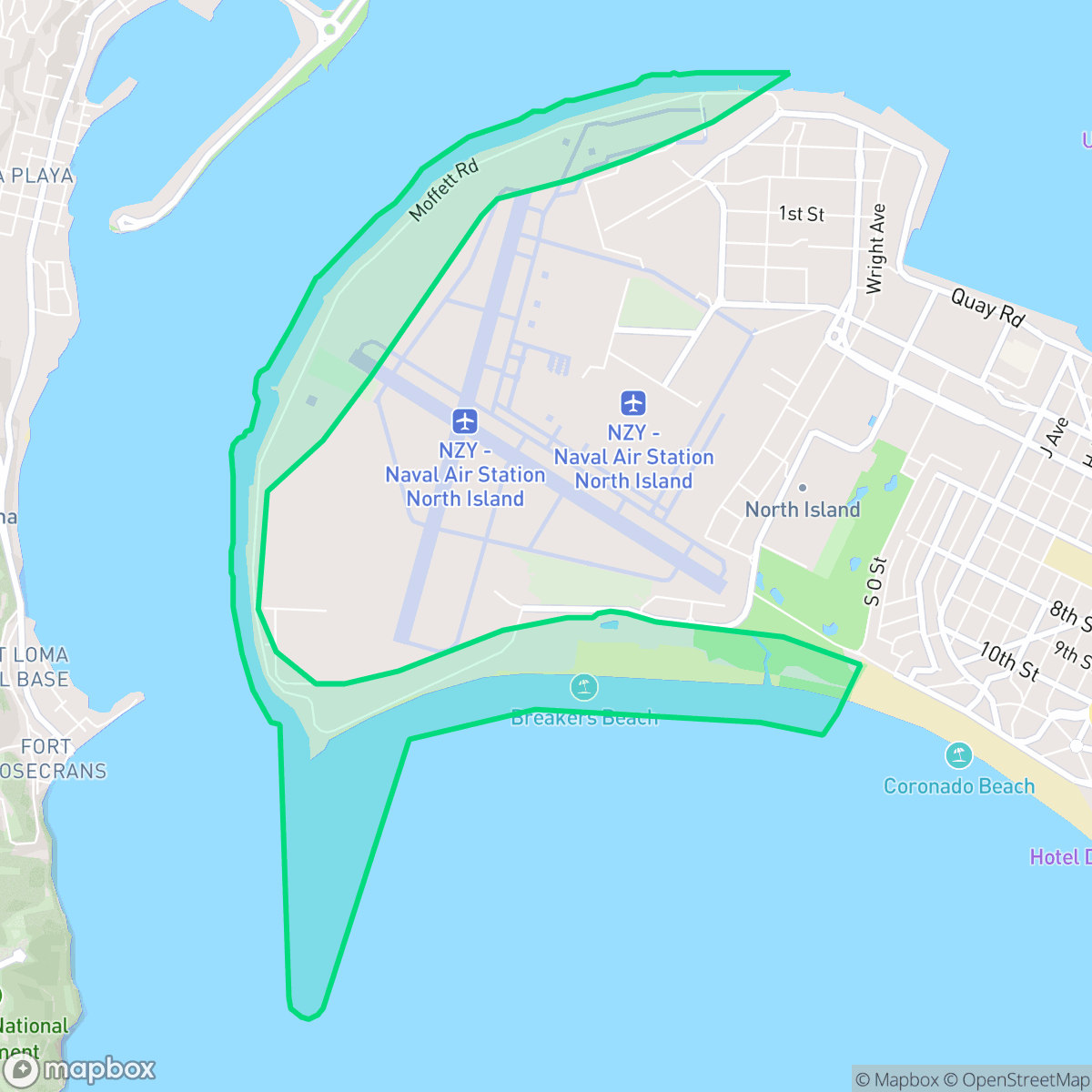
North Island Naval Air Station, located on the northern end of the Coronado peninsula, is officially recognized as the 'Birthplace of Naval Aviation.' Originally an uninhabited sand flat used for recreation by Hotel del Coronado guests, the site became a hub for aviation pioneers like Glenn Curtiss in 1911. It was commissioned as a naval air station in 1917 and served as a joint Army-Navy installation until 1937. The neighborhood's geography was permanently altered during World War II when the Spanish Bight, which once separated North Island from the rest of the peninsula, was filled with dredged material to expand the base. A cornerstone of Pacific Fleet operations, the station hosted historic milestones, including the first mid-air refueling and the departure point for Charles Lindbergh’s 1927 transcontinental flight.
The area functions primarily as a cornerstone of Pacific Fleet operations, characterized by a sprawling, low-density landscape that contrasts with the urban density found elsewhere in San Diego. The environment is defined by its vast airfield, coastal proximity, and specialized infrastructure, resulting in a quiet atmosphere with minimal local commercial activity. The wide spacing between facilities provides a high level of spatial privacy, though the lack of traditional pedestrian infrastructure means that walking is less convenient than in more developed parts of the city. Prospective residents should consider the trade-offs of living in a high-security military zone, including significant acoustic disruptions from aircraft activity and potential flood risks associated with its coastal location. According to iHuus data, the neighborhood is best suited for those affiliated with the installation who prioritize privacy and proximity to military facilities over urban convenience. While the area offers generous open spaces for pet owners, the population is largely composed of young adults, contributing to a distinct social profile compared to the broader San Diego region.
Neighborhood Scores Across 15 Qualities
Buildings are widely spaced with significant open landscape buffers between functional zones, offering much greater privacy than the San Diego average according to iHuus data.
Quiet streets and paved pathways facilitate easy access to the beach, though the lack of sidewalks makes walking significantly less accessible than in many other parts of San Diego. According to iHuus data, the area lacks the robust pedestrian connectivity found throughout the rest of the city.
Residential views consist mostly of modest housing with simple architectural lines and small yards, making the area less visually diverse than the San Diego average. Some waterfront sections offer a notable contrast with manicured grounds and upscale resort amenities, according to iHuus data.
Large beach and grassy expanses offer ample room for pets to play. While this area is slightly below the San Diego average for dog friendliness, the presence of wide, safe paths provides a favorable environment for walking dogs.
Large expanses of airfield, coastline, and industrial infrastructure create a landscape with significantly more open space than the San Diego average. Residents will find a lack of traditional urban density due to the dominance of maritime and military facilities.
Limited local commercial activity and a sparse presence of destinations make this area significantly less lively than the San Diego average. Residents will find a very quiet, low-development landscape dominated by residential blocks, warehouses, and open green space.
Frequent aircraft activity and proximity to transit corridors create a noisier environment than the San Diego average. Residents can expect significant acoustic disruptions due to the active flight paths and nearby infrastructure, according to iHuus data.
Air quality levels fluctuate between acceptable and unhealthy, occasionally posing a concern for sensitive groups. According to iHuus data, the air quality in this area is slightly lower than the San Diego city average.
Significant noise and traffic hazards arise from the presence of an active airfield, large-scale logistics hubs, and fuel storage facilities. This level of industrial and operational activity is notably higher than the San Diego average.
Health insurance access is more prevalent here than the San Diego average, according to iHuus data. Residents benefit from a higher rate of coverage compared to the rest of the city.
Political views in this area are distributed fairly evenly between conservative and liberal leaning residents. This represents a more moderate ideological landscape than the significantly more progressive leaning average seen across San Diego.
Residents are predominantly young adults, with a significantly lower proportion of families and seniors compared to the San Diego average. According to iHuus data, the area lacks the age diversity found in most other parts of the city.
Coastal high-hazard zones and wave action present significant flood risks that are considerably higher than the San Diego average. Residents should anticipate elevated or potentially prohibitive flood insurance costs according to iHuus data.
Address-Level Insights for North Island Naval Air Station


iHuus Neighborhood Intelligence Insights
Get address-level neighborhood insights for North Island Naval Air Station
- Street-level scores — see how individual blocks compare, not just neighborhood averages
- Micro-zone boundaries — identify quiet pockets, flood boundaries, and walkable clusters before you visit
- 15 dimensions in full — walkability, noise, air quality, school quality, insurance coverage, population age profile, urban/rural index, and more
- Boundary risk alerts — know if your address sits near a block boundary where scores drop, the kind of detail no listing will ever mention
- School insights — individual school ratings and insights, not just district-level data
- Compare before you commit — side-by-side data across neighborhoods, down to block precision
No credit card required
Compare with Any Neighborhood
| Dimension | North Island Naval Air Station | Adams North |
|---|---|---|
| 🚶 Walkabilityavg 8.58 | ||
| 🔊 Acoustic Comfortavg 3.33 | ||
| 🤫 Privacy Indexavg 4.87 | ||
| 🎨 Visual Appealavg 6.85 | ||
| 🐕 Dog Friendlinessavg 6.91 | ||
| 🗺️ Urban-Rural Indexavg 6.6 | ||
| ✨ Neighborhood Vibeavg 5.12 | ||
| 🏥 Health Insurance Coverageavg 7.53 | ||
| 🌿 Air Qualityavg 6.36 | ||
| 🏭 Industrial Proximityavg 9.12 | ||
| 🌊 Flood Safetyavg 4.2 | ||
| 🗳️ Ideological Leanavg 8.51 | ||
| 👥 Population Age Profileavg 4.8 | ||
| 🔥 Fire Safetyavg 0.61 | ||
| 🏫 School Quality |
North Island Naval Air Station Rankings
School Districts Serving North Island Naval Air Station
School Insights for North Island Naval Air Station
Below average outcomes; significant attendance and academic challenges.
School Insights
See what's really behind every school rating near North Island Naval Air Station
- Individual school ratings — each school's own score with outcome context, not just a district average
- Enrollment & class size data — student-to-teacher ratio and how it compares to the state average
- Full demographics breakdown — ethnicity and gender composition for every school in the enrollment zone
- Every school in the district — all schools within the enrollment boundary ranked by rating, not just the closest one
- Grade levels & benchmarks — elementary through high school, with below/above state-average flags
No credit card required