North Clairemont, San Diego
Updated · 16,211 residents
North Clairemont is a quiet, mid-century suburban community defined by its winding streets and accessible, pedestrian-friendly layout. While it offers high walkability and proximity to essential services, the area experiences significant noise from nearby road traffic and maintains a low-key, residential atmosphere.
Key Highlights
About North Clairemont
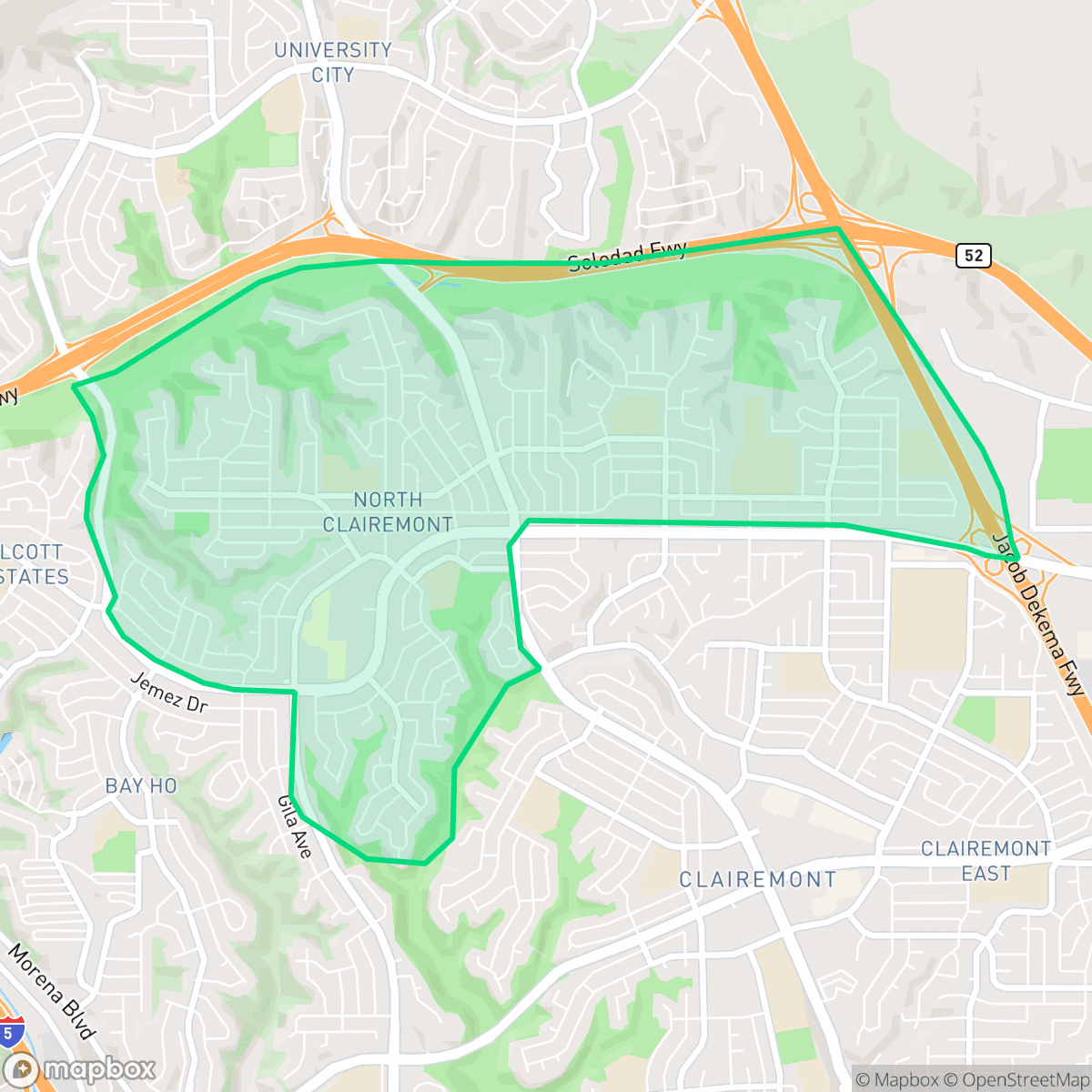
North Clairemont, a neighborhood in north-central San Diego, emerged during the post-World War II suburban boom of the 1950s. Developed by Carlos Tavares and Lou Burgener, the community was designed with winding streets that followed the natural contours of the surrounding mesas and San Clemente Canyon. The neighborhood is characterized by midcentury modern and tract ranch-style homes. A prominent local landmark is the North Clairemont Library, which opened in 1962. Designed by renowned architect Robert Platt, the building is celebrated for its distinctive Googie architectural style, featuring Space Age and car-culture-inspired design elements. The area is also anchored by the North Clairemont Square shopping center, a major retail hub since the mid-20th century. Notable residents who spent their youth in the area include actor Mark Hamill.
North Clairemont serves as a residential hub in north-central San Diego, characterized by a consistent suburban layout of single-family homes and mid-sized apartment complexes. According to iHuus data, the neighborhood maintains a high level of walkability, with a comprehensive network of sidewalks and crosswalks connecting residential blocks to local retail centers. Residents have access to various green spaces, including school fields and local parks like Gershwin Park, which provide necessary relief in an otherwise dense suburban environment.
Prospective residents should note that the area experiences elevated noise levels primarily due to nearby arterial road traffic. While the neighborhood lacks a high-energy commercial scene, it offers a stable, well-insured population and a consistent architectural aesthetic. It is best suited for those prioritizing a walkable, established residential setting over proximity to nightlife or high-intensity urban amenities.
Neighborhood Scores Across 15 Qualities
Property spacing offers more separation than the San Diego average, characterized by detached homes and many lots that back onto private open-space canyons. While some areas feature tighter suburban layouts, most residents benefit from moderate setbacks and buffered boundaries.
Continuous sidewalks on both sides of most streets and clearly marked pedestrian crossings make navigating the area on foot easy. According to iHuus data, the sidewalk network in North Clairemont is more comprehensive than the city average.
Well-maintained properties and large homes with private pools characterize this area, which offers a more visually pleasant environment than the San Diego average. According to iHuus data, the landscape features a mix of upscale estates and established residential blocks with significant greenery.
Extensive canyon trails, school fields, and wide sidewalk verges provide ample space for dog walking. This access to connected green spaces and unpaved corridors makes the area slightly more accommodating for pet owners than the San Diego average.
Residential layouts feature single-family homes integrated with natural canyon topography and greenbelts. This level of open space and low-density development is slightly higher than the San Diego average, according to iHuus data.
Suburban streets and open spaces provide a serene environment, but the lack of concentrated commercial activity makes the area below the city average for social energy. While a few local dining options and services are accessible via walkable paths, most daily needs require a vehicle.
Frequent noise from nearby freeway traffic and transit corridors makes this area significantly louder than the San Diego average. According to iHuus data, residents can expect regular auditory disturbances from heavy vehicle movement.
Air quality levels in North Clairemont are slightly below the San Diego average. Residents may experience occasional periods of poor air quality that could affect sensitive groups, according to iHuus data.
Industrial activity is virtually non-existent here, as the area consists entirely of residential and light commercial uses. This lack of warehouses or heavy manufacturing makes the neighborhood even more residential than the San Diego average.
Health insurance accessibility is strong in this area, sitting well above the San Diego city average according to iHuus data.
Political leanings in this area align closely with the broader San Diego landscape, characterized by a strong liberal majority and a small conservative presence.
Residents live alongside a balanced mix of young adults, families, and older individuals. This demographic spread is slightly more varied than the typical San Diego profile, according to iHuus data.
Flood risk in this area is comparable to the city average, though detailed FEMA studies for this specific location are currently unavailable. Residents should note that a lack of official studies means certain flood hazards remain unverified according to iHuus data.
Significant fire hazards exist in this area, which represents a notably higher risk level than the San Diego average. Residents should prioritize enhanced fire mitigation and awareness according to iHuus data.
Address-Level Insights for North Clairemont


iHuus Neighborhood Intelligence Insights
Get address-level neighborhood insights for North Clairemont
- Street-level scores — see how individual blocks compare, not just neighborhood averages
- Micro-zone boundaries — identify quiet pockets, flood boundaries, and walkable clusters before you visit
- 15 dimensions in full — walkability, noise, air quality, school quality, insurance coverage, population age profile, urban/rural index, and more
- Boundary risk alerts — know if your address sits near a block boundary where scores drop, the kind of detail no listing will ever mention
- School insights — individual school ratings and insights, not just district-level data
- Compare before you commit — side-by-side data across neighborhoods, down to block precision
No credit card required
Compare with Any Neighborhood
| Dimension | North Clairemont | Adams North |
|---|---|---|
| 🚶 Walkabilityavg 8.58 | ||
| 🔊 Acoustic Comfortavg 3.33 | ||
| 🤫 Privacy Indexavg 4.87 | ||
| 🎨 Visual Appealavg 6.85 | ||
| 🐕 Dog Friendlinessavg 6.91 | ||
| 🗺️ Urban-Rural Indexavg 6.6 | ||
| ✨ Neighborhood Vibeavg 5.12 | ||
| 🏥 Health Insurance Coverageavg 7.53 | ||
| 🌿 Air Qualityavg 6.36 | ||
| 🏭 Industrial Proximityavg 9.12 | ||
| 🌊 Flood Safetyavg 4.2 | ||
| 🗳️ Ideological Leanavg 8.51 | ||
| 👥 Population Age Profileavg 4.8 | ||
| 🔥 Fire Safetyavg 0.61 | ||
| 🏫 School Quality |
North Clairemont Rankings
School Districts Serving North Clairemont
School Insights for North Clairemont
Below average outcomes; significant attendance and academic challenges.
School Insights
See what's really behind every school rating near North Clairemont
- Individual school ratings — each school's own score with outcome context, not just a district average
- Enrollment & class size data — student-to-teacher ratio and how it compares to the state average
- Full demographics breakdown — ethnicity and gender composition for every school in the enrollment zone
- Every school in the district — all schools within the enrollment boundary ranked by rating, not just the closest one
- Grade levels & benchmarks — elementary through high school, with below/above state-average flags
No credit card required