Normal Heights, San Diego
Updated · 11,635 residents
Normal Heights is a highly walkable urban grid defined by its historic bungalow architecture and a vibrant commercial corridor along Adams Avenue. While the neighborhood offers excellent access to local eateries and social hubs, residents experience high-density living with limited privacy and notable noise levels from surrounding traffic.
Key Highlights
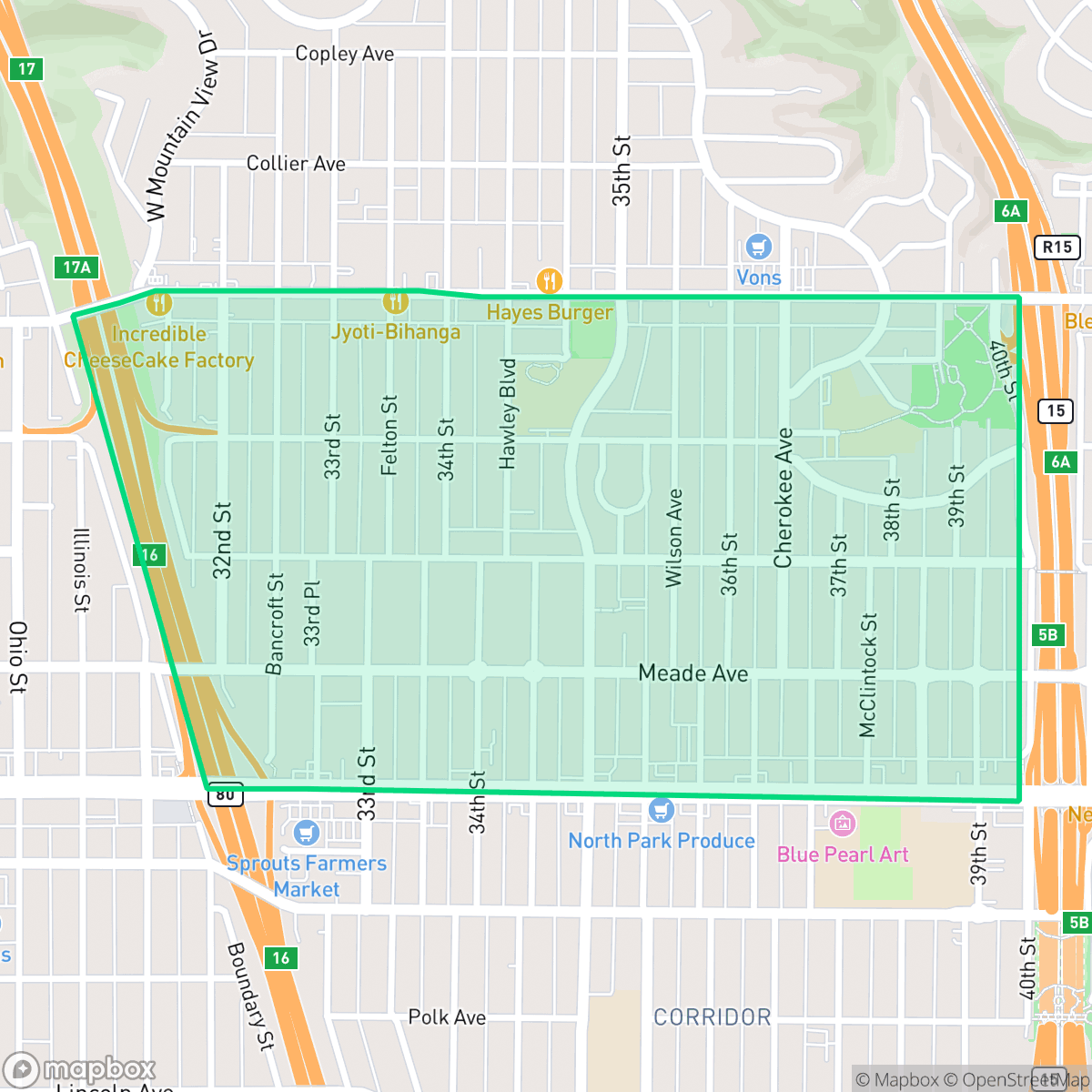
About Normal Heights
Officially founded in 1906 by developers D. C. Collier and George M. Hawley, Normal Heights was named after the nearby State Normal School, a teacher’s college that preceded San Diego State University. The neighborhood quickly grew from a sparsely populated mesa into one of San Diego’s first 'streetcar suburbs' after an electric trolley line was established along Adams Avenue. During the 1920s, carpenter and developer Bertram J. Carteri transformed Adams Avenue into a bustling commercial district known as the Carteri Center. Architecturally, the neighborhood is celebrated for its historic single-family bungalows, the Louis L. Gill-designed Santa Rosa Court bungalow court, and the landmark 1926 Mission Revival 'Rock House,' constructed with native canyon cobblestones. Normal Heights was formally annexed by the city of San Diego in 1925.
The area functions as a dense, pedestrian-friendly enclave where the grid-based street system encourages active street life. Visitors and residents find a variety of local businesses, from casual taco shops to unique cafes, that contribute to the neighborhood's lively social atmosphere. The landscape is dominated by closely spaced residential structures, creating a tightly knit environment that lacks the seclusion found in more suburban settings.
Prospective residents should note that the neighborhood experiences consistent noise from nearby highway traffic, which is a common trade-off for its central location. While the area is exceptionally walkable and free from heavy industrial activity, the compact housing and high density result in reduced acoustic comfort and limited personal space. According to iHuus data, the area is well-suited for those who prioritize immediate access to urban amenities and a strong sense of community over quiet, expansive private grounds.
Neighborhood Scores Across 15 Qualities
Residential structures are often placed in close proximity with minimal separation between buildings. This density results in a much lower level of privacy than is typically found across San Diego.
Extensive sidewalk networks and clearly marked pedestrian crossings make navigating the area on foot easy. The consistent grid layout and pedestrian-priority zones offer a level of walkability that is notably higher than the San Diego average.
Residential views consist primarily of standard tract housing and multi-family complexes with minimal yard space. According to iHuus data, the visual variety in this area is slightly lower than the San Diego average.
Limited green space and narrow sidewalk verges make much of the area challenging for pet owners. While some central parks provide walking areas, the overall accessibility for dogs is below the San Diego average according to iHuus data.
Residential streets and green spaces are balanced with low-rise urban density, though the area feels slightly less urbanized than the San Diego average. According to iHuus data, the landscape consists of a mix of single-family homes and multi-unit housing interspersed with commercial corridors.
Local eateries, coffee shops, and galleries create a social atmosphere that is notably more active than the San Diego average. While some blocks near the highway remain calm and suburban, the area features a concentrated presence of walkable dining and community spaces according to iHuus data.
Frequent disturbances from nearby railroad tracks and freeway traffic characterize the area. According to iHuus data, acoustic comfort in this neighborhood is lower than the San Diego average.
Air quality in this area fluctuates between acceptable and unhealthy levels, which may cause occasional concern for sensitive groups. According to iHuus data, the local air quality is slightly lower than the San Diego city average.
Heavy industry and large warehouses are absent from this area, which consists primarily of residential and light commercial spaces. This lack of industrial presence is even more pronounced here than in the rest of San Diego, according to iHuus data.
Health insurance enrollment among residents is lower than the San Diego average, according to iHuus data.
Voting patterns and census indicators reflect a deeply liberal political leaning that is notably more pronounced than the San Diego city average, according to iHuus data.
Residents live alongside a balanced mix of young professionals, families, and seniors. According to iHuus data, this age distribution is slightly more varied than the typical San Diego profile.
Flood risk is notably higher here than the San Diego average, as portions of the neighborhood fall within a designated floodplain. Residents should be aware that flood insurance is typically required for properties in these areas according to iHuus data.
Address-Level Insights for Normal Heights


iHuus Neighborhood Intelligence Insights
Get address-level neighborhood insights for Normal Heights
- Street-level scores — see how individual blocks compare, not just neighborhood averages
- Micro-zone boundaries — identify quiet pockets, flood boundaries, and walkable clusters before you visit
- 15 dimensions in full — walkability, noise, air quality, school quality, insurance coverage, population age profile, urban/rural index, and more
- Boundary risk alerts — know if your address sits near a block boundary where scores drop, the kind of detail no listing will ever mention
- School insights — individual school ratings and insights, not just district-level data
- Compare before you commit — side-by-side data across neighborhoods, down to block precision
No credit card required
Compare with Any Neighborhood
| Dimension | Normal Heights | Adams North |
|---|---|---|
| 🚶 Walkabilityavg 8.58 | ||
| 🔊 Acoustic Comfortavg 3.33 | ||
| 🤫 Privacy Indexavg 4.87 | ||
| 🎨 Visual Appealavg 6.85 | ||
| 🐕 Dog Friendlinessavg 6.91 | ||
| 🗺️ Urban-Rural Indexavg 6.6 | ||
| ✨ Neighborhood Vibeavg 5.12 | ||
| 🏥 Health Insurance Coverageavg 7.53 | ||
| 🌿 Air Qualityavg 6.36 | ||
| 🏭 Industrial Proximityavg 9.12 | ||
| 🌊 Flood Safetyavg 4.2 | ||
| 🗳️ Ideological Leanavg 8.51 | ||
| 👥 Population Age Profileavg 4.8 | ||
| 🔥 Fire Safetyavg 0.61 | ||
| 🏫 School Quality |
Normal Heights Rankings
School Districts Serving Normal Heights
School Insights for Normal Heights
Below average outcomes; significant attendance and academic challenges.
School Insights
See what's really behind every school rating near Normal Heights
- Individual school ratings — each school's own score with outcome context, not just a district average
- Enrollment & class size data — student-to-teacher ratio and how it compares to the state average
- Full demographics breakdown — ethnicity and gender composition for every school in the enrollment zone
- Every school in the district — all schools within the enrollment boundary ranked by rating, not just the closest one
- Grade levels & benchmarks — elementary through high school, with below/above state-average flags
No credit card required