Mt. Hope, San Diego
Updated · 5,104 residents
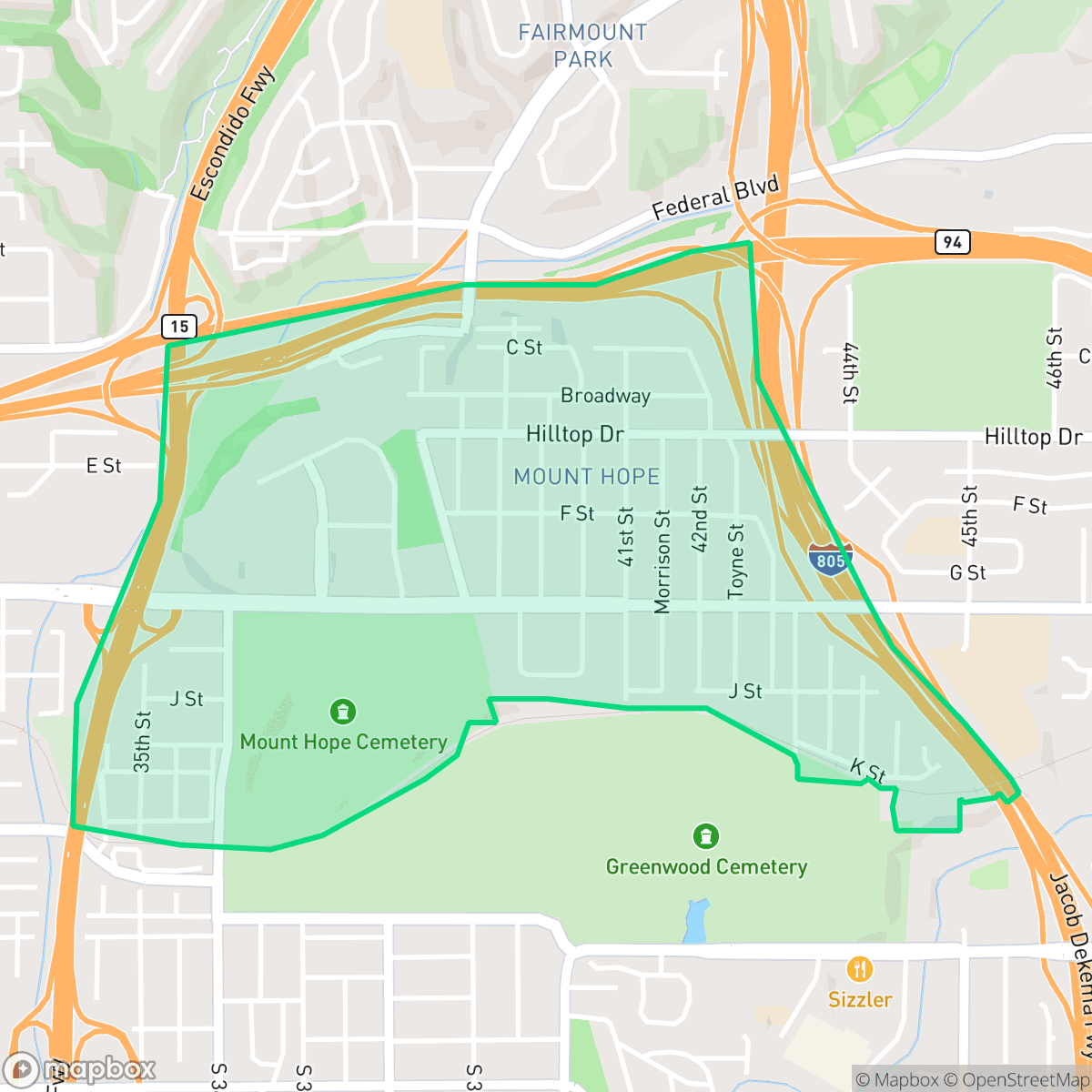
Mt. Hope is a diverse, hilly neighborhood defined by its proximity to historic cemeteries and major freeway infrastructure. Residents experience a quiet, suburban atmosphere characterized by tightly packed residential lots and significant highway barriers that limit overall walkability.
Key Highlights
About Mt. Hope
The hilly urban neighborhood of Mt. Hope in southeastern San Diego takes its name from the historic, city-owned Mount Hope Cemetery. Established in 1869 by a citizen committee led by San Diego developer Alonzo Horton, the cemetery officially opened in 1871 and serves as the final resting place for prominent local figures, including Horton himself, architect Irving Gill, and novelist Raymond Chandler. Adjacent to it lies Greenwood Memorial Park, home to the 1919 Cathedral Mausoleum, which was once the world's largest single-building mausoleum. Developed with a mix of single-family residential homes, industrial zones, and the five-acre Dennis V. Allen Park, Mt. Hope has evolved into a highly diverse community with deep cultural roots and a strong Latino and African-American heritage.
The neighborhood functions as a dense suburban landscape that blends residential homes with light industrial zones and logistics facilities. It is defined by its hilly terrain and immediate access to major transit corridors, which contribute to a high level of ambient road noise throughout the area. While the community lacks a dense concentration of local businesses, it offers a utilitarian environment for those seeking central access to San Diego's transit arteries and nearby green spaces like Dennis V. Allen Park.
Living in this area involves navigating a landscape where residential privacy is reduced by close housing proximity and consistent traffic noise. The neighborhood is best suited for individuals who prioritize central location and affordability over quiet surroundings or walkable retail amenities. Prospective residents should consider the impact of nearby industrial and infrastructure-heavy zones on their daily quality of life.
Neighborhood Scores Across 15 Qualities
Residential lots often feature homes in close proximity with shared fencing or narrow spacing between structures. This level of density is slightly higher than the San Diego average, according to iHuus data.
Residential streets feature established sidewalks and safe crossings, but major freeway interchanges create significant pedestrian barriers. This makes walking within certain pockets easy, though navigating the wider area is more difficult than in many other parts of San Diego.
Standard tract housing and high-density complexes define the local landscape, which features relatively small yards and uniform architecture. This level of visual variety is slightly below the San Diego average according to iHuus data.
Opportunities for dog walking are primarily concentrated near southern parklands and highway buffers, as many residential pockets feature narrow sidewalks and a lack of large open green spaces. According to iHuus data, the overall accessibility to pet-friendly areas in Mt. Hope is below the San Diego average.
A blend of residential, commercial, and light industrial zones defines the area, creating a landscape that is slightly more open than the typical San Diego urban core. According to iHuus data, the neighborhood features a mix of single-family homes alongside significant infrastructure and large-scale commercial buildings.
Low levels of commercial activity and a predominance of residential and light industrial zones create a calmer atmosphere than the San Diego average. While certain pockets offer local dining, most daily services are not within walking distance.
Persistent noise from nearby airport flight paths and heavy transit infrastructure significantly impacts acoustic comfort. This level of disturbance is considerably higher than the average found across San Diego.
Air quality in this area fluctuates between acceptable and unhealthy levels, appearing slightly lower than the San Diego average. Sensitive groups may experience occasional concern during certain periods, according to iHuus data.
Industrial presence is minimal throughout the neighborhood, consisting mostly of residential and institutional zones. While some nearby commercial strips and freeway corridors exist, the area lacks the significant industrial density found elsewhere in San Diego.
Health insurance accessibility is notably lower in this area compared to the San Diego average, according to iHuus data.
Voting patterns and census indicators show a notably more liberal political leaning than the San Diego average, according to iHuus data.
Residents live alongside a balanced mix of young adults, families, and seniors. This demographic spread is slightly lower than the San Diego average, according to iHuus data.
Flood risk in this area is significantly higher than the San Diego average due to its location in a coastal high-hazard zone. Residents should anticipate potential for wave action and elevated insurance costs, according to iHuus data.
Address-Level Insights for Mt. Hope


iHuus Neighborhood Intelligence Insights
Get address-level neighborhood insights for Mt. Hope
- Street-level scores — see how individual blocks compare, not just neighborhood averages
- Micro-zone boundaries — identify quiet pockets, flood boundaries, and walkable clusters before you visit
- 15 dimensions in full — walkability, noise, air quality, school quality, insurance coverage, population age profile, urban/rural index, and more
- Boundary risk alerts — know if your address sits near a block boundary where scores drop, the kind of detail no listing will ever mention
- School insights — individual school ratings and insights, not just district-level data
- Compare before you commit — side-by-side data across neighborhoods, down to block precision
No credit card required
Compare with Any Neighborhood
| Dimension | Mt. Hope | Adams North |
|---|---|---|
| 🚶 Walkabilityavg 8.58 | ||
| 🔊 Acoustic Comfortavg 3.33 | ||
| 🤫 Privacy Indexavg 4.87 | ||
| 🎨 Visual Appealavg 6.85 | ||
| 🐕 Dog Friendlinessavg 6.91 | ||
| 🗺️ Urban-Rural Indexavg 6.6 | ||
| ✨ Neighborhood Vibeavg 5.12 | ||
| 🏥 Health Insurance Coverageavg 7.53 | ||
| 🌿 Air Qualityavg 6.36 | ||
| 🏭 Industrial Proximityavg 9.12 | ||
| 🌊 Flood Safetyavg 4.2 | ||
| 🗳️ Ideological Leanavg 8.51 | ||
| 👥 Population Age Profileavg 4.8 | ||
| 🔥 Fire Safetyavg 0.61 | ||
| 🏫 School Quality |
Mt. Hope Rankings
School Districts Serving Mt. Hope
School Insights for Mt. Hope
Below average outcomes; significant attendance and academic challenges.
School Insights
See what's really behind every school rating near Mt. Hope
- Individual school ratings — each school's own score with outcome context, not just a district average
- Enrollment & class size data — student-to-teacher ratio and how it compares to the state average
- Full demographics breakdown — ethnicity and gender composition for every school in the enrollment zone
- Every school in the district — all schools within the enrollment boundary ranked by rating, not just the closest one
- Grade levels & benchmarks — elementary through high school, with below/above state-average flags
No credit card required