Morena, San Diego
Updated · 6,106 residents
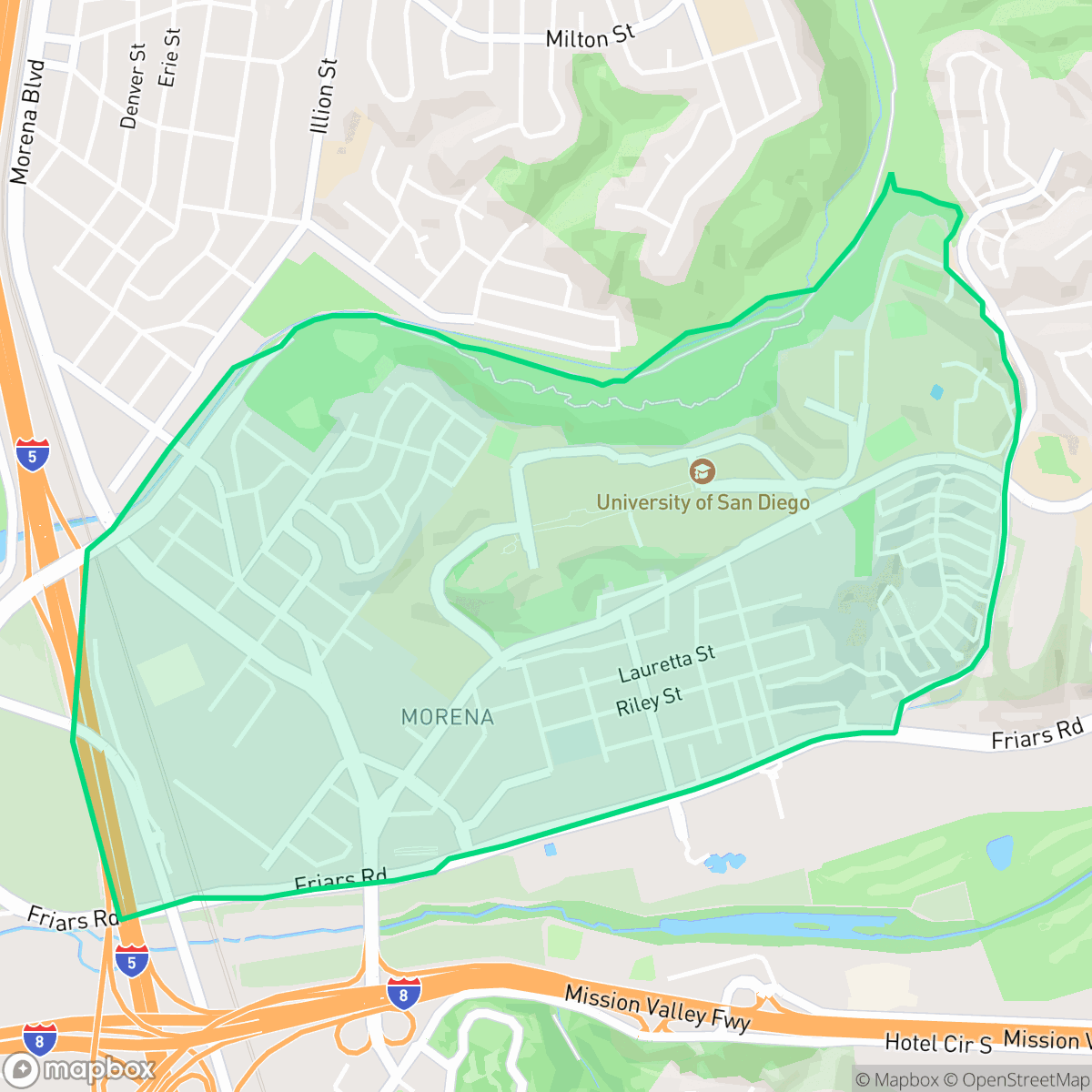
Morena is a quiet, suburban neighborhood in San Diego characterized by well-kept residential streets and proximity to natural canyon trails. It offers a balanced environment with strong walkability and convenient access to local dining, though road traffic noise remains a factor for some areas.
Key Highlights
About Morena
Laid out in 1887 by a syndicate led by Oliver J. Stough, the Morena tract in San Diego originally spanned 1,000 acres sloping toward False Bay (now Mission Bay). Early development was slow, but notable remnants include the Victorian-era Ambort Residence (ca. 1896), built for a prominent local dairy ranch. In 1936, developer Harold J. Peterson transformed a portion of the defunct tract into Bay Park Village, a planned community of Minimal Traditional style homes. Morena’s primary artery, Morena Boulevard, historically served as part of the original U.S. Highway 101 route from 1926 until Interstate 5 bypassed it in 1964. The corridor became a bustling commercial hub, famously hosting the first-ever Price Club (later Costco) in 1976 inside a former Convair aviation plant, alongside long-standing local landmarks like the Silver Spigot bar, which opened in 1954.
The area maintains a serene atmosphere, blending suburban housing with educational and recreational spaces. Residents benefit from consistent, well-maintained properties and access to extensive outdoor areas, including canyon trails and campus grounds that are well-suited for dog walking. While the neighborhood lacks the high-intensity nightlife found in other parts of San Diego, it provides a stable, community-oriented environment with high levels of health insurance coverage among its population.
Those considering this area should note that while it is highly walkable, ambient noise levels are influenced by road traffic along primary corridors. The neighborhood faces specific environmental challenges, including lower scores for flood and fire safety, which are important considerations for prospective residents. It is best suited for individuals or families seeking a quiet, established community that balances suburban living with proximity to the amenities of the broader San Diego region.
Neighborhood Scores Across 15 Qualities
Residential spacing varies between dense apartment clusters and detached homes with moderate yard buffers. According to iHuus data, the level of privacy is slightly higher than the San Diego average due to this mix of housing types.
Sidewalks and safe crossings are well-established along major roads and near local schools; however, overall connectivity is slightly below the San Diego average.
Well-maintained estates and upscale amenities characterize the landscape, offering a higher level of visual quality than the San Diego average. According to iHuus data, the area features a mix of large residential properties with private pools alongside modern, high-density developments.
Extensive canyon trails, large athletic fields, and connected green spaces provide abundant space for pets. According to iHuus data, the availability of wide paths and proximity to open scrubland makes this area significantly more dog friendly than the San Diego average.
Natural canyon open spaces and significant green buffers are interspersed with dense industrial zones and suburban housing. This balance of developed land and open space is roughly in line with the San Diego average, according to iHuus data.
Suburban streets and light industrial corridors create a low-activity environment that is slightly below the city average for liveliness. While some local dining options are accessible on foot, many parts of the area require a vehicle for easy access to amenities.
Steady traffic sounds from nearby busy streets are present, though the acoustic environment is more tranquil than the San Diego average.
Air quality levels in Morena are slightly lower than the San Diego average, characterized by a mix of acceptable and unhealthy days. Sensitive groups may experience occasional concerns due to fluctuating particulate levels, according to iHuus data.
Residential, educational, and recreational spaces define this area with no detected warehouses or industrial hazards. According to iHuus data, this lack of industrial activity is consistent with the rest of San Diego.
Health insurance access is exceptionally high among residents, significantly outpacing the San Diego city average according to iHuus data.
Voting patterns and census indicators show a strong liberal leaning that is slightly higher than the San Diego average, according to iHuus data.
A balanced range of age groups, including young adults, families, and older residents, characterizes this area. This demographic spread is roughly in line with the city average according to iHuus data.
Flood risk is higher than the San Diego average, as parts of this area fall within a designated floodplain. Residents should account for the potential requirement of flood insurance according to iHuus data.
Extreme fire hazards are present in this area, which is slightly higher than the San Diego average. According to iHuus data, residents must prioritize maximum protection measures due to the significant risk of wildfire.
Address-Level Insights for Morena


iHuus Neighborhood Intelligence Insights
Get address-level neighborhood insights for Morena
- Street-level scores — see how individual blocks compare, not just neighborhood averages
- Micro-zone boundaries — identify quiet pockets, flood boundaries, and walkable clusters before you visit
- 15 dimensions in full — walkability, noise, air quality, school quality, insurance coverage, population age profile, urban/rural index, and more
- Boundary risk alerts — know if your address sits near a block boundary where scores drop, the kind of detail no listing will ever mention
- School insights — individual school ratings and insights, not just district-level data
- Compare before you commit — side-by-side data across neighborhoods, down to block precision
No credit card required
Compare with Any Neighborhood
| Dimension | Morena | Adams North |
|---|---|---|
| 🚶 Walkabilityavg 8.58 | ||
| 🔊 Acoustic Comfortavg 3.33 | ||
| 🤫 Privacy Indexavg 4.87 | ||
| 🎨 Visual Appealavg 6.85 | ||
| 🐕 Dog Friendlinessavg 6.91 | ||
| 🗺️ Urban-Rural Indexavg 6.6 | ||
| ✨ Neighborhood Vibeavg 5.12 | ||
| 🏥 Health Insurance Coverageavg 7.53 | ||
| 🌿 Air Qualityavg 6.36 | ||
| 🏭 Industrial Proximityavg 9.12 | ||
| 🌊 Flood Safetyavg 4.2 | ||
| 🗳️ Ideological Leanavg 8.51 | ||
| 👥 Population Age Profileavg 4.8 | ||
| 🔥 Fire Safetyavg 0.61 | ||
| 🏫 School Quality |
Morena Rankings
School Districts Serving Morena
School Insights for Morena
Below average outcomes; significant attendance and academic challenges.
School Insights
See what's really behind every school rating near Morena
- Individual school ratings — each school's own score with outcome context, not just a district average
- Enrollment & class size data — student-to-teacher ratio and how it compares to the state average
- Full demographics breakdown — ethnicity and gender composition for every school in the enrollment zone
- Every school in the district — all schools within the enrollment boundary ranked by rating, not just the closest one
- Grade levels & benchmarks — elementary through high school, with below/above state-average flags
No credit card required