Mission Valley East, San Diego
Updated · 12,073 residents
Mission Valley East features a blend of modern, high-density residential developments and major retail hubs, offering a convenient suburban-urban lifestyle. While it provides excellent access to green corridors and pet-friendly trails, residents should expect significant noise from nearby highway traffic and limited privacy due to the close proximity of shared-wall housing.
Key Highlights
About Mission Valley East
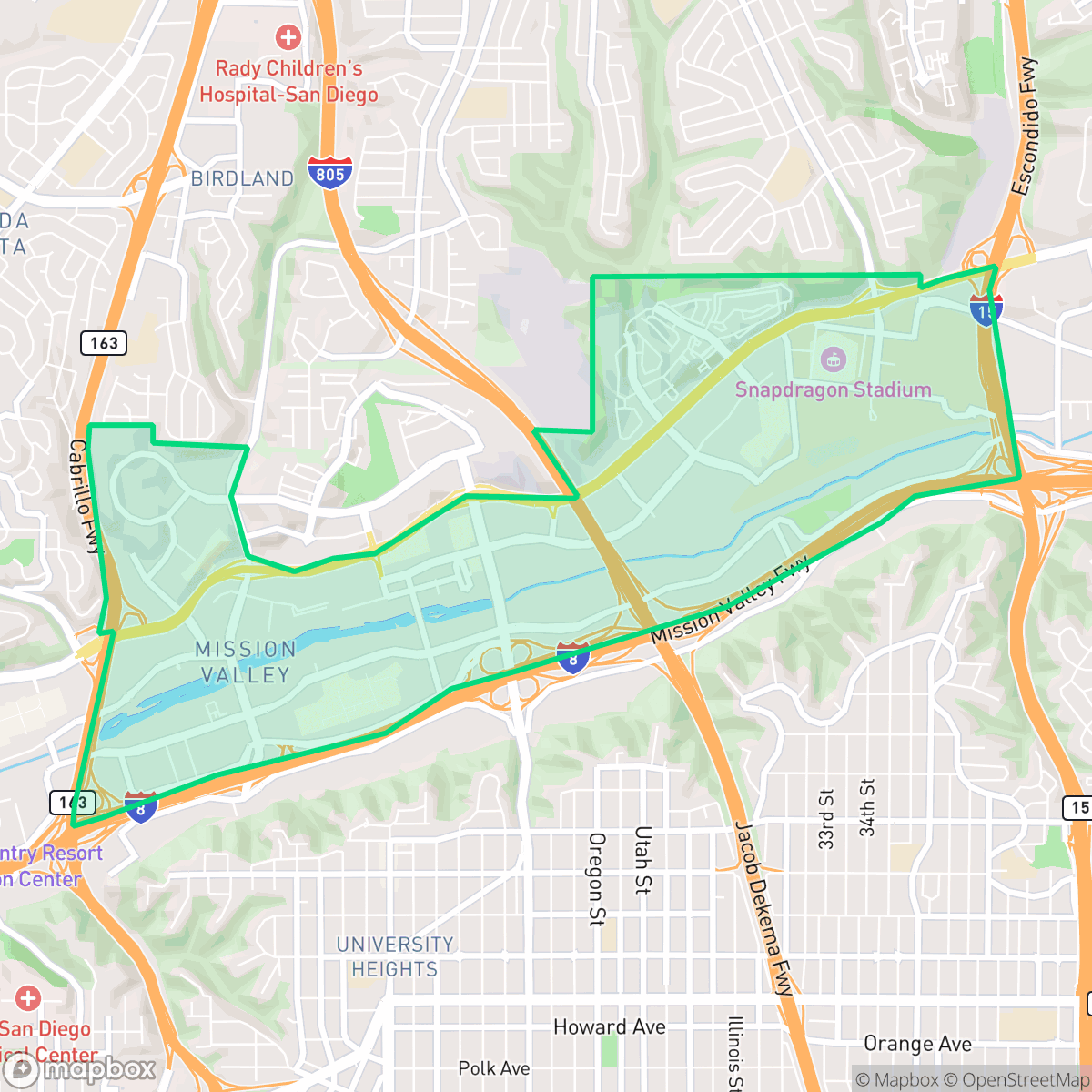
Mission Valley East, bounded to the west by State Route 163, holds deep historical roots as the home of the Kumeyaay people for millennia. In 1774, Spanish colonizers relocated the Mission San Diego de Alcalá—the first of California's 21 missions—to this eastern end of the valley to secure better access to fresh water and agricultural land. The area remained dominated by dairy farming and sand and gravel quarrying until the mid-20th century. The post-World War II era brought rapid urbanization, catalyzed by the construction of Interstate 8 and the introduction of major retail hubs. Today, the neighborhood's modern identity is anchored by major regional landmarks, including the historic reconstructed Mission Basilica, the transit-oriented Civita development built on a former quarry site, and Snapdragon Stadium.
The area is characterized by a dense mix of multi-story apartment complexes, townhomes, and expansive commercial centers that serve as a central transit-oriented hub. It functions as a bustling suburban fringe where residents benefit from proximity to major retail destinations and regional transit connections. The landscape is defined by its planned community aesthetic, featuring well-maintained landscaping and modern architecture that balances the high-density footprint with shared luxury amenities.
Living here involves distinct trade-offs, particularly regarding acoustic comfort, as the neighborhood experiences elevated noise levels primarily driven by heavy road traffic. The housing stock consists of tightly packed units, which results in reduced individual privacy compared to lower-density parts of San Diego. However, the area remains attractive to those who prioritize convenience, dog-friendly outdoor spaces, and access to diverse dining options. According to iHuus data, the community maintains high health insurance coverage rates and a strong sense of civic engagement, making it a functional choice for professionals and commuters who value central connectivity over quiet seclusion.
Neighborhood Scores Across 15 Qualities
Shared walls and closely spaced multi-story buildings are common in certain sections of the area. This level of density is slightly higher than the San Diego average, resulting in less separation between neighbors according to iHuus data.
Pedestrian access is inconsistent, as major highways and high-traffic arterials can create barriers between residential pockets and retail centers. While some apartment layouts offer direct connections to shops, the overall walkability is lower than the San Diego average.
Residential views range from manicured, affluent planned communities to high-density apartment complexes and large commercial retail centers. According to iHuus data, the overall visual appeal is slightly below the San Diego city average.
Abundant green corridors and river-adjacent trails provide reliable walking options for pets. According to iHuus data, the availability of these continuous paths and park verges is roughly in line with the city average.
Developed areas featuring a dense mix of apartment complexes and large commercial structures characterize this landscape. This environment is largely consistent with the broader San Diego urban-rural balance.
Suburban blocks and light industrial zones offer a varied atmosphere with a mix of quiet green spaces and diverse dining options. According to iHuus data, the level of activity and access to amenities is roughly in line with the city average.
Persistent noise from nearby freeways and railroad tracks characterizes this area. Acoustic levels are noticeably higher than the San Diego average, according to iHuus data.
Air quality levels fluctuate between acceptable and unhealthy ranges, which is slightly lower than the San Diego average. Sensitive groups should monitor periodic shifts in air quality according to iHuus data.
Residential life is largely uninterrupted by heavy industry, though some areas near major highways and utility infrastructure may experience increased noise and dust. According to iHuus data, the neighborhood remains slightly more industrial than the San Diego average due to nearby warehouses and a concrete plant.
Health insurance access is very high among residents, significantly surpassing the San Diego average according to iHuus data.
Voting patterns and census indicators reflect a predominantly liberal political leaning, which is notably higher than the San Diego average according to iHuus data.
A diverse range of age demographics exists here, reflecting a balance of young adults, families, and seniors that is nearly identical to the broader San Diego area.
Residual flood risks exist within certain areas of the neighborhood, though safety levels remain notably higher than the San Diego average according to iHuus data.
Significant fire hazards exist within this area, representing a much higher risk level than the San Diego average. Residents should be aware of heightened mitigation requirements and seasonal wildfire concerns according to iHuus data.
Address-Level Insights for Mission Valley East


iHuus Neighborhood Intelligence Insights
Get address-level neighborhood insights for Mission Valley East
- Street-level scores — see how individual blocks compare, not just neighborhood averages
- Micro-zone boundaries — identify quiet pockets, flood boundaries, and walkable clusters before you visit
- 15 dimensions in full — walkability, noise, air quality, school quality, insurance coverage, population age profile, urban/rural index, and more
- Boundary risk alerts — know if your address sits near a block boundary where scores drop, the kind of detail no listing will ever mention
- School insights — individual school ratings and insights, not just district-level data
- Compare before you commit — side-by-side data across neighborhoods, down to block precision
No credit card required
Compare with Any Neighborhood
| Dimension | Mission Valley East | Adams North |
|---|---|---|
| 🚶 Walkabilityavg 8.58 | ||
| 🔊 Acoustic Comfortavg 3.33 | ||
| 🤫 Privacy Indexavg 4.87 | ||
| 🎨 Visual Appealavg 6.85 | ||
| 🐕 Dog Friendlinessavg 6.91 | ||
| 🗺️ Urban-Rural Indexavg 6.6 | ||
| ✨ Neighborhood Vibeavg 5.12 | ||
| 🏥 Health Insurance Coverageavg 7.53 | ||
| 🌿 Air Qualityavg 6.36 | ||
| 🏭 Industrial Proximityavg 9.12 | ||
| 🌊 Flood Safetyavg 4.2 | ||
| 🗳️ Ideological Leanavg 8.51 | ||
| 👥 Population Age Profileavg 4.8 | ||
| 🔥 Fire Safetyavg 0.61 | ||
| 🏫 School Quality |
Mission Valley East Rankings
School Districts Serving Mission Valley East
School Insights for Mission Valley East
Below average outcomes; significant attendance and academic challenges.
School Insights
See what's really behind every school rating near Mission Valley East
- Individual school ratings — each school's own score with outcome context, not just a district average
- Enrollment & class size data — student-to-teacher ratio and how it compares to the state average
- Full demographics breakdown — ethnicity and gender composition for every school in the enrollment zone
- Every school in the district — all schools within the enrollment boundary ranked by rating, not just the closest one
- Grade levels & benchmarks — elementary through high school, with below/above state-average flags
No credit card required