Mission Hills, San Diego
Updated · 5,935 residents
Mission Hills is characterized by its rolling canyon topography and well-manicured residential streets that feature a diverse mix of historic and modern architecture. While the area offers a balanced suburban atmosphere, residents should be aware of elevated wildfire risks and noise levels from nearby transit corridors.
Key Highlights
About Mission Hills
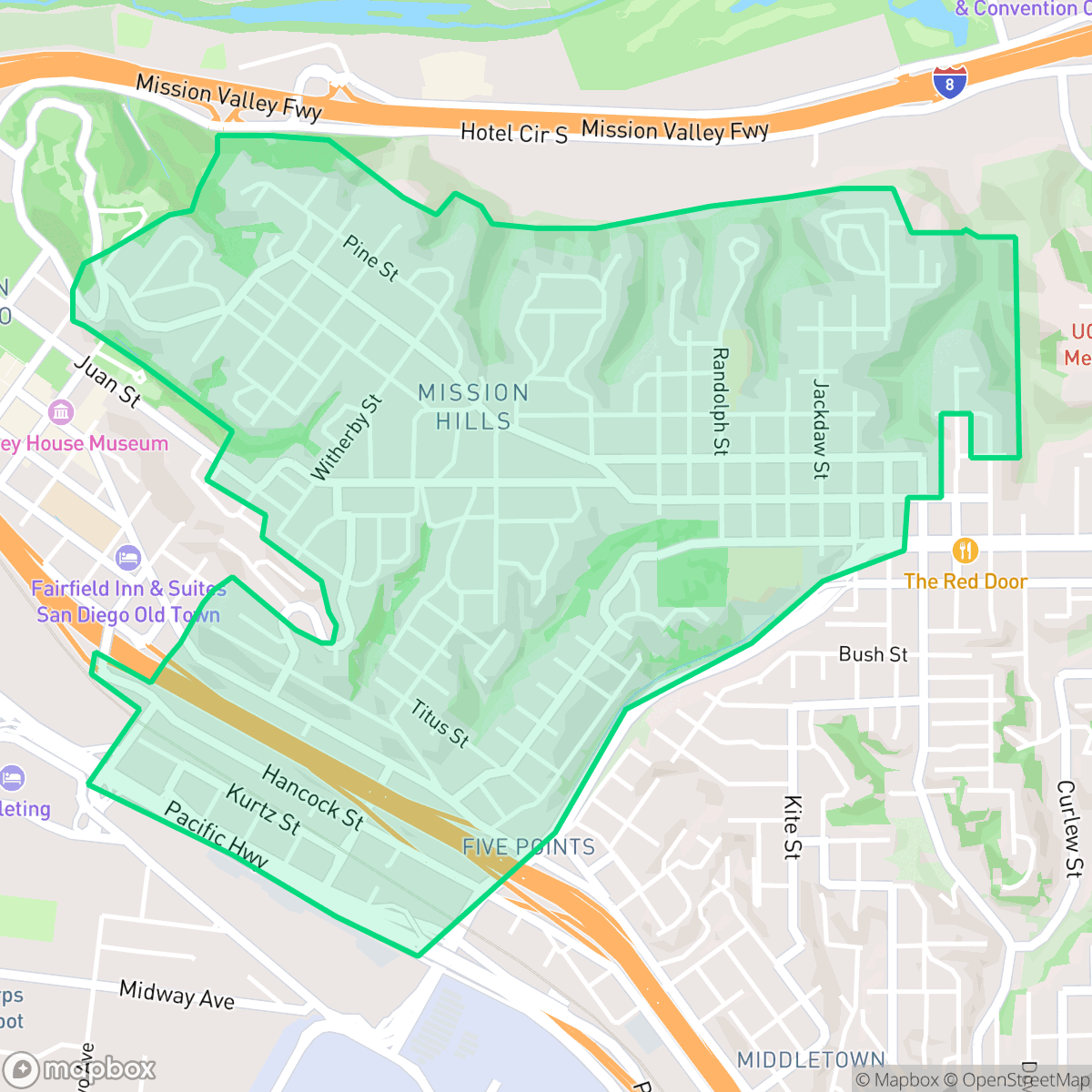
Mission Hills, officially subdivided in 1908, evolved from hilly chaparral into one of San Diego's premier streetcar suburbs. Its development was heavily influenced by civic leaders George Marston and horticulturist Kate Sessions, who founded the enduring Mission Hills Nursery in 1910. The neighborhood is celebrated for its intact collection of early 20th-century architecture, featuring Craftsman, Prairie School, and Spanish Colonial Revival styles. Unlike grid-heavy urban areas, its streets follow the natural topography of the canyons. The area’s growth was further catalyzed by the 1910 extension of the San Diego Electric Railway’s Fort Stockton line. Notable landmarks include the historic Villa Orizaba, built in 1887, and Pioneer Park, which served as a cemetery for early settlers until its conversion into a public space in 1970. Mid-century modern infill by architects like Lloyd Ruocco later added to its diverse architectural character.
Mission Hills provides a distinct residential environment defined by its blend of canyon-side landscapes and upscale, well-maintained properties. The area maintains a stable social fabric with a diverse age demographic and a strong ideological alignment. Local social hubs and dining options contribute to a steady, active rhythm that feels less urbanized than many surrounding parts of the city.
Prospective residents should consider specific environmental and infrastructure factors when evaluating the area. According to iHuus data, the neighborhood faces notable challenges regarding wildfire safety and traffic noise from nearby freeways. While the street network is generally walkable, accessibility can fluctuate near transit borders and airfield zones. Educational needs are served by the San Diego City Unified School District, which currently navigates significant budget and labor challenges that impact its overall stability.
Neighborhood Scores Across 15 Qualities
Residential spacing is consistent with the city average, offering a mix of fenced backyards and natural canyon buffers. Some higher density apartment blocks are present alongside more detached homes, according to iHuus data.
Residential streets feature a consistent sidewalk network and clear pedestrian crossings, though accessibility is limited near airfield zones and high-traffic transit borders. This level of walkability is lower than the San Diego average due to these infrastructure gaps, according to iHuus data.
Large homes featuring private pools and well-maintained landscapes create a polished aesthetic that is slightly below the San Diego average. According to iHuus data, the presence of multi-car driveways and upscale amenities is a defining characteristic of this residential area.
Access to greenery and trails is inconsistent across the area. While some sections offer large central parks and canyon trails, other parts of the neighborhood lack grass verges and are below the San Diego average for dog friendliness.
Residential streets and canyon parklands are balanced by pockets of institutional and light industrial zones. This area feels slightly less urbanized than the San Diego average, offering a blend of single-family homes and significant green space.
A mix of quiet residential blocks and active social hubs provides a steady rhythm of local dining and services. This area offers a slightly more active atmosphere than the San Diego average, though certain sections remain car-dependent due to industrial proximity.
Frequent noise from nearby freeways and railroad corridors is a notable characteristic of this area. According to iHuus data, acoustic levels are more disruptive than the typical experience found elsewhere in San Diego.
Air quality in this area fluctuates between acceptable and unhealthy levels, slightly lower than the San Diego average. Residents sensitive to pollutants may experience occasional concern during certain periods, according to iHuus data.
Residential and light commercial spaces dominate the landscape with no visible heavy industry or large warehouses. This area maintains a slightly higher level of industrial proximity than the city average according to iHuus data.
Health insurance access among residents is nearly in line with the San Diego average. According to iHuus data, the majority of the population maintains coverage.
Voting patterns and census indicators show a predominantly liberal leaning that is more pronounced than the San Diego city average, according to iHuus data.
A balanced mix of young adults, families, and older residents characterizes the area, reflecting a distribution slightly more varied than the San Diego average according to iHuus data.
Properties in this area are situated within a designated floodplain, which may necessitate flood insurance. According to iHuus data, the risk level for this neighborhood is higher than the San Diego average.
Wildfire hazards in this area are exceptionally high, presenting significantly greater danger than the typical San Diego neighborhood. According to iHuus data, residents must prioritize maximum fire protection measures due to the severe level of risk present.
Address-Level Insights for Mission Hills


iHuus Neighborhood Intelligence Insights
Get address-level neighborhood insights for Mission Hills
- Street-level scores — see how individual blocks compare, not just neighborhood averages
- Micro-zone boundaries — identify quiet pockets, flood boundaries, and walkable clusters before you visit
- 15 dimensions in full — walkability, noise, air quality, school quality, insurance coverage, population age profile, urban/rural index, and more
- Boundary risk alerts — know if your address sits near a block boundary where scores drop, the kind of detail no listing will ever mention
- School insights — individual school ratings and insights, not just district-level data
- Compare before you commit — side-by-side data across neighborhoods, down to block precision
No credit card required
Compare with Any Neighborhood
| Dimension | Mission Hills | Adams North |
|---|---|---|
| 🚶 Walkabilityavg 8.58 | ||
| 🔊 Acoustic Comfortavg 3.33 | ||
| 🤫 Privacy Indexavg 4.87 | ||
| 🎨 Visual Appealavg 6.85 | ||
| 🐕 Dog Friendlinessavg 6.91 | ||
| 🗺️ Urban-Rural Indexavg 6.6 | ||
| ✨ Neighborhood Vibeavg 5.12 | ||
| 🏥 Health Insurance Coverageavg 7.53 | ||
| 🌿 Air Qualityavg 6.36 | ||
| 🏭 Industrial Proximityavg 9.12 | ||
| 🌊 Flood Safetyavg 4.2 | ||
| 🗳️ Ideological Leanavg 8.51 | ||
| 👥 Population Age Profileavg 4.8 | ||
| 🔥 Fire Safetyavg 0.61 | ||
| 🏫 School Quality |
Mission Hills Rankings
School Districts Serving Mission Hills
School Insights for Mission Hills
Below average outcomes; significant attendance and academic challenges.
School Insights
See what's really behind every school rating near Mission Hills
- Individual school ratings — each school's own score with outcome context, not just a district average
- Enrollment & class size data — student-to-teacher ratio and how it compares to the state average
- Full demographics breakdown — ethnicity and gender composition for every school in the enrollment zone
- Every school in the district — all schools within the enrollment boundary ranked by rating, not just the closest one
- Grade levels & benchmarks — elementary through high school, with below/above state-average flags
No credit card required