Mission Beach, San Diego
Updated · 3,320 residents
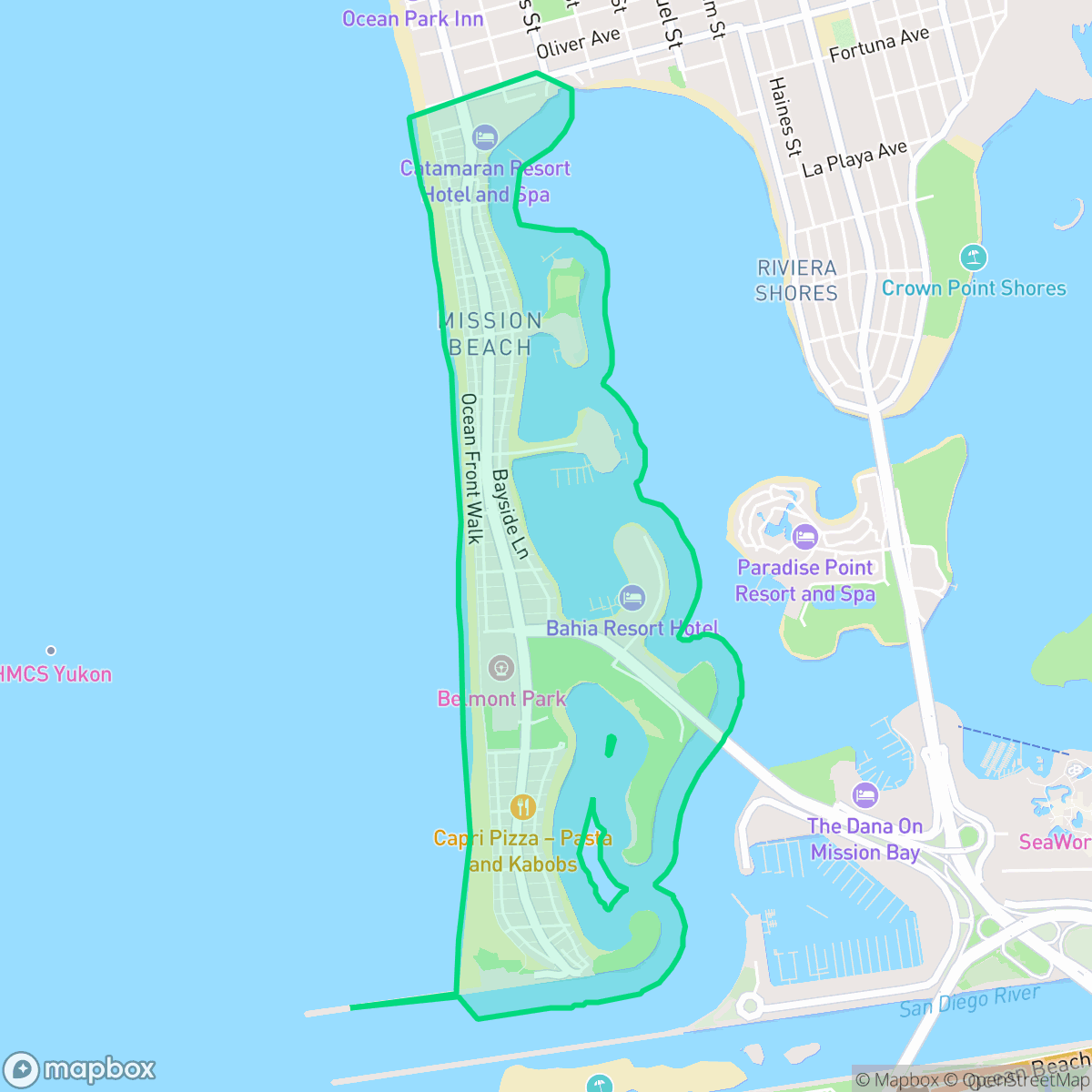
Mission Beach is a highly walkable coastal enclave defined by its two-mile boardwalk and immediate access to both the Pacific Ocean and Mission Bay. Residents experience a dense, community-oriented lifestyle with excellent dog friendliness, though the area faces challenges regarding limited privacy and environmental risks like flooding and fire.
Key Highlights
About Mission Beach
Developed on a narrow sandbar between the Pacific Ocean and Mission Bay, Mission Beach was subdivided in 1914 by a syndicate led by John D. Spreckels and George L. Barney. In 1916, J.M. Asher established "Tent City," a seasonal resort of striped tents and cabanas that transitioned into a year-round community. To stimulate real estate sales, Spreckels built the Mission Beach Amusement Center in 1925 (now Belmont Park), featuring the historic Giant Dipper roller coaster and the Plunge, a Spanish Renaissance-style indoor saltwater pool. The neighborhood's early residential stock is characterized by 1920s to 1940s summer cottages, including rare airplane bungalows. Today, the community is defined by its high-density layout, its two-mile oceanfront boardwalk, and its vibrant, laid-back coastal identity.
The neighborhood functions as a distinct coastal hub, prioritizing pedestrian access and outdoor engagement. With a perfect walkability score according to iHuus data, the area allows for seamless movement between the Pacific coastline and the calm waters of Mission Bay. The housing stock remains tightly clustered, fostering a social environment where the boardwalk serves as the primary artery for recreation and transit.
Prospective residents should consider the trade-offs of this high-density environment. While the location offers superior access to amenities and high rates of health insurance coverage, the close proximity of homes results in limited individual privacy. The area also requires awareness of environmental factors, specifically lower scores for flood and fire safety. Educational needs are served by the San Diego City Unified School District, which provides a mix of academic opportunities despite ongoing budget and labor challenges.
Neighborhood Scores Across 15 Qualities
Limited separation between homes creates a densely packed environment with very narrow gaps between structures. This level of proximity is notably higher than the San Diego average, according to iHuus data.
Dense street grids and dedicated sidewalks allow for easy movement between residential zones and local parks. According to iHuus data, the accessibility of crossings and pedestrian paths is significantly higher than the San Diego average.
High-value coastal real estate and luxury housing features provide a visual landscape that is more polished than the San Diego average. While some areas contain dense, standard housing, much of the neighborhood features premium amenities and private rooftop decks according to iHuus data.
Expansive beach access and large central park areas with green sports fields provide ample space for pets. According to iHuus data, this accessibility to open, traffic-safe areas is significantly higher than the San Diego average.
A dense coastal grid of low to mid-rise buildings and significant public green space characterizes the area. This balance of developed infrastructure and recreational land is roughly in line with the city average, according to iHuus data.
Mixes lively dining pockets with quieter, suburban coastal blocks. This area offers more social energy and amenities than the typical San Diego neighborhood according to iHuus data.
Steady traffic sounds from nearby busy streets are common here; however, acoustic levels remain more tranquil than the average for San Diego. According to iHuus data, the area experiences a consistent hum but is notably quieter than many other parts of the city.
Occasional periods of poor air quality may affect sensitive individuals, as levels in Mission Beach are slightly below the San Diego average according to iHuus data.
No warehouses, manufacturing facilities, or industrial hazards are present in this area. According to iHuus data, this neighborhood is exclusively residential and recreational, offering a cleaner environment than the San Diego average.
Health insurance access is exceptionally high among residents; this rate sits well above the San Diego average according to iHuus data.
Political leanings in this area are consistent with the broader San Diego area, characterized by a liberal majority and a small conservative presence.
Residents live alongside a balanced demographic of young adults, families, and older individuals. According to iHuus data, this age distribution is consistent with the broader San Diego area.
Located within a designated floodplain, this area faces significantly higher flood risks than the San Diego average. Residents should be aware that flood insurance is typically required for properties in this zone according to iHuus data.
Address-Level Insights for Mission Beach


iHuus Neighborhood Intelligence Insights
Get address-level neighborhood insights for Mission Beach
- Street-level scores — see how individual blocks compare, not just neighborhood averages
- Micro-zone boundaries — identify quiet pockets, flood boundaries, and walkable clusters before you visit
- 15 dimensions in full — walkability, noise, air quality, school quality, insurance coverage, population age profile, urban/rural index, and more
- Boundary risk alerts — know if your address sits near a block boundary where scores drop, the kind of detail no listing will ever mention
- School insights — individual school ratings and insights, not just district-level data
- Compare before you commit — side-by-side data across neighborhoods, down to block precision
No credit card required
Compare with Any Neighborhood
| Dimension | Mission Beach | Adams North |
|---|---|---|
| 🚶 Walkabilityavg 8.58 | ||
| 🔊 Acoustic Comfortavg 3.33 | ||
| 🤫 Privacy Indexavg 4.87 | ||
| 🎨 Visual Appealavg 6.85 | ||
| 🐕 Dog Friendlinessavg 6.91 | ||
| 🗺️ Urban-Rural Indexavg 6.6 | ||
| ✨ Neighborhood Vibeavg 5.12 | ||
| 🏥 Health Insurance Coverageavg 7.53 | ||
| 🌿 Air Qualityavg 6.36 | ||
| 🏭 Industrial Proximityavg 9.12 | ||
| 🌊 Flood Safetyavg 4.2 | ||
| 🗳️ Ideological Leanavg 8.51 | ||
| 👥 Population Age Profileavg 4.8 | ||
| 🔥 Fire Safetyavg 0.61 | ||
| 🏫 School Quality |
Mission Beach Rankings
School Districts Serving Mission Beach
School Insights for Mission Beach
Below average outcomes; significant attendance and academic challenges.
School Insights
See what's really behind every school rating near Mission Beach
- Individual school ratings — each school's own score with outcome context, not just a district average
- Enrollment & class size data — student-to-teacher ratio and how it compares to the state average
- Full demographics breakdown — ethnicity and gender composition for every school in the enrollment zone
- Every school in the district — all schools within the enrollment boundary ranked by rating, not just the closest one
- Grade levels & benchmarks — elementary through high school, with below/above state-average flags
No credit card required