Mission Bay Park, San Diego
Updated · 11,436 residents
Mission Bay Park is a serene, aquatic-focused residential area defined by its proximity to expansive recreational waterways and quiet, dense suburban streets. Residents benefit from high walkability and excellent access to dog-friendly green spaces, though the area experiences moderate road traffic noise.
Key Highlights
About Mission Bay Park
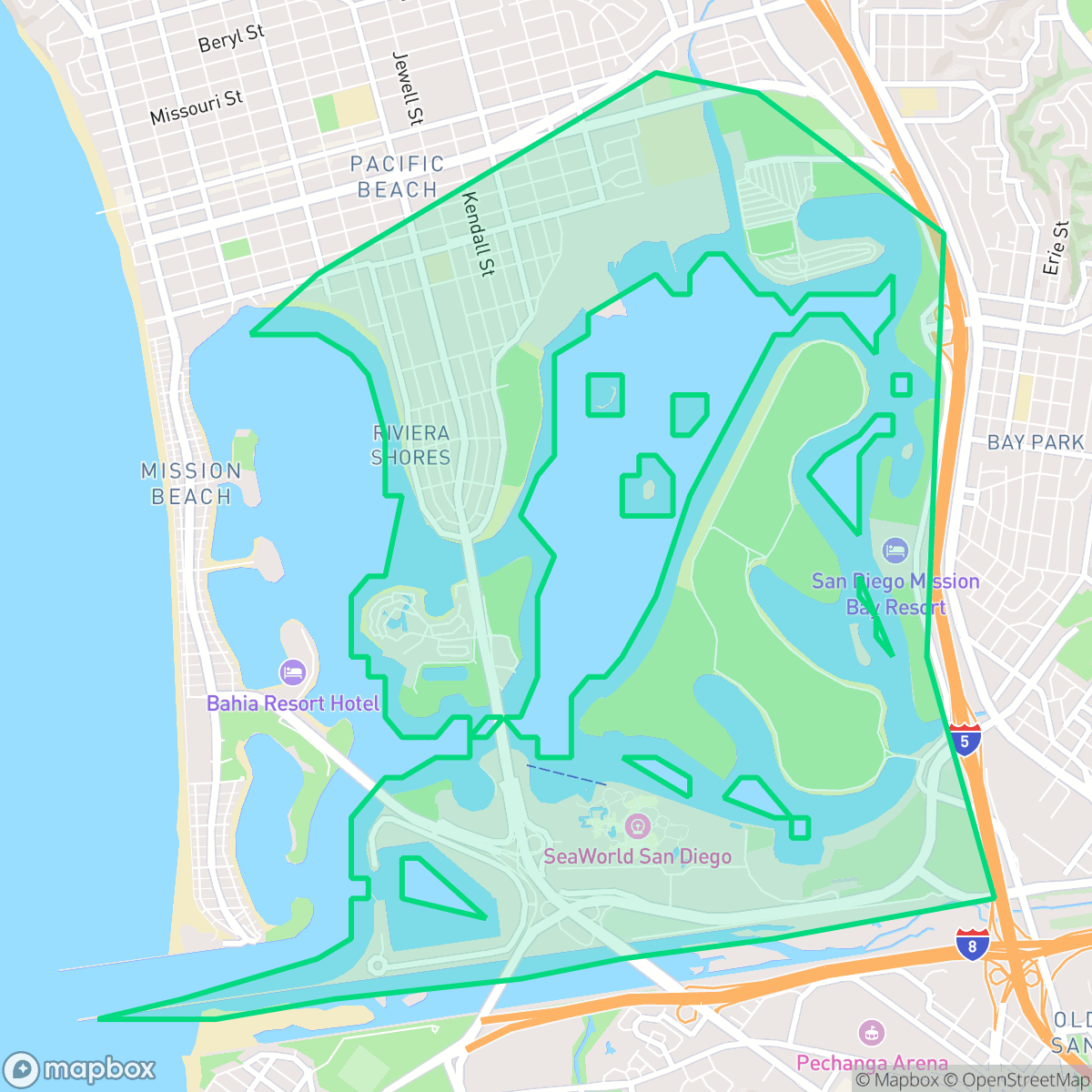
Originally a vast tidal marsh named "False Bay" by Spanish explorer Juan Rodriguez Cabrillo in 1542, San Diego’s Mission Bay Park was transformed through one of the most ambitious land reclamation projects in local history. In 1944, civic leaders proposed converting the marsh into a recreational center to diversify the city’s military-dependent economy. Beginning in the late 1940s, the city and the U.S. Army Corps of Engineers dredged 25 million cubic yards of sand and silt, reshaping the wetlands into a completely man-made aquatic park that officially opened in 1962. Today, spanning over 4,000 acres, it is the largest municipal aquatic park in the United States. While it features popular landmarks like Fiesta Island and Bahia Point, the Kendall-Frost Marsh Reserve preserves the last remaining fragment of the area's original salt marsh.
The neighborhood offers a coastal suburban environment characterized by a mix of single-family homes and apartment blocks. While the area is primarily residential, it features scattered local amenities and unique dining options that cater to a relaxed, outdoor-oriented lifestyle. According to iHuus data, the community benefits from a consistent grid layout that supports high walkability, allowing residents to easily access the extensive parklands and waterfront paths that define the local landscape.
Prospective residents should consider the trade-offs between the area's quiet, low-density atmosphere and the moderate noise levels generated by nearby road traffic. Families often gravitate toward the district due to the strong performance of local institutions like Mission Bay High School and the high rate of health insurance coverage among residents. While the neighborhood lacks heavy industry, it provides a stable environment for those who prioritize outdoor recreation and access to natural beauty over a bustling urban nightlife.
Neighborhood Scores Across 15 Qualities
Building proximity varies throughout the area, with some residential blocks and the RV park featuring closely packed structures. According to iHuus data, the level of separation between neighbors is slightly lower than the San Diego average.
Continuous sidewalks and clear pedestrian paths provide safe access throughout the area. This neighborhood offers greater ease of movement on foot compared to the San Diego average, according to iHuus data.
Coastal real estate and well-manicured landscapes provide a visually pleasing environment that sits above the San Diego average. According to iHuus data, the area features many large homes and premium amenities like private pools and rooftop decks.
Expansive beach access, large sports fields, and nearby natural marshlands provide ample space for pet exercise. This level of access to green space and wide paths is notably higher than the San Diego average.
A blend of dense coastal urban grids and large undeveloped wetlands characterizes this area. This landscape reflects the same level of urban-to-rural transition found across the rest of San Diego.
A mix of lively coastal pockets and quiet suburban blocks provides a diverse atmosphere that is slightly more active than the city average. While many areas feature accessible dining and green spaces, some sections remain car-dependent with sparse local amenities.
Frequent noise from nearby freeway and railroad activity persists in this area. According to iHuus data, acoustic levels are slightly more disruptive than the San Diego average.
Air quality levels fluctuate between acceptable and unhealthy for sensitive groups. According to iHuus data, the air quality in this area is slightly lower than the San Diego city average.
No warehouses, heavy industry, or hazardous facilities are present in this area. This neighborhood maintains a cleaner profile than the San Diego average, consisting entirely of residential, recreational, and light commercial zones.
Health insurance enrollment among residents is significantly higher than the San Diego average, according to iHuus data. This high rate of coverage suggests greater access to medical services within the community.
Political leanings in this area align closely with the broader San Diego landscape, characterized by a liberal majority and a small presence of opposing viewpoints.
Residents live alongside a balanced demographic of young professionals, families, and seniors. This age distribution aligns closely with the broader San Diego area.
Flood risk in this area is higher than the San Diego average due to the lack of completed federal flood studies for this specific location. Residents should note that according to iHuus data, the area is currently classified with an undetermined risk level.
Address-Level Insights for Mission Bay Park


iHuus Neighborhood Intelligence Insights
Get address-level neighborhood insights for Mission Bay Park
- Street-level scores — see how individual blocks compare, not just neighborhood averages
- Micro-zone boundaries — identify quiet pockets, flood boundaries, and walkable clusters before you visit
- 15 dimensions in full — walkability, noise, air quality, school quality, insurance coverage, population age profile, urban/rural index, and more
- Boundary risk alerts — know if your address sits near a block boundary where scores drop, the kind of detail no listing will ever mention
- School insights — individual school ratings and insights, not just district-level data
- Compare before you commit — side-by-side data across neighborhoods, down to block precision
No credit card required
Compare with Any Neighborhood
| Dimension | Mission Bay Park | Adams North |
|---|---|---|
| 🚶 Walkabilityavg 8.58 | ||
| 🔊 Acoustic Comfortavg 3.33 | ||
| 🤫 Privacy Indexavg 4.87 | ||
| 🎨 Visual Appealavg 6.85 | ||
| 🐕 Dog Friendlinessavg 6.91 | ||
| 🗺️ Urban-Rural Indexavg 6.6 | ||
| ✨ Neighborhood Vibeavg 5.12 | ||
| 🏥 Health Insurance Coverageavg 7.53 | ||
| 🌿 Air Qualityavg 6.36 | ||
| 🏭 Industrial Proximityavg 9.12 | ||
| 🌊 Flood Safetyavg 4.2 | ||
| 🗳️ Ideological Leanavg 8.51 | ||
| 👥 Population Age Profileavg 4.8 | ||
| 🔥 Fire Safetyavg 0.61 | ||
| 🏫 School Quality |
Mission Bay Park Rankings
School Districts Serving Mission Bay Park
School Insights for Mission Bay Park
Below average outcomes; significant attendance and academic challenges.
School Insights
See what's really behind every school rating near Mission Bay Park
- Individual school ratings — each school's own score with outcome context, not just a district average
- Enrollment & class size data — student-to-teacher ratio and how it compares to the state average
- Full demographics breakdown — ethnicity and gender composition for every school in the enrollment zone
- Every school in the district — all schools within the enrollment boundary ranked by rating, not just the closest one
- Grade levels & benchmarks — elementary through high school, with below/above state-average flags
No credit card required