Miramar, San Diego
Updated · 7,955 residents
Miramar is a major commercial and industrial center in San Diego defined by its active military airfield and sprawling logistics infrastructure. While the area offers proximity to major transit routes and a diverse dining scene along Black Mountain Road, residents face significant noise from road traffic and high fire safety risks.
Key Highlights
About Miramar
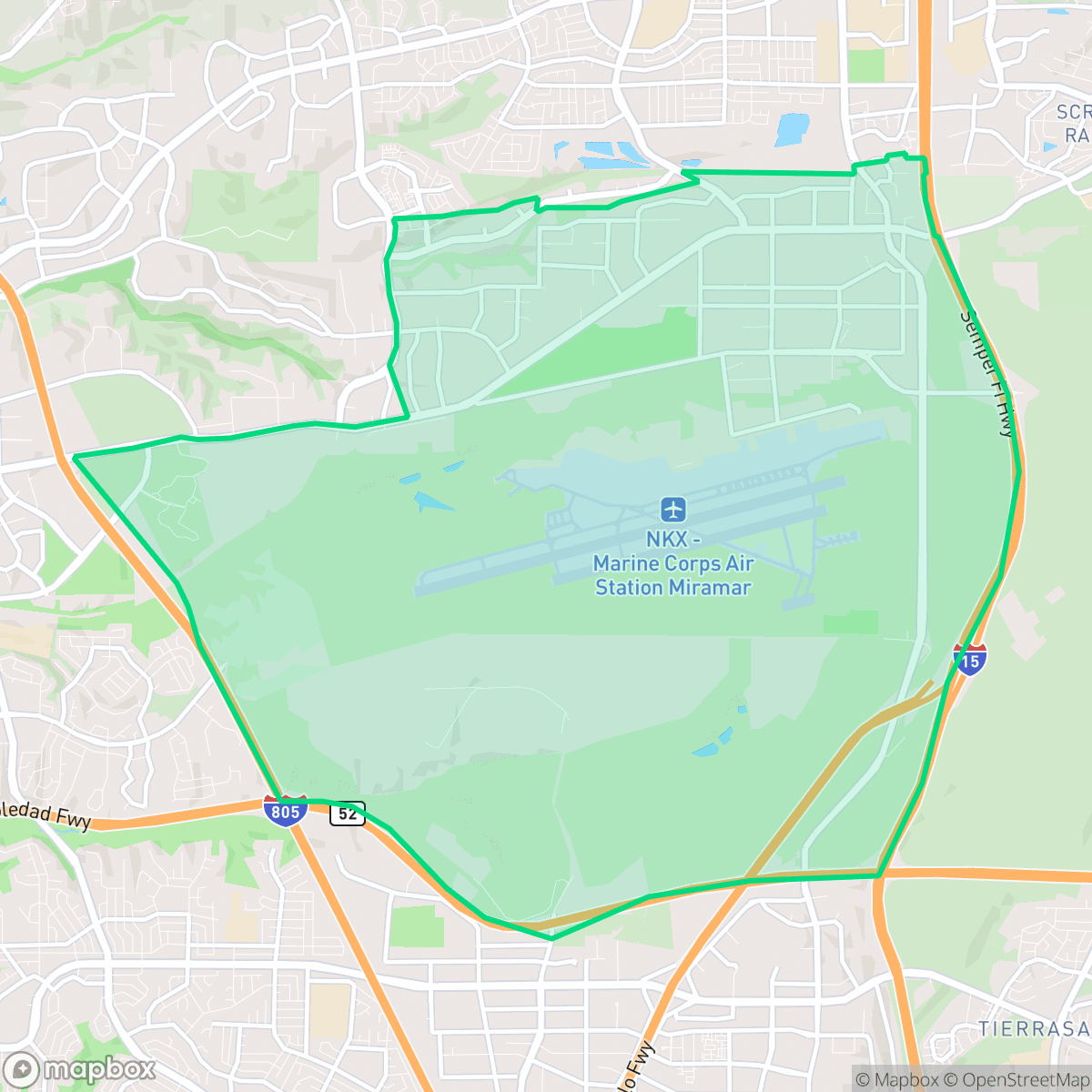
The San Diego neighborhood of Miramar, meaning “view of the sea,” traces its origins to the 1890s when newspaper magnate Edward W. Scripps named his ranch after Archduke Maximilian’s Miramare Castle in Italy. Originally a quiet, rural community centered around a railroad station, Miramar underwent a massive transformation in 1950 with the establishment of the military airfield. As Naval Air Station Miramar, it became internationally famous as the original home of the elite TOPGUN flight school. Today, the neighborhood is a bustling commercial and light industrial hub. It is highly regarded for its thriving craft beverage scene, featuring major names like AleSmith Brewing Company and Cutwater Spirits, as well as a vibrant "Little India" cultural and commercial enclave along Black Mountain Road.
The area functions primarily as a hub for light industry, military operations, and large-scale logistics, characterized by vast warehouses, specialized commercial facilities, and significant asphalt coverage. Despite the industrial dominance, the landscape is punctuated by rugged canyon topography and open scrubland that provides a stark contrast to the dense building footprints. According to iHuus data, the neighborhood maintains a quiet, suburban atmosphere, though the prevalence of freight corridors and heavy vehicle traffic makes the environment highly car-dependent.
Prospective residents should consider the trade-offs of living in an industrial-heavy zone, where acoustic comfort is limited by constant road noise and the proximity of active air operations. While the area is not designed for walkability, it offers unique cultural amenities, including a notable concentration of craft breweries and a vibrant Little India district. Given the low fire safety scores and the mixed performance of the local school district, the neighborhood is often better suited for professionals working in the immediate industrial sector rather than families seeking traditional residential amenities.
Neighborhood Scores Across 15 Qualities
Residential spacing varies between tightly packed multi-family clusters and larger industrial buffers. According to iHuus data, privacy levels are roughly in line with the San Diego average.
Sidewalks and pedestrian paths are available throughout residential and campus areas, but the presence of a major freeway creates a notable barrier to movement. Overall, walking accessibility is lower than the San Diego average.
Landscapes consist primarily of industrial warehouses, corporate offices, and dense apartment complexes with shared amenities. This visual environment is less lush than the San Diego average, characterized by standard multi-family housing and functional commercial architecture.
Large public parks and shared green strips within apartment complexes offer decent walking space, though some areas are constrained by major roads and industrial asphalt. According to iHuus data, the availability of connected green spaces is slightly below the city average.
Expansive open canyons and scrubland are interspersed with dense industrial parks and military installations. This landscape provides a slightly more open, semi-rural character than the typical San Diego urban environment.
Low business density and a heavy industrial presence make the area feel primarily functional rather than social. Most dining and services are scattered across a landscape of warehouses and highways, necessitating a vehicle for most errands.
Constant aircraft noise from the nearby airport runway and heavy transit infrastructure makes this area significantly louder than the San Diego average. According to iHuus data, residents will experience frequent and intense acoustic disturbances.
Air quality fluctuates between acceptable and unhealthy levels, presenting occasional concerns for sensitive groups. According to iHuus data, these conditions are slightly lower than the San Diego city average.
Industrial activity and logistics hubs are notably more prevalent here than in the rest of San Diego. Residents may encounter frequent heavy vehicle traffic and noise from nearby military airfield operations and large-scale warehouses.
Health insurance accessibility is higher than the San Diego average, according to iHuus data. Most residents in this area have access to medical coverage.
Political leanings in this area are largely liberal, though the community shows a more moderate ideological profile than the San Diego average according to iHuus data.
A balanced mix of young adults, families, and older residents characterizes the area, though the population leans slightly more toward a specific age demographic than the San Diego average. According to iHuus data, this distribution provides a varied community profile.
Properties within this area are situated inside a designated floodplain, which means residents may face a higher risk of flooding and likely need flood insurance. According to iHuus data, this risk is notably higher than the average for San Diego.
Fire hazards in this area are significantly higher than the San Diego average, requiring extreme caution and robust protection measures. Data from iHuus indicates that this neighborhood faces a severe level of wildfire vulnerability.
Address-Level Insights for Miramar


iHuus Neighborhood Intelligence Insights
Get address-level neighborhood insights for Miramar
- Street-level scores — see how individual blocks compare, not just neighborhood averages
- Micro-zone boundaries — identify quiet pockets, flood boundaries, and walkable clusters before you visit
- 15 dimensions in full — walkability, noise, air quality, school quality, insurance coverage, population age profile, urban/rural index, and more
- Boundary risk alerts — know if your address sits near a block boundary where scores drop, the kind of detail no listing will ever mention
- School insights — individual school ratings and insights, not just district-level data
- Compare before you commit — side-by-side data across neighborhoods, down to block precision
No credit card required
Compare with Any Neighborhood
| Dimension | Miramar | Adams North |
|---|---|---|
| 🚶 Walkabilityavg 8.58 | ||
| 🔊 Acoustic Comfortavg 3.33 | ||
| 🤫 Privacy Indexavg 4.87 | ||
| 🎨 Visual Appealavg 6.85 | ||
| 🐕 Dog Friendlinessavg 6.91 | ||
| 🗺️ Urban-Rural Indexavg 6.6 | ||
| ✨ Neighborhood Vibeavg 5.12 | ||
| 🏥 Health Insurance Coverageavg 7.53 | ||
| 🌿 Air Qualityavg 6.36 | ||
| 🏭 Industrial Proximityavg 9.12 | ||
| 🌊 Flood Safetyavg 4.2 | ||
| 🗳️ Ideological Leanavg 8.51 | ||
| 👥 Population Age Profileavg 4.8 | ||
| 🔥 Fire Safetyavg 0.61 | ||
| 🏫 School Quality |
Miramar Rankings
School Districts Serving Miramar
School Insights for Miramar
Below average outcomes; significant attendance and academic challenges.
School Insights
See what's really behind every school rating near Miramar
- Individual school ratings — each school's own score with outcome context, not just a district average
- Enrollment & class size data — student-to-teacher ratio and how it compares to the state average
- Full demographics breakdown — ethnicity and gender composition for every school in the enrollment zone
- Every school in the district — all schools within the enrollment boundary ranked by rating, not just the closest one
- Grade levels & benchmarks — elementary through high school, with below/above state-average flags
No credit card required