Miramar Ranch North, San Diego
Updated · 14,857 residents
Miramar Ranch North is a master-planned community in San Diego defined by its scenic eucalyptus groves and proximity to natural canyon trails. Residents enjoy a quiet, suburban environment with high air quality and excellent access to local schools, though the area remains largely car-dependent for daily errands.
Key Highlights
About Miramar Ranch North
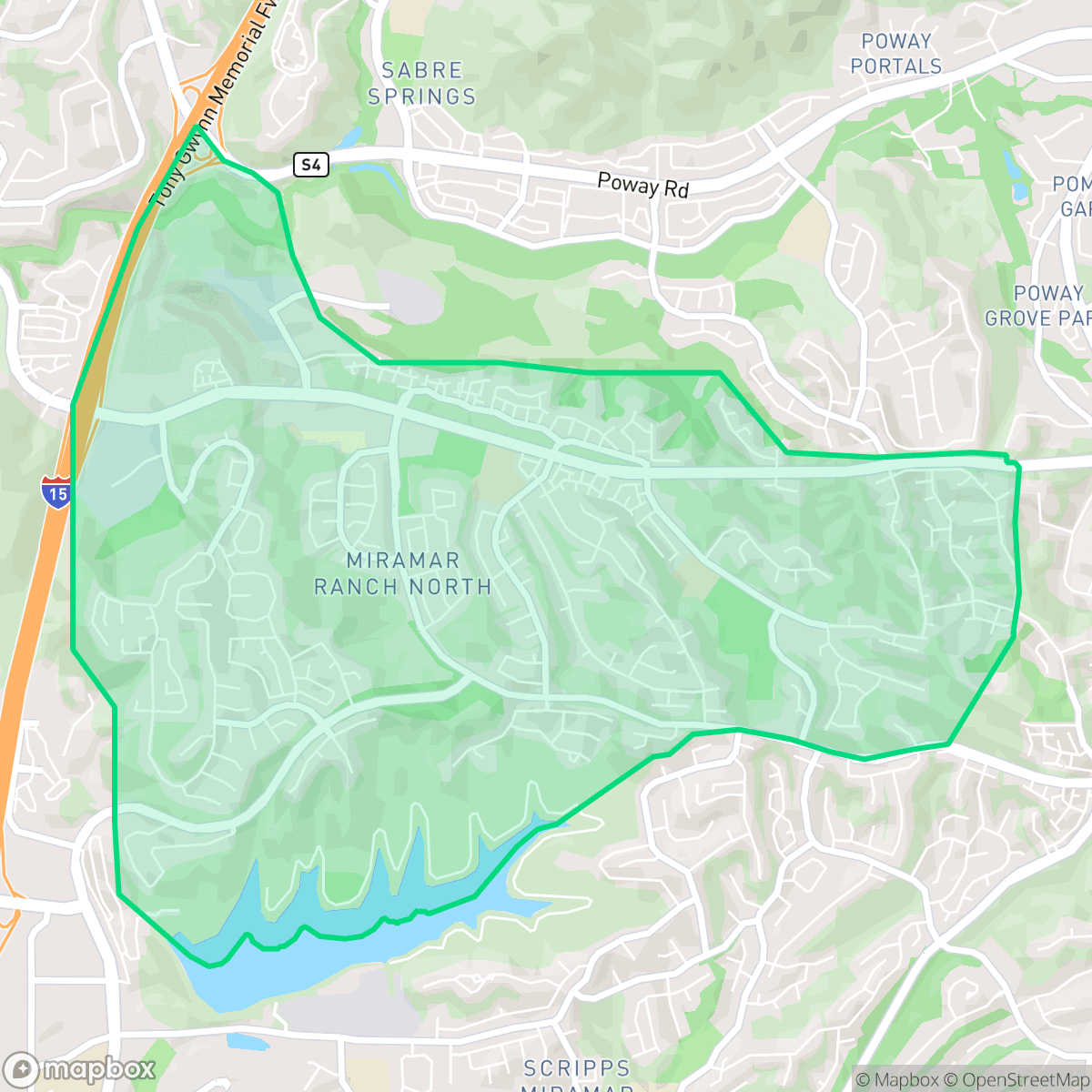
Miramar Ranch North in San Diego originated as part of the expansive Miramar Ranch, established in the 1890s by newspaper magnate E.W. Scripps and his half-sister Ellen Browning Scripps. A defining ecological legacy of this era is the neighborhood's dense eucalyptus groves, initially planted by Scripps' gardener for railroad ties. The area transitioned from historic ranch land into a modern master-planned community following the adoption of the Miramar Ranch North Community Plan in March 1980. Developed largely during the 1990s, the neighborhood features tranquil, tree-lined streets, spacious single-family homes, and key local landmarks like Spring Canyon Park and Ellen Browning Scripps Elementary School. Today, it remains one of two communities comprising Scripps Ranch, proudly upholding the civic identity and historic motto, 'Scripps Ranch - Country Living'.
The neighborhood is characterized by its orderly, suburban layout, featuring spacious single-family homes and well-maintained green spaces. It benefits from a strong sense of community and is served by the high-performing Poway Unified School District, which includes top-rated institutions like Dingeman Elementary. The area offers significant visual appeal with its uniform architecture and mature tree-lined streets, while the surrounding canyons provide extensive opportunities for outdoor recreation and dog walking.
While the area provides a serene residential experience, it is not a high-density commercial hub. Daily life is centered on private residential living rather than walkable retail, necessitating a vehicle for most shopping and dining needs. According to iHuus data, the community maintains a quiet atmosphere, though residents should be mindful of traffic noise from nearby major thoroughfares. It is an ideal setting for families and professionals seeking a stable, nature-integrated environment away from the urban core.
Neighborhood Scores Across 15 Qualities
Housing density is higher than the San Diego average, featuring a mix of closely spaced detached homes and multi-family units. While some canyon slopes provide natural buffers, certain areas with shared walls and apartment blocks offer limited personal distance between neighbors.
Pedestrian access is well-supported by continuous sidewalks and safe crossings to local commercial areas, though the nearby freeway serves as a significant barrier to movement. This level of walkability is slightly below the San Diego average according to iHuus data.
Large homes, manicured landscaping, and private backyard pools characterize this area. According to iHuus data, the visual quality of the neighborhood is notably higher than the San Diego average.
Abundant canyon trails and connected green belts provide ample space for exercise. According to iHuus data, these natural buffers and wide street verges offer significantly more walking opportunities than the San Diego average.
Open natural spaces and pockets of woodland provide a more semi-rural atmosphere than the typical San Diego urban landscape. According to iHuus data, the area features frequent open land and scattered residential clusters integrated with natural topography.
Suburban streets and green spaces provide a steady residential rhythm that is consistent with the city average. While some pockets offer diverse dining and local services, much of the area remains car-dependent with limited commercial density.
Frequent noise from nearby freeways and railroad tracks defines the acoustic environment. According to iHuus data, levels of disturbance in this area are slightly higher than the San Diego average.
Air quality in this area is consistently high with rare instances of elevated readings. According to iHuus data, the air is notably cleaner than the San Diego average.
Industrial activity and heavy warehouses are absent from this area, providing a cleaner environment than the San Diego average. According to iHuus data, the neighborhood is comprised exclusively of residential zones, retail spaces, and natural preserves.
Health insurance access is more prevalent here than the San Diego average, according to iHuus data. Residents in this area benefit from higher rates of coverage compared to the rest of the city.
Political leanings here are largely liberal, though the area is slightly less progressive than the San Diego average according to iHuus data.
Residents live alongside a balanced distribution of young adults, families, and seniors. This demographic spread aligns closely with the broader San Diego area.
Flood risk in this area is difficult to determine because FEMA has not completed a detailed study for the neighborhood. According to iHuus data, the level of risk is roughly in line with the San Diego average.
Significant fire hazards exist in this area, representing a higher risk level than the San Diego average according to iHuus data.
Address-Level Insights for Miramar Ranch North


iHuus Neighborhood Intelligence Insights
Get address-level neighborhood insights for Miramar Ranch North
- Street-level scores — see how individual blocks compare, not just neighborhood averages
- Micro-zone boundaries — identify quiet pockets, flood boundaries, and walkable clusters before you visit
- 15 dimensions in full — walkability, noise, air quality, school quality, insurance coverage, population age profile, urban/rural index, and more
- Boundary risk alerts — know if your address sits near a block boundary where scores drop, the kind of detail no listing will ever mention
- School insights — individual school ratings and insights, not just district-level data
- Compare before you commit — side-by-side data across neighborhoods, down to block precision
No credit card required
Compare with Any Neighborhood
| Dimension | Miramar Ranch North | Adams North |
|---|---|---|
| 🚶 Walkabilityavg 8.58 | ||
| 🔊 Acoustic Comfortavg 3.33 | ||
| 🤫 Privacy Indexavg 4.87 | ||
| 🎨 Visual Appealavg 6.85 | ||
| 🐕 Dog Friendlinessavg 6.91 | ||
| 🗺️ Urban-Rural Indexavg 6.6 | ||
| ✨ Neighborhood Vibeavg 5.12 | ||
| 🏥 Health Insurance Coverageavg 7.53 | ||
| 🌿 Air Qualityavg 6.36 | ||
| 🏭 Industrial Proximityavg 9.12 | ||
| 🌊 Flood Safetyavg 4.2 | ||
| 🗳️ Ideological Leanavg 8.51 | ||
| 👥 Population Age Profileavg 4.8 | ||
| 🔥 Fire Safetyavg 0.61 | ||
| 🏫 School Quality |
Miramar Ranch North Rankings
School Districts Serving Miramar Ranch North
School Insights for Miramar Ranch North
Below average outcomes; significant attendance and academic challenges.
School Insights
See what's really behind every school rating near Miramar Ranch North
- Individual school ratings — each school's own score with outcome context, not just a district average
- Enrollment & class size data — student-to-teacher ratio and how it compares to the state average
- Full demographics breakdown — ethnicity and gender composition for every school in the enrollment zone
- Every school in the district — all schools within the enrollment boundary ranked by rating, not just the closest one
- Grade levels & benchmarks — elementary through high school, with below/above state-average flags
No credit card required