Mira Mesa, San Diego
Updated · 70,416 residents
Mira Mesa is a dense, highly walkable suburban neighborhood in San Diego known for its diverse culinary scene and strong military heritage. Residents benefit from a robust network of sidewalks and proximity to community parks, though the area features closely spaced homes and moderate traffic noise.
Key Highlights
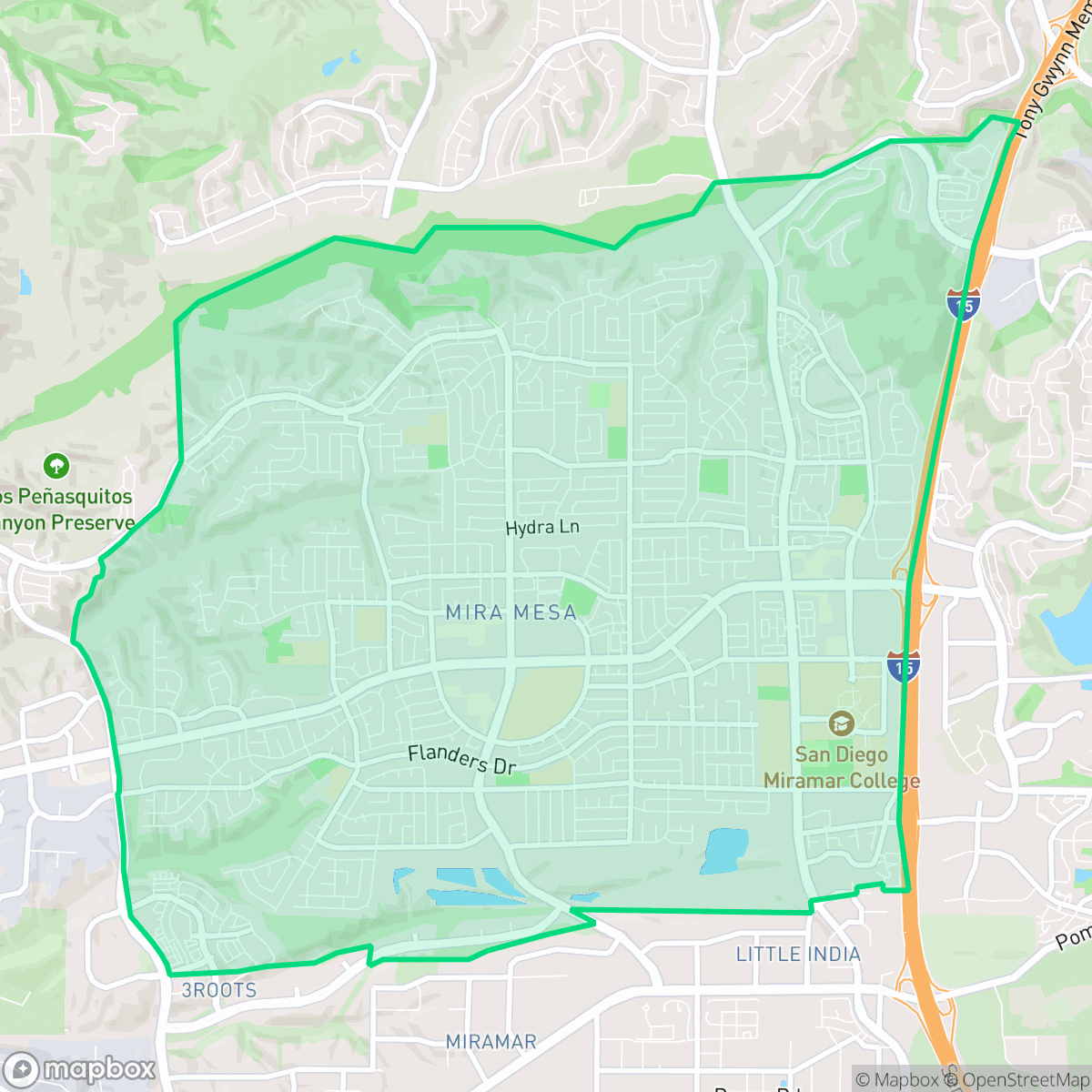
About Mira Mesa
Originally part of the Rancho Santa María de Los Peñasquitos land grant, the land that became Mira Mesa was used during World War II as a U.S. Army test area and a Navy bombing range. A key military landmark was Hourglass Field, an auxiliary landing field named for its distinct runway shape, which was later redeveloped into San Diego Miramar College. In 1969, developers initiated a rapid residential housing boom to accommodate military personnel from nearby NAS Miramar. The development was so fast and unplanned—initially lacking schools and basic shopping—that in 1971, Pete Wilson successfully ran for mayor of San Diego using the campaign slogan "No more Mira Mesas!" Today, the neighborhood is known for its strong military ties and a vibrant, diverse Asian-American community.
The neighborhood functions as a central hub within San Diego, characterized by a dense suburban layout that balances residential tract housing with active commercial corridors. It is particularly noted for a vibrant and diverse culinary landscape, featuring numerous highly-rated dining spots that draw visitors from across the region. With a high walkability score, the area provides residents with consistent access to neighborhood parks, sports fields, and canyon trails, which offer significant green space despite the high density of the built environment. According to iHuus data, the area maintains a steady rhythm of local services and social hubs, making it a functional and accessible location for daily life.
Prospective residents should consider the trade-offs inherent in this high-density setting, including limited residential privacy due to closely spaced homes and moderate noise levels from regional road traffic. The neighborhood is served by a mix of school districts, with some areas falling under the high-performing Poway Unified School District and others within the San Diego City Unified School District. It is best suited for families and professionals who prioritize convenience, access to amenities, and a community-oriented environment over the seclusion of lower-density suburbs.
Neighborhood Scores Across 15 Qualities
Residential spacing varies from closely packed multi-family units to standard suburban layouts. According to iHuus data, the level of separation between neighbors is roughly in line with the San Diego average.
Extensive sidewalk networks and well-defined crosswalks provide safe routes through residential streets and major corridors. This level of connectivity is slightly above the San Diego average, though the nearby freeway can act as a significant barrier for pedestrians.
Vibrant pockets of affluent estates with private pools and manicured yards sit alongside standard mid-density apartment complexes. This mix of large, modern homes and traditional tract housing provides a visual character that is slightly above the San Diego average.
Access to expansive canyon trails and large public parks provides ample space for pets. According to iHuus data, the abundance of wide sidewalks and green buffers makes this area more dog friendly than the San Diego average.
Dense suburban development characterizes the area, featuring a mix of single-family homes and apartment complexes integrated with nearby natural canyons and undeveloped hilly terrain. This landscape is largely consistent with the broader San Diego area.
Diverse dining and social hubs provide a higher level of activity than the city average. While some blocks feature concentrated clusters of restaurants and shops, other areas remain quiet and car-dependent due to a lower density of walkable businesses.
Continuous traffic sounds from nearby busy thoroughfares are present. This level of acoustic activity is slightly higher than the San Diego average, according to iHuus data.
Air quality remains mostly clean with infrequent periods of elevated readings, performing better than the San Diego average according to iHuus data.
Industrial activity is minimal, as the area consists primarily of residential, educational, and light commercial zones. According to iHuus data, this level of separation from heavy industrial hazards is consistent with the city average.
Health insurance coverage among residents is notably higher than the San Diego average, according to iHuus data. This indicates a strong level of access to medical coverage within the community.
Political leanings in this area are predominantly liberal, though the community displays slightly less progressive density than the San Diego average according to iHuus data.
A balanced mix of young adults, families, and older residents characterizes this area, mirroring the overall demographic spread found across San Diego.
Significant flood risk exists here due to being located within a 100-year floodplain. According to iHuus data, this level of risk is notably higher than the San Diego average and often necessitates flood insurance.
Extreme fire hazards exist within this area, representing a significantly higher risk than the San Diego average. Residents should prioritize maximum protection measures and remain vigilant regarding local fire safety protocols according to iHuus data.
Address-Level Insights for Mira Mesa


iHuus Neighborhood Intelligence Insights
Get address-level neighborhood insights for Mira Mesa
- Street-level scores — see how individual blocks compare, not just neighborhood averages
- Micro-zone boundaries — identify quiet pockets, flood boundaries, and walkable clusters before you visit
- 15 dimensions in full — walkability, noise, air quality, school quality, insurance coverage, population age profile, urban/rural index, and more
- Boundary risk alerts — know if your address sits near a block boundary where scores drop, the kind of detail no listing will ever mention
- School insights — individual school ratings and insights, not just district-level data
- Compare before you commit — side-by-side data across neighborhoods, down to block precision
No credit card required
Compare with Any Neighborhood
| Dimension | Mira Mesa | Adams North |
|---|---|---|
| 🚶 Walkabilityavg 8.58 | ||
| 🔊 Acoustic Comfortavg 3.33 | ||
| 🤫 Privacy Indexavg 4.87 | ||
| 🎨 Visual Appealavg 6.85 | ||
| 🐕 Dog Friendlinessavg 6.91 | ||
| 🗺️ Urban-Rural Indexavg 6.6 | ||
| ✨ Neighborhood Vibeavg 5.12 | ||
| 🏥 Health Insurance Coverageavg 7.53 | ||
| 🌿 Air Qualityavg 6.36 | ||
| 🏭 Industrial Proximityavg 9.12 | ||
| 🌊 Flood Safetyavg 4.2 | ||
| 🗳️ Ideological Leanavg 8.51 | ||
| 👥 Population Age Profileavg 4.8 | ||
| 🔥 Fire Safetyavg 0.61 | ||
| 🏫 School Quality |
Mira Mesa Rankings
School Districts Serving Mira Mesa
School Insights for Mira Mesa
Below average outcomes; significant attendance and academic challenges.
School Insights
See what's really behind every school rating near Mira Mesa
- Individual school ratings — each school's own score with outcome context, not just a district average
- Enrollment & class size data — student-to-teacher ratio and how it compares to the state average
- Full demographics breakdown — ethnicity and gender composition for every school in the enrollment zone
- Every school in the district — all schools within the enrollment boundary ranked by rating, not just the closest one
- Grade levels & benchmarks — elementary through high school, with below/above state-average flags
No credit card required