Midway District, San Diego
Updated · 12,066 residents
The Midway District is a dense, industrial-leaning neighborhood defined by its proximity to major transit corridors and the San Diego International Airport. While it offers a central location for commuters and access to diverse dining, the area is notably loud due to heavy aviation and road traffic.
Key Highlights
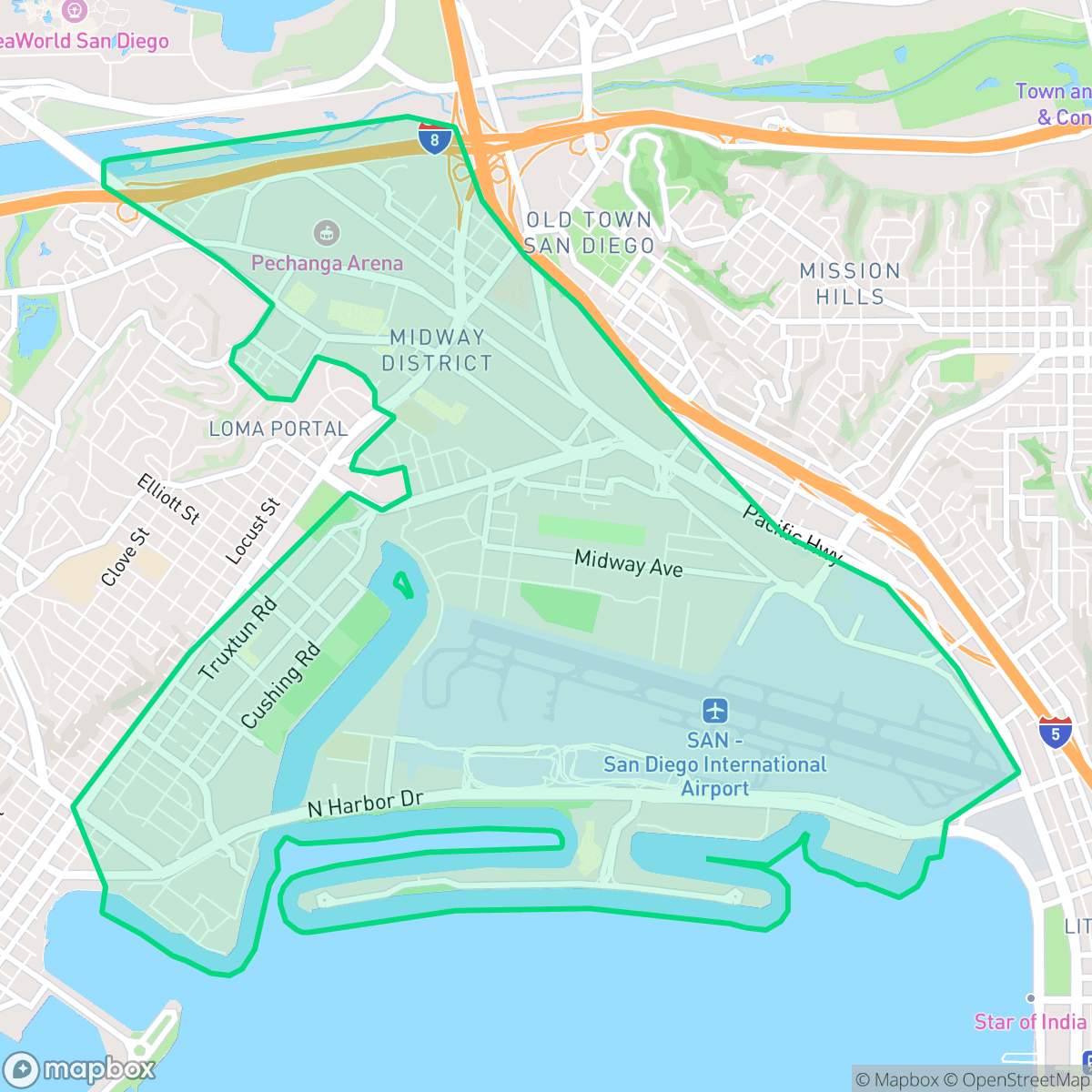
About Midway District
Once a tidal marshland known as "Dutch Flats" within the San Diego River delta, the Midway District was opened for development after an 1877 levee confined the river. The neighborhood’s modern identity was forged by the military; the 1921 establishment of the Marine Corps Recruit Depot (MCRD) and nearby Naval Training Center catalyzed rapid growth. During World War II, Midway became a defense industry hub, hosting the massive, federally built Frontier Housing complex for thousands of wartime workers. In the 1960s, the city demolished this complex to construct the San Diego Sports Arena (now Pechanga Arena), shifting the area toward commercial and entertainment uses. Today, the district’s rich history is anchored by landmarks like the historic Spanish Revival-style MCRD and the 1912 brick Mission Brewery building.
The neighborhood functions as a vital commercial and industrial hub, characterized by massive logistics centers, warehouses, and extensive asphalt infrastructure. Its identity is deeply tied to its transit-oriented landscape, featuring a mix of mid-rise buildings and large-scale commercial facilities. Residents benefit from a central position within San Diego, providing convenient access to nearby coastal amenities and a variety of local dining options ranging from casual eateries to specialized international cuisine. According to iHuus data, the area maintains a steady rhythm of services that cater to both daytime workers and local residents. Prospective residents should be aware that the area is heavily influenced by its proximity to airport flight paths, resulting in significant noise levels that impact the overall acoustic environment. The district is largely car-dependent, with walkability limited by high-traffic arterial roads and industrial zones. It is best suited for those who prioritize central connectivity and proximity to commercial services over a quiet, suburban residential atmosphere.
Neighborhood Scores Across 15 Qualities
Residential spacing varies between single-family homes and multi-unit complexes, resulting in a privacy level slightly below the San Diego average. Some areas feature close proximity between structures with minimal setbacks, while other sections offer more buffer between neighbors.
Sidewalk connectivity is inconsistent across the district, as some residential streets feature well-maintained paths while major freeway borders and airfield zones lack pedestrian access. While many corridors are navigable, the overall ease of walking is below the San Diego average.
The landscape ranges from high-density apartment complexes and transit infrastructure to affluent pockets featuring manicured yards and private pools. Overall visual variety in the area is slightly below the San Diego average.
Access to public parks and grassy verges is below the San Diego average. While some areas feature sports field access, much of the neighborhood consists of dense urban fabric and concrete environments that offer minimal greenery for walking dogs.
A blend of residential blocks and large-scale industrial infrastructure defines the area, resulting in a landscape that is slightly less developed than the San Diego average. Extensive paved surfaces and airport-related facilities coexist with suburban housing and local commercial corridors.
A diverse mix of dining and social hubs provides a level of activity slightly higher than the San Diego average. While some pockets feature lively restaurant clusters and green spaces, much of the area maintains a quieter, car-dependent industrial and suburban character.
Frequent aircraft noise from the nearby airport runway defines the auditory environment. This level of acoustic disturbance is significantly higher than the San Diego average, according to iHuus data.
Air quality in this area fluctuates between acceptable and unhealthy levels, which may pose occasional concerns for sensitive groups. According to iHuus data, the air quality here is slightly lower than the San Diego city average.
Significant noise and traffic from adjacent airport runways and large-scale logistics warehouses are present, making the industrial presence notably higher than the San Diego average. According to iHuus data, residents may experience frequent heavy vehicle movement and jet engine noise due to the nearby flight paths and distribution hubs.
Health insurance enrollment among Midway District residents is lower than the San Diego average. Data from iHuus indicates a notable gap in coverage compared to the broader city area.
Political leanings in this area align closely with the broader San Diego landscape, characterized by a liberal majority and a small conservative presence.
Residents live alongside a balanced spread of young adults, families, and older individuals. This demographic distribution is very similar to the typical age profile seen across San Diego.
Flood risk in this area is slightly higher than the San Diego average, though official FEMA studies for the Midway District remain incomplete. Residents should note that precise flood hazard levels for certain properties are currently undetermined according to iHuus data.
Address-Level Insights for Midway District


iHuus Neighborhood Intelligence Insights
Get address-level neighborhood insights for Midway District
- Street-level scores — see how individual blocks compare, not just neighborhood averages
- Micro-zone boundaries — identify quiet pockets, flood boundaries, and walkable clusters before you visit
- 15 dimensions in full — walkability, noise, air quality, school quality, insurance coverage, population age profile, urban/rural index, and more
- Boundary risk alerts — know if your address sits near a block boundary where scores drop, the kind of detail no listing will ever mention
- School insights — individual school ratings and insights, not just district-level data
- Compare before you commit — side-by-side data across neighborhoods, down to block precision
No credit card required
Compare with Any Neighborhood
| Dimension | Midway District | Adams North |
|---|---|---|
| 🚶 Walkabilityavg 8.58 | ||
| 🔊 Acoustic Comfortavg 3.33 | ||
| 🤫 Privacy Indexavg 4.87 | ||
| 🎨 Visual Appealavg 6.85 | ||
| 🐕 Dog Friendlinessavg 6.91 | ||
| 🗺️ Urban-Rural Indexavg 6.6 | ||
| ✨ Neighborhood Vibeavg 5.12 | ||
| 🏥 Health Insurance Coverageavg 7.53 | ||
| 🌿 Air Qualityavg 6.36 | ||
| 🏭 Industrial Proximityavg 9.12 | ||
| 🌊 Flood Safetyavg 4.2 | ||
| 🗳️ Ideological Leanavg 8.51 | ||
| 👥 Population Age Profileavg 4.8 | ||
| 🔥 Fire Safetyavg 0.61 | ||
| 🏫 School Quality |
Midway District Rankings
School Districts Serving Midway District
School Insights for Midway District
Below average outcomes; significant attendance and academic challenges.
School Insights
See what's really behind every school rating near Midway District
- Individual school ratings — each school's own score with outcome context, not just a district average
- Enrollment & class size data — student-to-teacher ratio and how it compares to the state average
- Full demographics breakdown — ethnicity and gender composition for every school in the enrollment zone
- Every school in the district — all schools within the enrollment boundary ranked by rating, not just the closest one
- Grade levels & benchmarks — elementary through high school, with below/above state-average flags
No credit card required