Midtown, San Diego
Updated · 4,337 residents
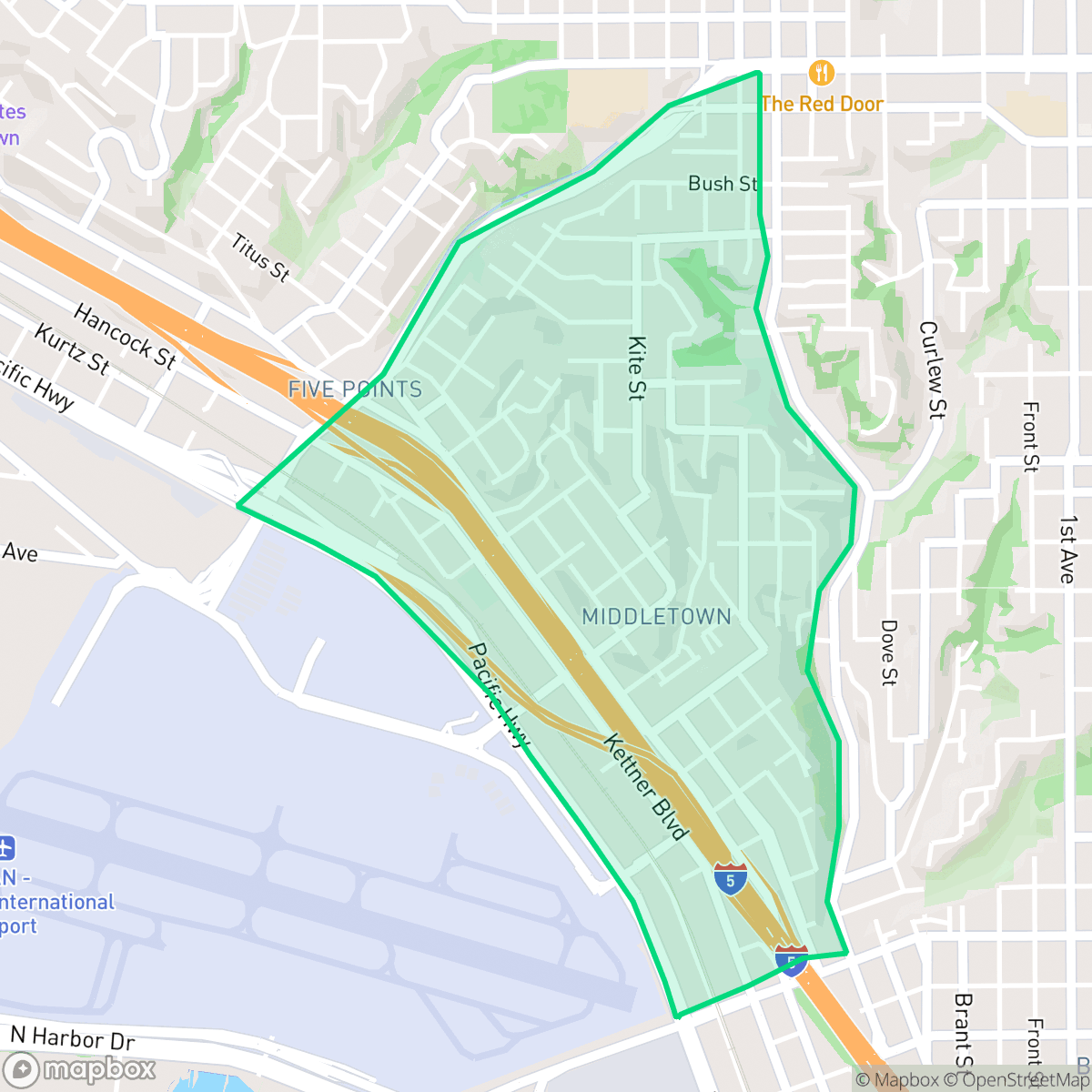
Midtown is a historic hillside community known for its distinct layered streetscape and proximity to the San Diego bay. While it offers an upscale, manicured aesthetic with well-maintained landscapes, residents should anticipate high noise levels from nearby transit corridors and potential flood risks.
Key Highlights
About Midtown
Middletown, often referred to as Midtown, is one of San Diego's oldest subdivisions, established in 1850 by Andrew Grey and William Heath Davis to connect 'New Town' (downtown) with 'Old Town.' Situated on hillside ridges overlooking the bay, the neighborhood’s topography created a distinct layered streetscape that differentiates it from the city's flatter grids. By the late 1800s, the area featured notable Georgian and Mediterranean-style homes on its western slopes. Historically, the area near India Street served as a heart of the local Italian community, characterized by family-owned businesses and specialty markets. Today, the neighborhood remains defined by its unique elevation, proximity to the bay, and a blend of historic architecture alongside modern infill development, maintaining a character shaped by its long-standing role as a central, transit-accessible hillside community.
The neighborhood features a mix of historic architecture and modern infill, creating a visually appealing environment with a strong sense of place. Residents benefit from high levels of health insurance coverage and a diverse age demographic that includes families, young professionals, and seniors. The area maintains a balance between suburban-style residential blocks and active dining pockets, offering a varied energy that fluctuates throughout the day.
Prospective residents should consider specific trade-offs, including elevated fire hazards and notable noise disruptions from nearby freeways and rail lines. While the area is moderately walkable, the presence of major transit infrastructure requires careful navigation. The community is well-suited for those who prioritize a central location and an affluent, established atmosphere, provided they are prepared for the environmental and acoustic realities of living near major urban corridors.
Neighborhood Scores Across 15 Qualities
Residential spacing is varied, ranging from shared walls in dense apartment blocks to larger detached homes buffered by canyons. This level of privacy is slightly higher than the San Diego average according to iHuus data.
Sidewalks and clearly marked crosswalks are common throughout many residential blocks, though the neighborhood is slightly less walkable than the San Diego average due to major freeway interruptions. Pedestrian-friendly street trees and a consistent grid layout make navigating local streets easy in several areas.
Well-maintained landscapes, private pools, and large residential footprints characterize the area, making the visual appeal higher than the San Diego average. While some sections feature standard urban density, many parts of the neighborhood reflect an affluent residential character according to iHuus data.
Walking paths and sidewalk verges are relatively narrow in the denser urban sections of Midtown, making the area slightly less dog friendly than the San Diego average. Access to pet-friendly space depends largely on proximity to the large central canyon park and its various natural trails.
Residential blocks and green spaces exist in roughly equal measure, though the area feels slightly more suburban than the San Diego average. According to iHuus data, the landscape features a blend of single-family homes, low-rise apartments, and significant industrial or transit infrastructure.
Social hubs and diverse eateries provide a more active atmosphere than the city average, though this energy fluctuates between quiet, green residential blocks and more industrial, car-oriented zones. According to iHuus data, the area offers a mix of lively dining pockets and calmer, suburban-style streets.
Frequent noise from nearby heavy transit corridors and rail lines makes this area less quiet than much of San Diego. Residents should expect significant acoustic disruption due to the proximity of major freeways and tracks, according to iHuus data.
Air quality levels in this area are generally acceptable, though occasional periods of concern for sensitive groups may occur. According to iHuus data, these conditions are slightly below the San Diego city average.
Residential and light commercial structures dominate the landscape with no significant heavy industry or warehouses visible. While the area lacks the large-scale industrial density found in some other parts of the city, presence of a gas station may introduce occasional utility odors and transit traffic.
Health insurance access is widespread among Midtown residents, appearing significantly higher than the San Diego average according to iHuus data.
Voting patterns and census indicators show a significantly more liberal political leaning than the San Diego average. According to iHuus data, residents in this area align with progressive social and political trends.
Residents live alongside a diverse age range of young professionals, families, and seniors. This demographic spread is more varied than the typical San Diego profile, according to iHuus data.
Flood risk in Midtown is notably higher than the San Diego average, as portions of the neighborhood fall within a designated floodplain. According to iHuus data, residents may find that flood insurance is typically required for properties in this area.
Fire safety conditions in Midtown are significantly below the city average, according to iHuus data. Residents should be aware of elevated fire hazards and limited safety protections in this area.
Address-Level Insights for Midtown


iHuus Neighborhood Intelligence Insights
Get address-level neighborhood insights for Midtown
- Street-level scores — see how individual blocks compare, not just neighborhood averages
- Micro-zone boundaries — identify quiet pockets, flood boundaries, and walkable clusters before you visit
- 15 dimensions in full — walkability, noise, air quality, school quality, insurance coverage, population age profile, urban/rural index, and more
- Boundary risk alerts — know if your address sits near a block boundary where scores drop, the kind of detail no listing will ever mention
- School insights — individual school ratings and insights, not just district-level data
- Compare before you commit — side-by-side data across neighborhoods, down to block precision
No credit card required
Compare with Any Neighborhood
| Dimension | Midtown | Adams North |
|---|---|---|
| 🚶 Walkabilityavg 8.58 | ||
| 🔊 Acoustic Comfortavg 3.33 | ||
| 🤫 Privacy Indexavg 4.87 | ||
| 🎨 Visual Appealavg 6.85 | ||
| 🐕 Dog Friendlinessavg 6.91 | ||
| 🗺️ Urban-Rural Indexavg 6.6 | ||
| ✨ Neighborhood Vibeavg 5.12 | ||
| 🏥 Health Insurance Coverageavg 7.53 | ||
| 🌿 Air Qualityavg 6.36 | ||
| 🏭 Industrial Proximityavg 9.12 | ||
| 🌊 Flood Safetyavg 4.2 | ||
| 🗳️ Ideological Leanavg 8.51 | ||
| 👥 Population Age Profileavg 4.8 | ||
| 🔥 Fire Safetyavg 0.61 | ||
| 🏫 School Quality |
Midtown Rankings
School Districts Serving Midtown
School Insights for Midtown
Below average outcomes; significant attendance and academic challenges.
School Insights
See what's really behind every school rating near Midtown
- Individual school ratings — each school's own score with outcome context, not just a district average
- Enrollment & class size data — student-to-teacher ratio and how it compares to the state average
- Full demographics breakdown — ethnicity and gender composition for every school in the enrollment zone
- Every school in the district — all schools within the enrollment boundary ranked by rating, not just the closest one
- Grade levels & benchmarks — elementary through high school, with below/above state-average flags
No credit card required