Loma Portal, San Diego
Updated · 5,205 residents
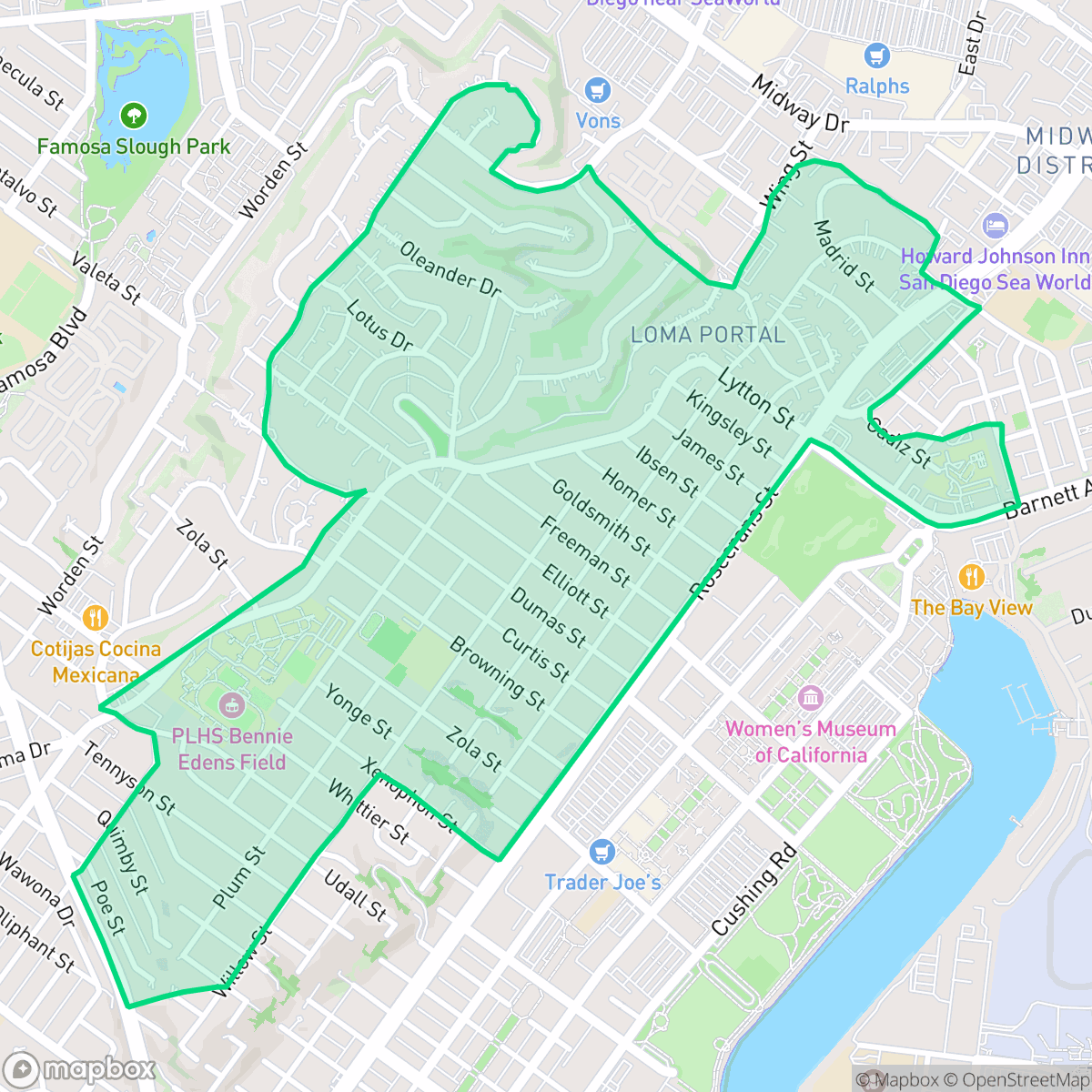
Loma Portal is a highly walkable residential enclave in San Diego, defined by its grid layout and proximity to Point Loma High School. While the area offers excellent pedestrian access and a strong sense of community, residents should be aware of significant noise levels from nearby aviation traffic.
Key Highlights
About Loma Portal
Loma Portal, a hilly neighborhood on San Diego's Point Loma peninsula, began developing in the early 20th century. The area is renowned for its diverse early-century architecture, featuring Spanish Colonial Revival, Prairie, and Tudor-style homes. A landmark of the neighborhood is the 1914 Loma Portal Elementary School, a Spanish Revival gem overlooking the bay. Loma Portal is uniquely defined by its "alphabetical author streets" (such as Addison, Browning, and Zola) and its historic, mid-intersection streetlights. It is also famously known for the "Point Loma Pause"—a temporary halt in conversation prompted by low-flying airplanes taking off from nearby San Diego International Airport.
The area functions as a quiet residential hub characterized by its grid-like street patterns and well-maintained sidewalks. According to iHuus data, the neighborhood achieves a perfect walkability score, providing residents with easy access to local parks and educational facilities. The visual landscape is defined by diverse architectural styles and large private lots, with a complete absence of industrial facilities or warehouses.
Prospective residents should weigh the benefits of this accessible environment against specific environmental trade-offs. The neighborhood experiences high levels of noise due to its proximity to the flight paths of San Diego International Airport. Additionally, while the area maintains high health insurance coverage and robust community engagement, it faces challenges regarding fire safety and requires careful consideration of local school district dynamics. It is best suited for those who prioritize pedestrian-friendly living and proximity to established community landmarks over absolute acoustic silence.
Neighborhood Scores Across 15 Qualities
Residential spacing is relatively balanced with a mix of detached homes and denser multi-family structures. According to iHuus data, this provides a level of seclusion that is slightly higher than the San Diego average.
Comprehensive sidewalk networks and well-marked crossings make navigating the neighborhood on foot easy. Pedestrian connectivity is even higher than the San Diego average, particularly around residential blocks and the central lagoon area.
Manicured landscapes, large homes, and frequent private pools contribute to a visual environment that is more polished than the San Diego average. According to iHuus data, the area features many well-maintained properties with spacious driveways and complex architectural details.
Extensive parklands and a large central nature preserve provide ample room for walking and recreation. According to iHuus data, the availability of connected green spaces and wide, safe paths is above the city average.
Residential pockets feature a blend of single-family homes and apartment complexes set against a backdrop of nearby open land. This landscape reflects a level of urban density that is very similar to the San Diego average.
Local dining and social spots provide a more vibrant atmosphere than the city average. Residents can access a variety of diverse eateries and leisure services concentrated within several lively suburban pockets.
Frequent acoustic disturbances from nearby freeway traffic and railroad corridors characterize this area. According to iHuus data, noise levels in Loma Portal are notably higher than the San Diego average.
Air quality levels in this area fluctuate between acceptable and unhealthy, posing occasional concerns for sensitive groups. This sits slightly below the San Diego city average according to iHuus data.
Industrial hazards, warehouses, and heavy machinery are absent from the area. According to iHuus data, this neighborhood maintains a higher level of separation from industrial zones than the San Diego average.
Health insurance accessibility is lower than the San Diego average. According to iHuus data, a minority of residents in this area have active coverage.
Political leanings in this area are predominantly liberal, slightly exceeding the San Diego city average according to iHuus data.
Residents live alongside a balanced spread of young adults, families, and older individuals. This demographic distribution is slightly lower than the San Diego average, according to iHuus data.
Flood risk levels in this area are higher than the San Diego average, though official FEMA studies for this specific zone remain incomplete. Residents should note that while the risk is higher than many parts of the city, the precise level of vulnerability is currently undetermined.
Address-Level Insights for Loma Portal


iHuus Neighborhood Intelligence Insights
Get address-level neighborhood insights for Loma Portal
- Street-level scores — see how individual blocks compare, not just neighborhood averages
- Micro-zone boundaries — identify quiet pockets, flood boundaries, and walkable clusters before you visit
- 15 dimensions in full — walkability, noise, air quality, school quality, insurance coverage, population age profile, urban/rural index, and more
- Boundary risk alerts — know if your address sits near a block boundary where scores drop, the kind of detail no listing will ever mention
- School insights — individual school ratings and insights, not just district-level data
- Compare before you commit — side-by-side data across neighborhoods, down to block precision
No credit card required
Compare with Any Neighborhood
| Dimension | Loma Portal | Adams North |
|---|---|---|
| 🚶 Walkabilityavg 8.58 | ||
| 🔊 Acoustic Comfortavg 3.33 | ||
| 🤫 Privacy Indexavg 4.87 | ||
| 🎨 Visual Appealavg 6.85 | ||
| 🐕 Dog Friendlinessavg 6.91 | ||
| 🗺️ Urban-Rural Indexavg 6.6 | ||
| ✨ Neighborhood Vibeavg 5.12 | ||
| 🏥 Health Insurance Coverageavg 7.53 | ||
| 🌿 Air Qualityavg 6.36 | ||
| 🏭 Industrial Proximityavg 9.12 | ||
| 🌊 Flood Safetyavg 4.2 | ||
| 🗳️ Ideological Leanavg 8.51 | ||
| 👥 Population Age Profileavg 4.8 | ||
| 🔥 Fire Safetyavg 0.61 | ||
| 🏫 School Quality |
Loma Portal Rankings
School Districts Serving Loma Portal
School Insights for Loma Portal
Below average outcomes; significant attendance and academic challenges.
School Insights
See what's really behind every school rating near Loma Portal
- Individual school ratings — each school's own score with outcome context, not just a district average
- Enrollment & class size data — student-to-teacher ratio and how it compares to the state average
- Full demographics breakdown — ethnicity and gender composition for every school in the enrollment zone
- Every school in the district — all schools within the enrollment boundary ranked by rating, not just the closest one
- Grade levels & benchmarks — elementary through high school, with below/above state-average flags
No credit card required