Linda Vista, San Diego
Updated · 24,202 residents
Linda Vista is a diverse, multicultural neighborhood defined by its mid-century military roots and proximity to the University of San Diego. It offers a dense suburban atmosphere with high walkability and excellent access to canyon trails for outdoor recreation. Residents experience a quiet, community-focused lifestyle, though the area is notably impacted by traffic noise from nearby freeways and elevated fire risks.
Key Highlights
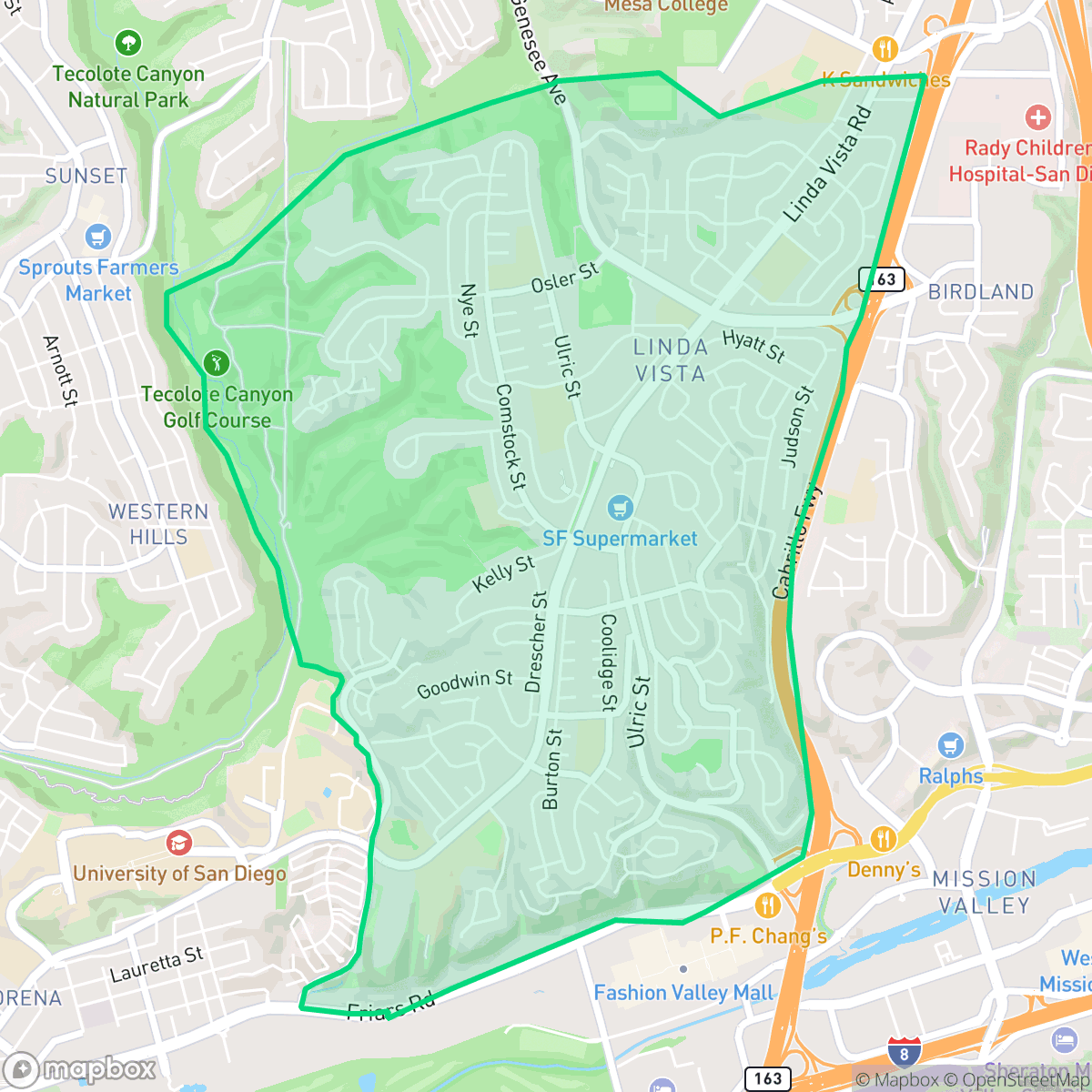
About Linda Vista
Linda Vista, meaning 'pretty view' in Spanish, was originally established in 1886 but was largely destroyed by a 1916 flood. The neighborhood was reborn in 1941 as a massive federal defense housing project, with over 3,000 homes constructed in roughly 200 days to support aircraft workers during World War II. This wartime development featured a garden city-inspired layout and included the Linda Vista Shopping Center, which opened in 1943 as one of the nation’s first shopping malls. Following the Vietnam War in the 1970s, the community saw a significant influx of Vietnamese immigrants, which solidified its reputation as a diverse, multicultural enclave. Today, Linda Vista is anchored by the University of San Diego and remains defined by its mid-century military heritage, canyon-adjacent topography, and vibrant, multi-ethnic character.
The neighborhood serves as a central hub for students and long-term residents, characterized by a dense suburban landscape that blends single-family homes with multi-family housing. Its layout promotes pedestrian connectivity, allowing residents to navigate between local services and green spaces with ease. The area is particularly well-suited for pet owners, as the abundance of canyon paths and athletic fields provides ample space for outdoor activity. According to data, the community benefits from high levels of health insurance coverage and a strong, progressive civic culture.
Prospective residents should be aware of certain trade-offs, including persistent noise from surrounding transit corridors and a heightened risk of fire that requires ongoing vigilance. While the local school district provides diverse educational opportunities, it faces systemic budget challenges that impact operational stability. Despite these factors, the area remains a stable choice for those seeking a centrally located, multi-generational environment with a distinct, multi-ethnic character.
Neighborhood Scores Across 15 Qualities
Property separation varies from shared walls in multi-family complexes to moderate buffers between single-family homes. This level of density is slightly higher than the San Diego average, according to iHuus data.
Sidewalk networks and safe crosswalks are consistent throughout residential and commercial zones, though the nearby freeway creates a notable barrier to the east. While highly navigable for strollers and pedestrians, the level of walkability is slightly below the San Diego average.
Visual variety ranges from large homes with private pools to more uniform apartment complexes and tract housing. This landscape of varying lot sizes and amenities is slightly below the San Diego average for visual appeal.
Abundant canyon trails, golf course greenbelts, and large athletic fields provide significant space for pets. This access to connected green spaces and wide paths makes the area slightly more dog friendly than the San Diego average, according to iHuus data.
A varied suburban landscape provides a blend of single-family homes, multi-family apartments, and institutional buildings. This level of development is largely consistent with the broader San Diego area.
Suburban streets and green spaces provide a serene setting with a moderate variety of local dining and services. Activity levels here are slightly below the San Diego average, as many areas remain low-density and primarily car-dependent.
Frequent noise from nearby freeways and transit corridors is a notable characteristic here. According to iHuus data, acoustic comfort levels are consistent with the city average.
Air quality in this area fluctuates between acceptable and unhealthy levels, which may present occasional concerns for sensitive groups. According to iHuus data, these conditions are slightly below the San Diego city average.
Industrial activity is virtually nonexistent in this area, which consists primarily of residential, educational, and light commercial spaces. According to iHuus data, the neighborhood is even more free of warehouses and heavy manufacturing sites than the San Diego average.
Health insurance accessibility is notably higher than the San Diego average, according to iHuus data. Most residents in this area have access to comprehensive medical coverage.
Voting patterns and census indicators show a notably progressive leaning, which is more pronounced than the average seen across San Diego.
Residents live alongside a diverse range of age groups, including students, families, and seniors. According to iHuus data, this demographic distribution is very similar to the broader San Diego area.
Flood risk in this area is difficult to assess because a detailed federal study has not yet been completed. According to iHuus data, the level of risk is slightly higher than the San Diego average.
Extreme fire hazards exist within this area, representing a risk level that is slightly higher than the San Diego city average. Residents should prioritize maximum protection measures and remain vigilant regarding local fire safety protocols.
Address-Level Insights for Linda Vista


iHuus Neighborhood Intelligence Insights
Get address-level neighborhood insights for Linda Vista
- Street-level scores — see how individual blocks compare, not just neighborhood averages
- Micro-zone boundaries — identify quiet pockets, flood boundaries, and walkable clusters before you visit
- 15 dimensions in full — walkability, noise, air quality, school quality, insurance coverage, population age profile, urban/rural index, and more
- Boundary risk alerts — know if your address sits near a block boundary where scores drop, the kind of detail no listing will ever mention
- School insights — individual school ratings and insights, not just district-level data
- Compare before you commit — side-by-side data across neighborhoods, down to block precision
No credit card required
Compare with Any Neighborhood
| Dimension | Linda Vista | Adams North |
|---|---|---|
| 🚶 Walkabilityavg 8.58 | ||
| 🔊 Acoustic Comfortavg 3.33 | ||
| 🤫 Privacy Indexavg 4.87 | ||
| 🎨 Visual Appealavg 6.85 | ||
| 🐕 Dog Friendlinessavg 6.91 | ||
| 🗺️ Urban-Rural Indexavg 6.6 | ||
| ✨ Neighborhood Vibeavg 5.12 | ||
| 🏥 Health Insurance Coverageavg 7.53 | ||
| 🌿 Air Qualityavg 6.36 | ||
| 🏭 Industrial Proximityavg 9.12 | ||
| 🌊 Flood Safetyavg 4.2 | ||
| 🗳️ Ideological Leanavg 8.51 | ||
| 👥 Population Age Profileavg 4.8 | ||
| 🔥 Fire Safetyavg 0.61 | ||
| 🏫 School Quality |
Linda Vista Rankings
School Districts Serving Linda Vista
School Insights for Linda Vista
Below average outcomes; significant attendance and academic challenges.
School Insights
See what's really behind every school rating near Linda Vista
- Individual school ratings — each school's own score with outcome context, not just a district average
- Enrollment & class size data — student-to-teacher ratio and how it compares to the state average
- Full demographics breakdown — ethnicity and gender composition for every school in the enrollment zone
- Every school in the district — all schools within the enrollment boundary ranked by rating, not just the closest one
- Grade levels & benchmarks — elementary through high school, with below/above state-average flags
No credit card required