Lincoln Park, San Diego
Updated · 8,636 residents
Lincoln Park is a dense, suburban neighborhood in Southeastern San Diego defined by its mid-century residential character and proximity to major educational institutions. Residents benefit from a comprehensive sidewalk network that supports local walking, though the area experiences frequent ambient noise from nearby highway traffic.
Key Highlights
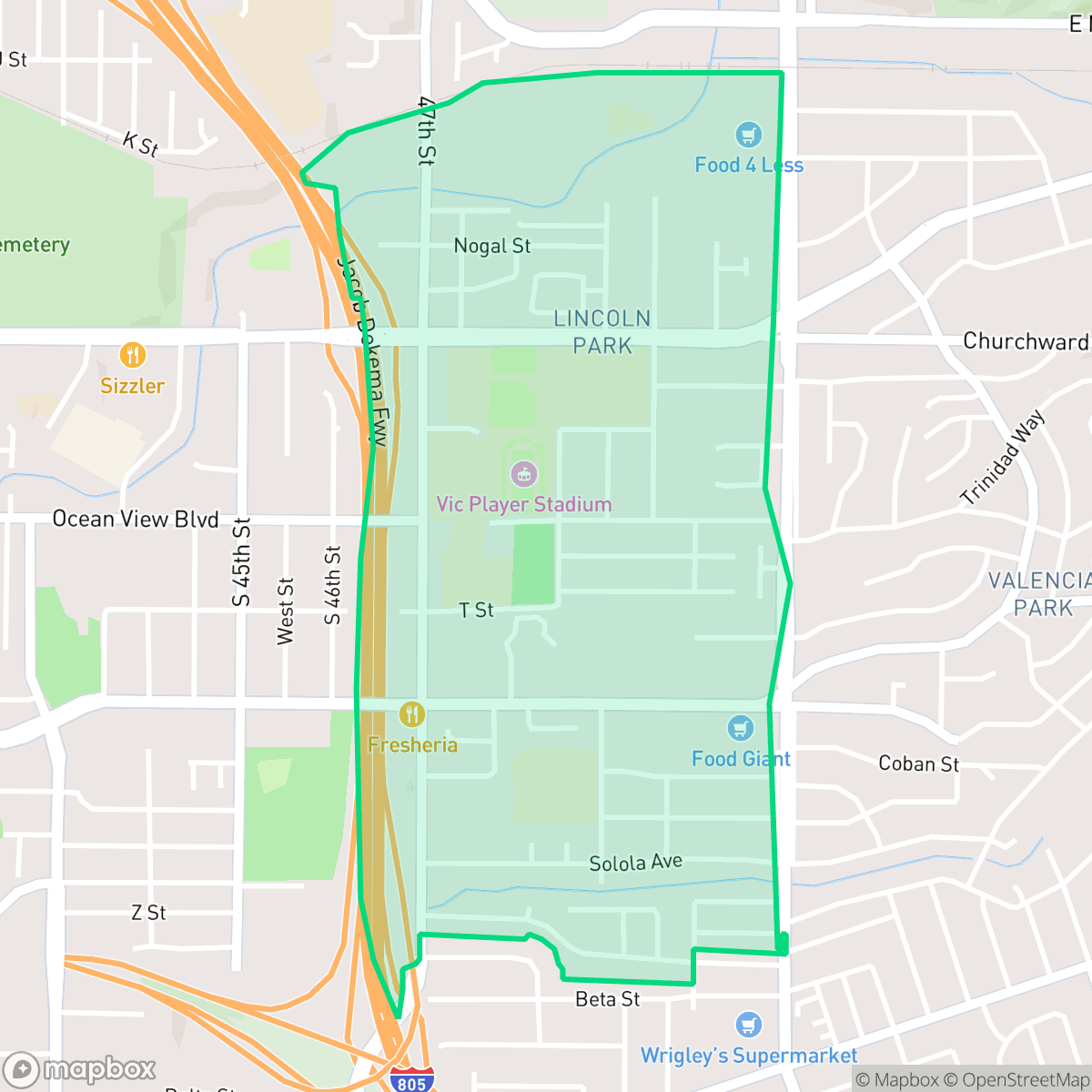
About Lincoln Park
Located in Southeastern San Diego, Lincoln Park is a culturally rich and resilient urban neighborhood named after President Abraham Lincoln. Originally developed with mid-century Ranch-style homes to accommodate post-World War II growth, its oldest residential section lies between Imperial Avenue and Ocean View Boulevard. The neighborhood is anchored by landmarks like Lincoln High School, Kennedy Park, and St. Rita Catholic Church. Historically shaped by redlining, Lincoln Park became a highly diverse community with strong African American, Hispanic, and Asian roots. A central local hub is "The Dip," a densely populated stretch of Logan Avenue. While the intersection of Euclid and Imperial avenues was historically dubbed the "Four Corners of Death" due to past gang violence, community-led arts initiatives and peace rallies have actively worked to reclaim and revitalize it as the "Four Corners of Life".
The neighborhood features a mix of single-family homes and multi-family units, creating a high-density environment where houses are often closely spaced. While the area lacks expansive private luxury amenities, it remains entirely residential and free from heavy industrial hazards. According to iHuus data, the community maintains a moderate level of walkability, allowing residents to navigate the grid easily despite the presence of freeway barriers. Local life centers around accessible green spaces and neighborhood schools, providing a stable, if academically varied, educational environment for families.
Prospective residents should consider that the neighborhood faces challenges regarding acoustic comfort due to road noise, alongside a lower-than-average privacy index resulting from high-density housing. While the area offers a strong sense of community and cultural identity, those seeking quiet, secluded living or high-scoring academic institutions may find the current infrastructure and school performance, as noted in iHuus research, to be a significant consideration. The area is best suited for those prioritizing proximity to community hubs and a central location within the city over absolute silence or expansive private property.
Neighborhood Scores Across 15 Qualities
Residential spacing is relatively mixed, with some closely packed housing clusters and shared walls alongside more traditional suburban setbacks. This level of density is roughly in line with the average found throughout San Diego.
Sidewalks are present on major streets and residential cul-de-sacs, though a large highway bisects the area. This level of pedestrian infrastructure is slightly below the San Diego average.
Standard tract housing and multi-family units define the landscape, featuring uniform rooflines and modest yards. This visual character is slightly below the San Diego city average.
Large public parks and athletic fields provide ample space for pets, though residential street verges are often narrow. Access to green space is slightly below the San Diego average according to iHuus data.
Residential layouts feature a dense suburban blend of single-family homes, apartments, and large institutions. This level of development is largely consistent with the broader San Diego area.
Quiet residential streets and green spaces characterize much of the area, though certain blocks offer a diverse selection of local dining and social hubs. The neighborhood's level of activity is consistent with the city average, providing a blend of serene suburban life and localized amenities.
Frequent noise from nearby freeway and railroad traffic is expected. This level of acoustic disturbance is consistent with the city average.
Air quality levels fluctuate between acceptable and unhealthy periods, presenting occasional concerns for sensitive groups. According to iHuus data, conditions in this area are slightly below the San Diego city average.
Industrial presence is minimal across most of the area, though some warehouses and truck facilities are located in the southern sector. This lack of heavy industry makes the neighborhood very similar to the wider San Diego average for industrial proximity.
Health insurance accessibility is notably lower in this area compared to the San Diego average. According to iHuus data, fewer residents in Lincoln Park are covered by health plans than is typical for the city.
Voting patterns and census indicators in Lincoln Park reflect a more liberal political leaning than the San Diego average, according to iHuus data.
Residents live alongside a balanced spread of young adults, families, and older individuals. According to iHuus data, this age distribution is slightly more concentrated toward younger and middle-aged groups compared to the San Diego average.
Significant flood risk exists because portions of the area fall within a designated floodplain. According to iHuus data, this risk level is higher than the average for San Diego.
Address-Level Insights for Lincoln Park


iHuus Neighborhood Intelligence Insights
Get address-level neighborhood insights for Lincoln Park
- Street-level scores — see how individual blocks compare, not just neighborhood averages
- Micro-zone boundaries — identify quiet pockets, flood boundaries, and walkable clusters before you visit
- 15 dimensions in full — walkability, noise, air quality, school quality, insurance coverage, population age profile, urban/rural index, and more
- Boundary risk alerts — know if your address sits near a block boundary where scores drop, the kind of detail no listing will ever mention
- School insights — individual school ratings and insights, not just district-level data
- Compare before you commit — side-by-side data across neighborhoods, down to block precision
No credit card required
Compare with Any Neighborhood
| Dimension | Lincoln Park | Adams North |
|---|---|---|
| 🚶 Walkabilityavg 8.58 | ||
| 🔊 Acoustic Comfortavg 3.33 | ||
| 🤫 Privacy Indexavg 4.87 | ||
| 🎨 Visual Appealavg 6.85 | ||
| 🐕 Dog Friendlinessavg 6.91 | ||
| 🗺️ Urban-Rural Indexavg 6.6 | ||
| ✨ Neighborhood Vibeavg 5.12 | ||
| 🏥 Health Insurance Coverageavg 7.53 | ||
| 🌿 Air Qualityavg 6.36 | ||
| 🏭 Industrial Proximityavg 9.12 | ||
| 🌊 Flood Safetyavg 4.2 | ||
| 🗳️ Ideological Leanavg 8.51 | ||
| 👥 Population Age Profileavg 4.8 | ||
| 🔥 Fire Safetyavg 0.61 | ||
| 🏫 School Quality |
Lincoln Park Rankings
School Districts Serving Lincoln Park
School Insights for Lincoln Park
Below average outcomes; significant attendance and academic challenges.
School Insights
See what's really behind every school rating near Lincoln Park
- Individual school ratings — each school's own score with outcome context, not just a district average
- Enrollment & class size data — student-to-teacher ratio and how it compares to the state average
- Full demographics breakdown — ethnicity and gender composition for every school in the enrollment zone
- Every school in the district — all schools within the enrollment boundary ranked by rating, not just the closest one
- Grade levels & benchmarks — elementary through high school, with below/above state-average flags
No credit card required