Lake Murray, San Diego
Updated · 18,417 residents
Lake Murray is a quiet, suburban community defined by its namesake reservoir and direct access to the scenic trails of Mission Trails Regional Park. The area features a consistent sidewalk network and a peaceful residential atmosphere, making it well-suited for those who prioritize outdoor recreation. According to iHuus data, residents benefit from high health insurance coverage and a well-maintained, affluent suburban environment.
Key Highlights
About Lake Murray
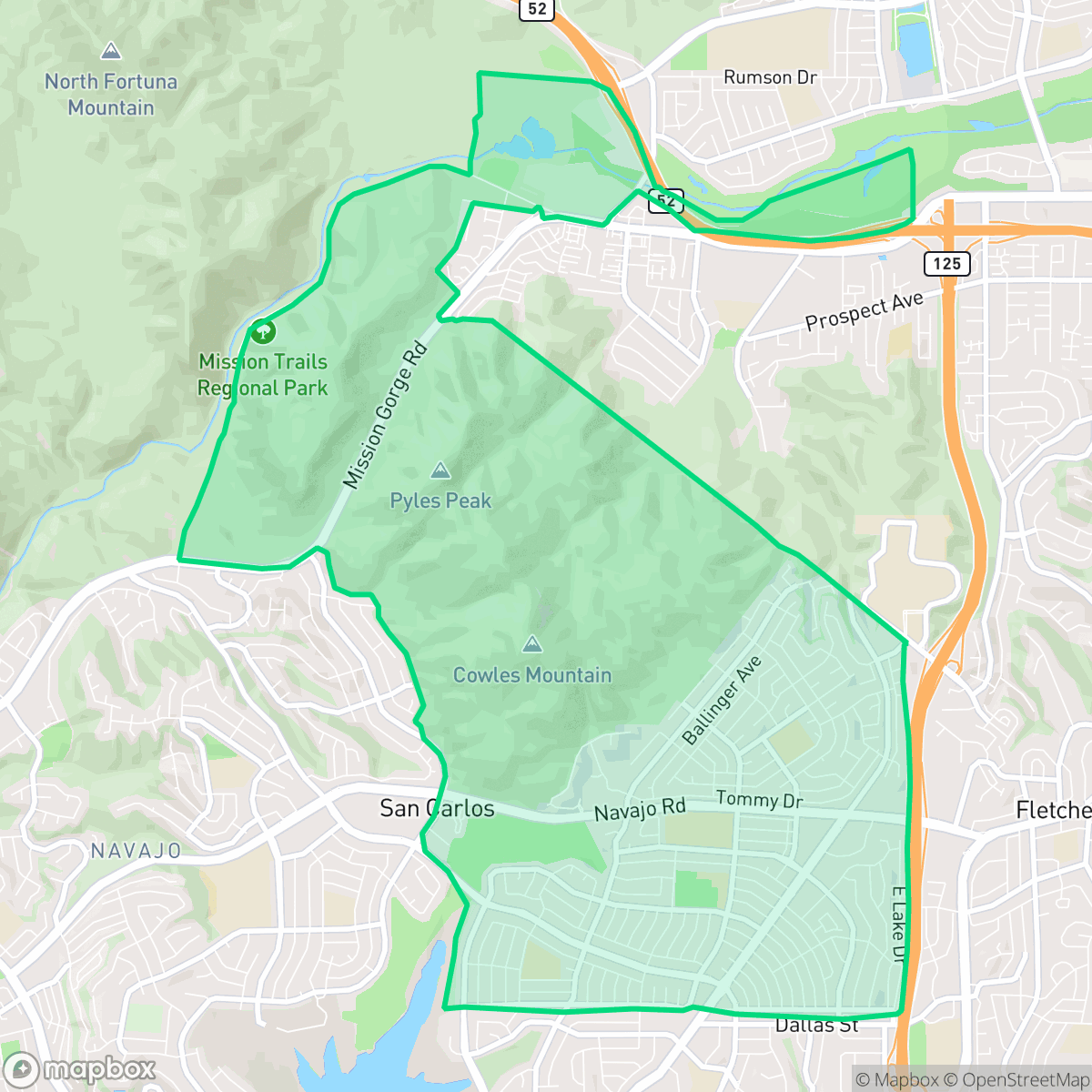
The Lake Murray neighborhood, situated along the San Diego-La Mesa border, is historically anchored by its namesake reservoir. Originally inhabited by the Kumeyaay people, the area was transformed in 1894 with the construction of the earthen La Mesa Dam. Following the historic 1916 San Diego floods, water magnates James Andrew Murray and Colonel Ed Fletcher oversaw the construction of a massive concrete dam downstream, which was renamed Lake Murray in 1920. The reservoir became a vital regional water source, with the adjacent Spanish Colonial-style Alvarado Filtration Plant built to process its supply. Residential development flourished during the mid-20th century, characterized by single-family tract homes. Today, the neighborhood is defined by its integration with Mission Trails Regional Park, where the lake's popular paved loop trail and views of nearby Cowles Mountain serve as central community landmarks.
The neighborhood is characterized by its dense, single-family residential layout and its integration with the surrounding natural landscape. Streets are lined with well-manicured properties, and the proximity to the reservoir provides a focal point for local leisure. While the area offers a high degree of visual appeal and a robust pedestrian infrastructure, the commercial landscape remains limited. Most daily errands require a short drive, as local business options are sparse and primarily consist of small social spots or convenience-oriented establishments.
Prospective residents should be aware of the trade-offs associated with this suburban setting. While the area boasts excellent educational options like Benchley/Weinberger Elementary, the acoustic environment is influenced by road traffic, resulting in moderate noise levels. Additionally, the neighborhood faces significant fire safety risks consistent with the broader San Diego region. It is an ideal location for families and outdoor enthusiasts who value a quiet, stable environment and easy access to regional parkland over the convenience of a walkable urban center.
Neighborhood Scores Across 15 Qualities
Residential spacing provides a moderate level of separation between neighbors, which is slightly higher than the San Diego average. While some multi-family units feature shared walls, many homes are situated on standard suburban lots with fenced backyards providing a buffer.
Extensive sidewalk networks and safe residential cul-de-sacs provide reliable pedestrian pathways throughout the area. This level of connectivity and safety for walkers is slightly below the city average.
Manicured properties and large homes with private pools characterize much of the area, making the visual landscape more polished than the San Diego average. According to iHuus data, the presence of well-maintained yards and expansive driveways creates a high-end suburban aesthetic throughout several parts of the neighborhood.
Abundant green spaces, including golf courses, school fields, and hilly trails, offer more walking opportunities for dogs than the San Diego average. Residents benefit from wide sidewalks and various neighborhood parks that provide safe, vegetated paths for exercise.
Frequent open land and scattered homes provide a slightly more rural atmosphere than the typical San Diego suburb. This landscape features a mix of single-family homes and undeveloped hillside terrain, according to iHuus data.
Suburban streets and green spaces provide a serene atmosphere, though local business density is slightly below the city average. Residents will find a peaceful environment with scattered social hubs, but most daily errands require a vehicle due to the limited number of walkable services.
Frequent noise from nearby major freeways and rail lines creates a louder environment than the San Diego average. According to iHuus data, this area experiences significant acoustic disturbances due to its proximity to heavy transit corridors.
Air quality in this area fluctuates between acceptable and unhealthy levels, appearing slightly lower than the San Diego average. According to iHuus data, sensitive groups may experience occasional concern on certain days.
Residents can expect a landscape composed of residential, educational, and recreational spaces with no heavy industrial warehouses or hazardous sites detected. This lack of industrial proximity is even more pronounced here than in the broader San Diego area, according to iHuus data.
Health insurance accessibility is notably higher than the San Diego average, according to iHuus data. This indicates a greater proportion of the resident population maintains active coverage.
Political leaning in this area is largely liberal, though it is less progressive than the San Diego city average according to iHuus data.
Residents live alongside a balanced range of young professionals, families, and seniors. According to iHuus data, this demographic distribution is slightly more varied than the typical San Diego profile.
Residual flood risk exists within this area as it sits within a designated floodplain. According to iHuus data, the level of safety from flooding is notably higher than the San Diego city average.
Wildfire vulnerability is exceptionally high in this area, representing a much greater danger than the typical San Diego neighborhood. According to iHuus data, the surrounding terrain poses a severe hazard that requires heightened safety precautions.
Address-Level Insights for Lake Murray


iHuus Neighborhood Intelligence Insights
Get address-level neighborhood insights for Lake Murray
- Street-level scores — see how individual blocks compare, not just neighborhood averages
- Micro-zone boundaries — identify quiet pockets, flood boundaries, and walkable clusters before you visit
- 15 dimensions in full — walkability, noise, air quality, school quality, insurance coverage, population age profile, urban/rural index, and more
- Boundary risk alerts — know if your address sits near a block boundary where scores drop, the kind of detail no listing will ever mention
- School insights — individual school ratings and insights, not just district-level data
- Compare before you commit — side-by-side data across neighborhoods, down to block precision
No credit card required
Compare with Any Neighborhood
| Dimension | Lake Murray | Adams North |
|---|---|---|
| 🚶 Walkabilityavg 8.58 | ||
| 🔊 Acoustic Comfortavg 3.33 | ||
| 🤫 Privacy Indexavg 4.87 | ||
| 🎨 Visual Appealavg 6.85 | ||
| 🐕 Dog Friendlinessavg 6.91 | ||
| 🗺️ Urban-Rural Indexavg 6.6 | ||
| ✨ Neighborhood Vibeavg 5.12 | ||
| 🏥 Health Insurance Coverageavg 7.53 | ||
| 🌿 Air Qualityavg 6.36 | ||
| 🏭 Industrial Proximityavg 9.12 | ||
| 🌊 Flood Safetyavg 4.2 | ||
| 🗳️ Ideological Leanavg 8.51 | ||
| 👥 Population Age Profileavg 4.8 | ||
| 🔥 Fire Safetyavg 0.61 | ||
| 🏫 School Quality |
Lake Murray Rankings
School Districts Serving Lake Murray
School Insights for Lake Murray
Below average outcomes; significant attendance and academic challenges.
School Insights
See what's really behind every school rating near Lake Murray
- Individual school ratings — each school's own score with outcome context, not just a district average
- Enrollment & class size data — student-to-teacher ratio and how it compares to the state average
- Full demographics breakdown — ethnicity and gender composition for every school in the enrollment zone
- Every school in the district — all schools within the enrollment boundary ranked by rating, not just the closest one
- Grade levels & benchmarks — elementary through high school, with below/above state-average flags
No credit card required