La Playa, San Diego
Updated · 2,451 residents
La Playa is a quiet, coastal neighborhood in Point Loma defined by its scenic bayfront views and established maritime culture. While it offers high visual appeal and good walkability for residents, the area maintains a suburban pace with limited daily commercial activity.
Key Highlights
About La Playa
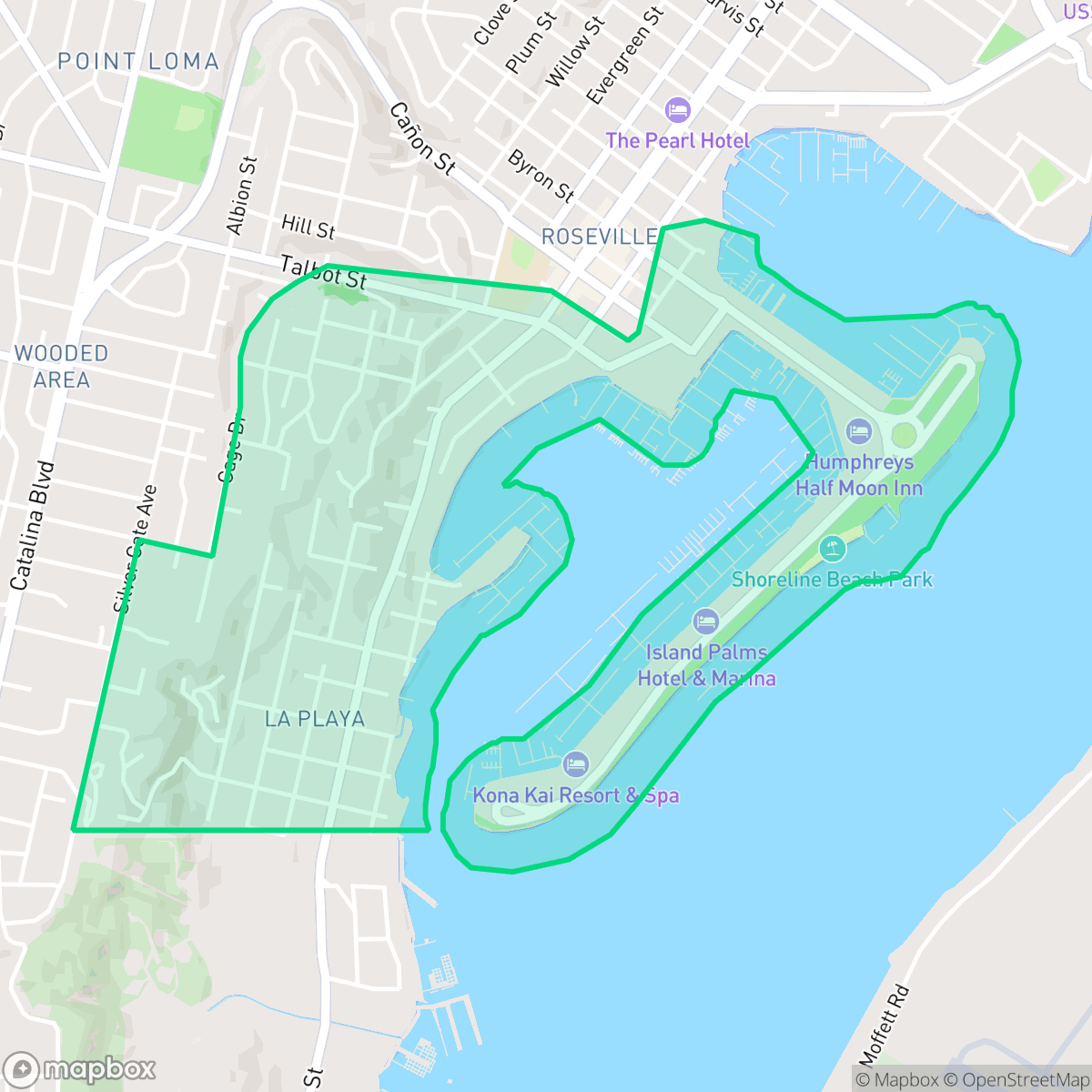
La Playa, a historic bayfront neighborhood in San Diego’s Point Loma, holds deep roots as California's oldest commercial port. In 1542, explorer Juan Rodríguez Cabrillo first landed here at Ballast Point. Serving as San Diego's primary harbor from 1770 to 1870, La Playa connected to inland settlements via the La Playa Trail, the oldest European-used commercial route in the Western United States. During the Mexican era, the beach transformed into a bustling trading hub centered on "hide houses" for processing cattle hides—a lively maritime scene immortalized by Richard Henry Dana Jr. in his 1840 memoir Two Years Before the Mast. Registered as California Historical Landmark #61, the original port site is now part of Naval Base Point Loma, while the modern residential neighborhood is defined by its coastal estates and prestigious yacht clubs, including the San Diego Yacht Club.
The area is defined by its proximity to the San Diego Bay and a concentration of residential estates mixed with significant marina infrastructure. It maintains a quiet, suburban atmosphere that prioritizes coastal living over high-density commercial development. Residents enjoy access to local leisure spots and waterfront dining, though the overall pace of the neighborhood remains subdued compared to more central parts of the city.
Prospective residents should note that the neighborhood faces specific trade-offs, including notable road traffic noise and the presence of light industrial infrastructure, such as fuel storage tanks in the southwest corner. While the area is visually striking, it exhibits lower scores for fire safety and health insurance coverage. It is best suited for those seeking a tranquil, scenic environment who are comfortable with the logistical realities of living in a historic, coastal-industrial hybrid zone.
Neighborhood Scores Across 15 Qualities
Residential spacing varies between detached houses and multi-unit complexes, providing more separation between neighbors than the San Diego average. According to iHuus data, this density level offers a balance of open space and communal living.
Pedestrian access is excellent due to a dense street grid, wide sidewalks, and frequent crossings. This level of walkability is significantly higher than the San Diego average, particularly near the marina access points.
Large estates, private pools, and premium marina slips create a visually polished environment that is notably more scenic than the San Diego average. According to iHuus data, the area is characterized by high-end amenities and spacious residential architecture.
Wide street verges and nearby coastal parks offer accessible green spaces for pets. According to iHuus data, the availability of walking paths is slightly below the San Diego average.
Dense coastal development meets preserved natural canyons, offering a suburban feel that is largely consistent with the city average. This area features a blend of residential grids, marina infrastructure, and significant open greenery according to iHuus data.
Suburban streets and coastal green spaces provide a serene environment with a lower level of activity than the San Diego average. While select dining and social hubs exist, many essential services and businesses are not within easy walking distance.
Frequent sounds from nearby transit corridors and heavy traffic are common in this area. According to iHuus data, the level of acoustic disturbance is slightly higher than the San Diego average.
Air quality levels fluctuate between acceptable and unhealthy, presenting occasional concerns for sensitive groups. This area experiences slightly lower air quality than the San Diego average, according to iHuus data.
Primarily residential streets and recreational marinas define this area, which lacks the heavy industrial activity found in other parts of San Diego. While some utility tanks are visible in the southern quadrant, the neighborhood remains significantly clearer of industrial hazards than the city average according to iHuus data.
Health insurance coverage among residents is lower than the San Diego average. According to iHuus data, a significant portion of the local population lacks employer-sponsored or private medical coverage.
Political leanings in this area are largely liberal, though this is less pronounced than the citywide average according to iHuus data.
Residents live alongside a balanced variety of young professionals, families, and seniors. According to iHuus data, this demographic spread is slightly more varied than the broader San Diego area.
Residual flood risk exists within parts of the area, though safety levels remain notably higher than the San Diego city average according to iHuus data.
Address-Level Insights for La Playa


iHuus Neighborhood Intelligence Insights
Get address-level neighborhood insights for La Playa
- Street-level scores — see how individual blocks compare, not just neighborhood averages
- Micro-zone boundaries — identify quiet pockets, flood boundaries, and walkable clusters before you visit
- 15 dimensions in full — walkability, noise, air quality, school quality, insurance coverage, population age profile, urban/rural index, and more
- Boundary risk alerts — know if your address sits near a block boundary where scores drop, the kind of detail no listing will ever mention
- School insights — individual school ratings and insights, not just district-level data
- Compare before you commit — side-by-side data across neighborhoods, down to block precision
No credit card required
Compare with Any Neighborhood
| Dimension | La Playa | Adams North |
|---|---|---|
| 🚶 Walkabilityavg 8.58 | ||
| 🔊 Acoustic Comfortavg 3.33 | ||
| 🤫 Privacy Indexavg 4.87 | ||
| 🎨 Visual Appealavg 6.85 | ||
| 🐕 Dog Friendlinessavg 6.91 | ||
| 🗺️ Urban-Rural Indexavg 6.6 | ||
| ✨ Neighborhood Vibeavg 5.12 | ||
| 🏥 Health Insurance Coverageavg 7.53 | ||
| 🌿 Air Qualityavg 6.36 | ||
| 🏭 Industrial Proximityavg 9.12 | ||
| 🌊 Flood Safetyavg 4.2 | ||
| 🗳️ Ideological Leanavg 8.51 | ||
| 👥 Population Age Profileavg 4.8 | ||
| 🔥 Fire Safetyavg 0.61 | ||
| 🏫 School Quality |
La Playa Rankings
School Districts Serving La Playa
School Insights for La Playa
Below average outcomes; significant attendance and academic challenges.
School Insights
See what's really behind every school rating near La Playa
- Individual school ratings — each school's own score with outcome context, not just a district average
- Enrollment & class size data — student-to-teacher ratio and how it compares to the state average
- Full demographics breakdown — ethnicity and gender composition for every school in the enrollment zone
- Every school in the district — all schools within the enrollment boundary ranked by rating, not just the closest one
- Grade levels & benchmarks — elementary through high school, with below/above state-average flags
No credit card required