La Jolla, San Diego
Updated · 40,461 residents
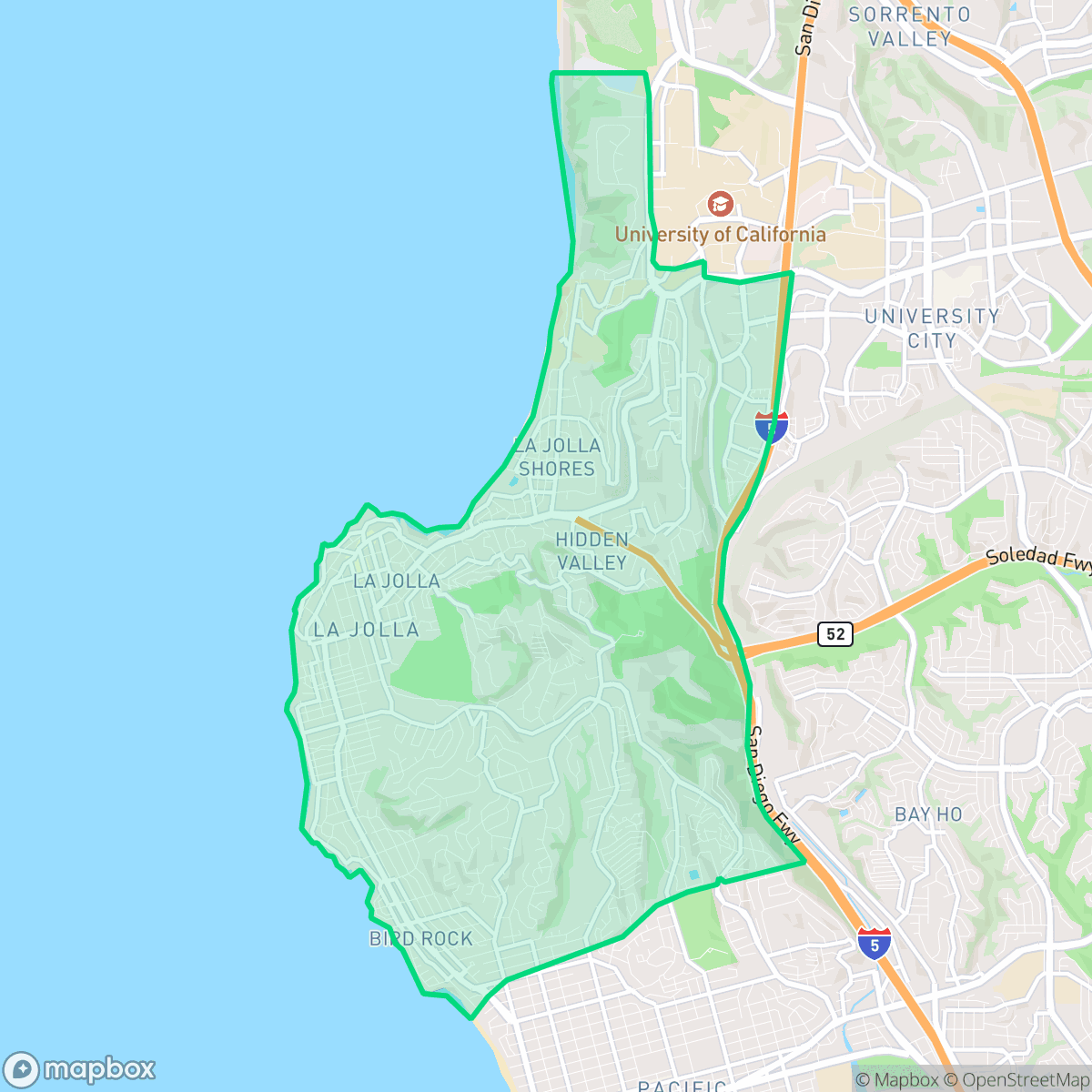
La Jolla is a prestigious coastal community defined by its dramatic cliffs, upscale estates, and a blend of urban activity and natural beauty. The area is highly pedestrian friendly and dog-friendly, offering residents access to extensive trails and a refined, polished aesthetic.
Key Highlights
About La Jolla
La Jolla, meaning 'The Jewel,' traces its modern development to 1887 when Frank Botsford and George Heald subdivided the area into 'La Jolla Park.' Originally a bohemian artist colony and seaside resort, it evolved into an affluent coastal community. The neighborhood is defined by its dramatic coastline, including the historic La Jolla Cove and sea caves. Architectural heritage ranges from late 19th-century beach cottages, such as the 'Red Roost' and 'Red Rest,' to mid-century modern landmarks like the Salk Institute. The 1903 establishment of the Scripps Institution of Oceanography anchored its identity as a global center for marine science. Once known as 'Little Hollywood' for its celebrity visitors and the founding of the La Jolla Playhouse by Gregory Peck, the area remains a distinct enclave characterized by its preserved natural landmarks, academic prestige, and enduring artistic roots as a creative retreat.
The neighborhood features a unique mix of dense coastal urban blocks and spacious hillside properties, maintaining a clean environment entirely free from industrial activity. Residents benefit from high levels of health insurance coverage and a diverse demographic profile that spans young adults, families, and older residents. The visual character is marked by manicured landscapes and premium amenities, contributing to an environment that is both intellectually and aesthetically stimulating. While the area offers a vibrant coastal atmosphere, it remains a place where residents enjoy a balance of social hubs and quiet residential pockets.
Prospective residents should consider several trade-offs when evaluating the area. While pedestrian connectivity is excellent, the neighborhood experiences significant traffic noise from nearby major transit corridors. Furthermore, the coastal terrain carries an extreme fire risk and a moderate level of flood vulnerability. Educational options fall under a district currently navigating financial and operational transitions, which balances high-performing academic clusters with systemic budget challenges.
Neighborhood Scores Across 15 Qualities
Housing density varies significantly across the area, ranging from tightly packed academic cores to spacious hillside estates. According to iHuus data, the level of buffer between neighbors is roughly in line with the San Diego average.
Extensive sidewalk networks and safe crosswalks throughout residential and commercial zones make most errands manageable on foot. This level of connectivity is largely consistent with the broader San Diego area.
Manicured landscapes, private pools, and high-value coastal estates create a visually polished environment that is notably more aesthetically pleasing than the San Diego average. According to iHuus data, the area is characterized by well-maintained modern structures and premium amenities throughout much of the residential landscape.
Extensive canyon trails, green belts, and wide residential verges provide ample space for pets. According to iHuus data, the availability of connected natural paths and large parks makes this area more dog friendly than the San Diego average.
Residential layouts vary from dense coastal urban blocks to low density suburban areas integrated with natural canyons. This balance of built environments is consistent with the broader San Diego area.
Diverse dining and social hubs coexist with quiet, suburban pockets. This neighborhood offers a more active atmosphere than the city average, though many areas remain car-dependent.
Frequent auditory disturbances from nearby major roadways and transit corridors are common here. According to iHuus data, acoustic comfort levels in this area are slightly below the San Diego average.
Air quality levels fluctuate between acceptable and unhealthy periods, which is slightly lower than the San Diego city average. Sensitive individuals should monitor local conditions during days when pollution levels rise.
Industrial presence is virtually non-existent in this area, offering a cleaner environment than the San Diego average. Residents will find an exclusively residential and light commercial landscape with no detectable warehouses or heavy industrial hazards.
Health insurance access is exceptionally high among residents, significantly surpassing the San Diego average. According to iHuus data, nearly all inhabitants are covered by a health plan.
Political leanings in this area are predominantly liberal, mirroring the broader trends seen across San Diego.
Residents experience a balanced demographic spread of young adults, families, and older adults, which is very similar to the broader San Diego area according to iHuus data.
Flood risk levels in this area are higher than the San Diego average, though specific localized data remains undetermined due to incomplete federal studies. Residents should remain aware of potential vulnerability during extreme weather events according to iHuus data.
High fire hazard levels persist in this area, which represents a significantly greater risk than the San Diego average according to iHuus data.
Address-Level Insights for La Jolla


iHuus Neighborhood Intelligence Insights
Get address-level neighborhood insights for La Jolla
- Street-level scores — see how individual blocks compare, not just neighborhood averages
- Micro-zone boundaries — identify quiet pockets, flood boundaries, and walkable clusters before you visit
- 15 dimensions in full — walkability, noise, air quality, school quality, insurance coverage, population age profile, urban/rural index, and more
- Boundary risk alerts — know if your address sits near a block boundary where scores drop, the kind of detail no listing will ever mention
- School insights — individual school ratings and insights, not just district-level data
- Compare before you commit — side-by-side data across neighborhoods, down to block precision
No credit card required
Compare with Any Neighborhood
| Dimension | La Jolla | Adams North |
|---|---|---|
| 🚶 Walkabilityavg 8.58 | ||
| 🔊 Acoustic Comfortavg 3.33 | ||
| 🤫 Privacy Indexavg 4.87 | ||
| 🎨 Visual Appealavg 6.85 | ||
| 🐕 Dog Friendlinessavg 6.91 | ||
| 🗺️ Urban-Rural Indexavg 6.6 | ||
| ✨ Neighborhood Vibeavg 5.12 | ||
| 🏥 Health Insurance Coverageavg 7.53 | ||
| 🌿 Air Qualityavg 6.36 | ||
| 🏭 Industrial Proximityavg 9.12 | ||
| 🌊 Flood Safetyavg 4.2 | ||
| 🗳️ Ideological Leanavg 8.51 | ||
| 👥 Population Age Profileavg 4.8 | ||
| 🔥 Fire Safetyavg 0.61 | ||
| 🏫 School Quality |
La Jolla Rankings
School Districts Serving La Jolla
School Insights for La Jolla
Below average outcomes; significant attendance and academic challenges.
School Insights
See what's really behind every school rating near La Jolla
- Individual school ratings — each school's own score with outcome context, not just a district average
- Enrollment & class size data — student-to-teacher ratio and how it compares to the state average
- Full demographics breakdown — ethnicity and gender composition for every school in the enrollment zone
- Every school in the district — all schools within the enrollment boundary ranked by rating, not just the closest one
- Grade levels & benchmarks — elementary through high school, with below/above state-average flags
No credit card required