Kearny Mesa, San Diego
Updated · 5,796 residents
Kearny Mesa is a central San Diego hub defined by its dense industrial parks and the vibrant Convoy District, which serves as a premier destination for diverse Asian cuisine and commerce. While the area offers significant convenience for commuters and food enthusiasts, residents experience a landscape dominated by car-dependent streets and high ambient noise levels from nearby highways and aviation activity.
Key Highlights
About Kearny Mesa
Named after the World War I-era training camp, Camp Kearny, the neighborhood of Kearny Mesa in San Diego began its modern development with the 1937 opening of Gibbs Airfield, now Montgomery Field. After World War II, the city zoned surplus military land as an industrial park, attracting prominent aerospace and defense giants like General Dynamics’ Convair division in 1955. Though designed for heavy industry, the area’s zoning allowed for commercial businesses, paving the way for the late-1970s emergence of the Convoy District. Starting with pioneering grocery stores like Woo Chee Chong and Zion Market in 1979, the corridor evolved into the officially designated Convoy Pan Asian Cultural and Business Innovation District, a vibrant hub of diverse Asian-owned businesses, supermarkets, and restaurants that defines the neighborhood’s modern cultural identity.
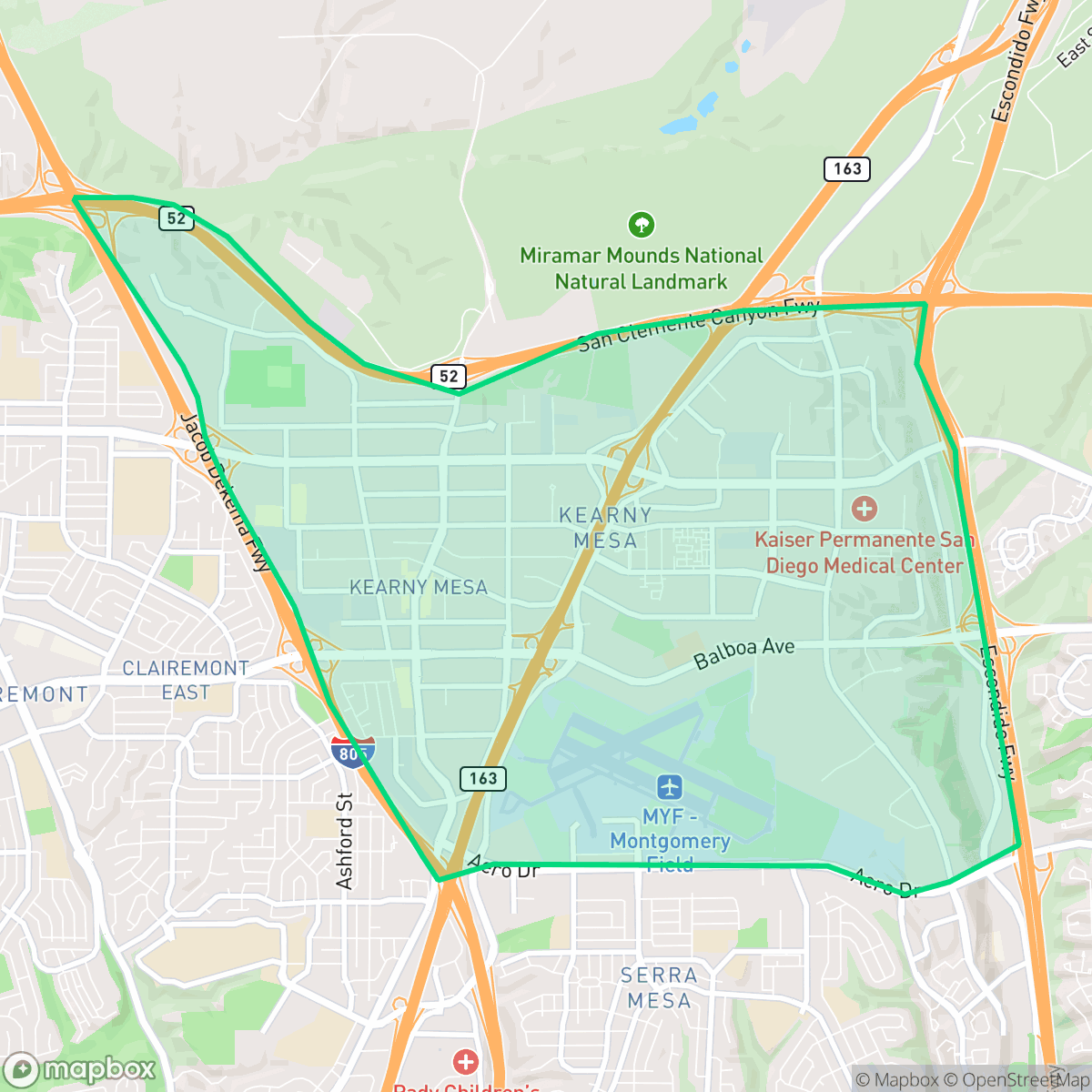
Kearny Mesa functions as a primary industrial and commercial engine of San Diego, characterized by its grid of logistics warehouses, expansive parking lots, and major transit corridors. The area is anchored by the Convoy District, a high-density corridor celebrated for its concentration of Asian-owned businesses, supermarkets, and diverse dining options that draw visitors from across the region. According to iHuus data, the built environment is largely defined by its functional, low-rise architecture and proximity to Montgomery Field, creating a distinct landscape that prioritizes business activity and logistical access over residential pedestrian flow. Living in this neighborhood requires adjusting to a car-centric infrastructure, as the area lacks the walkability found in neighboring communities like Clairemont or Serra Mesa. Prospective residents should note that the environment is notably loud, with significant noise contributions from road traffic and aviation operations. While the district offers excellent access to major highways and a wide array of amenities, it is best suited for those who prioritize proximity to employment hubs and culinary variety over a quiet, pedestrian-friendly residential experience.
Neighborhood Scores Across 15 Qualities
Residential structures are often closely packed with minimal setbacks or shared walls, resulting in a lower privacy index than the San Diego average. According to iHuus data, some areas feature high-density layouts where buildings are situated very near one another.
Pedestrian access is supported by a consistent sidewalk network and marked crosswalks, though major freeways and high-traffic roads can create disconnected routes. This level of walkability is roughly comparable to the San Diego average according to iHuus data.
Residential pockets feature a blend of private pools and multi-car driveways alongside denser apartment complexes. Overall visual appeal sits slightly below the San Diego average due to the presence of standard tract housing and high-density communities.
Public parks and trail access in the northern canyon area provide essential space for pets, though most residential greenery is confined to private backyards. According to iHuus data, the availability of shared green space is slightly below the San Diego average.
Extensive industrial parks and large-scale commercial infrastructure characterize the landscape, matching the urban-rural balance found across much of San Diego. While some pockets contain residential apartment blocks, much of the area is defined by low-rise warehouses and significant paved surfaces.
A mix of industrial warehouses and suburban pockets creates a subdued atmosphere that is less lively than the San Diego average. While diverse dining options are available, the landscape is primarily car-dependent and lacks significant pedestrian activity.
Constant aircraft noise from the nearby airport runway and heavy industrial activity makes this area significantly louder than the San Diego average. Residents should expect frequent disruptions from high-decibel transit and aviation sounds according to iHuus data.
Air quality levels in this area are slightly below the San Diego average. Residents may experience occasional periods of poor air quality that could affect sensitive groups, according to iHuus data.
Significant logistics hubs, large warehouses, and proximity to a major airfield create notable levels of noise and traffic. This concentration of industrial activity is notably higher than the San Diego average, according to iHuus data.
Health insurance access among residents is notably higher than the San Diego average, according to iHuus data.
Political leanings in this area are primarily liberal, which is quite similar to the broader San Diego area according to iHuus data.
Residents live alongside a balanced mix of young professionals, families, and older adults. According to iHuus data, this demographic distribution is very similar to the broader San Diego area.
Flood risk in this area is higher than the San Diego average, though official assessments remain incomplete due to a lack of detailed studies. Residents should remain aware of localized drainage patterns during heavy rain events.
Fire hazards in this area are significantly higher than the San Diego average. According to iHuus data, residents should prepare for extreme fire safety risks and ensure maximum protection measures are in place.
Address-Level Insights for Kearny Mesa


iHuus Neighborhood Intelligence Insights
Get address-level neighborhood insights for Kearny Mesa
- Street-level scores — see how individual blocks compare, not just neighborhood averages
- Micro-zone boundaries — identify quiet pockets, flood boundaries, and walkable clusters before you visit
- 15 dimensions in full — walkability, noise, air quality, school quality, insurance coverage, population age profile, urban/rural index, and more
- Boundary risk alerts — know if your address sits near a block boundary where scores drop, the kind of detail no listing will ever mention
- School insights — individual school ratings and insights, not just district-level data
- Compare before you commit — side-by-side data across neighborhoods, down to block precision
No credit card required
Compare with Any Neighborhood
| Dimension | Kearny Mesa | Adams North |
|---|---|---|
| 🚶 Walkabilityavg 8.58 | ||
| 🔊 Acoustic Comfortavg 3.33 | ||
| 🤫 Privacy Indexavg 4.87 | ||
| 🎨 Visual Appealavg 6.85 | ||
| 🐕 Dog Friendlinessavg 6.91 | ||
| 🗺️ Urban-Rural Indexavg 6.6 | ||
| ✨ Neighborhood Vibeavg 5.12 | ||
| 🏥 Health Insurance Coverageavg 7.53 | ||
| 🌿 Air Qualityavg 6.36 | ||
| 🏭 Industrial Proximityavg 9.12 | ||
| 🌊 Flood Safetyavg 4.2 | ||
| 🗳️ Ideological Leanavg 8.51 | ||
| 👥 Population Age Profileavg 4.8 | ||
| 🔥 Fire Safetyavg 0.61 | ||
| 🏫 School Quality |
Kearny Mesa Rankings
School Districts Serving Kearny Mesa
School Insights for Kearny Mesa
Below average outcomes; significant attendance and academic challenges.
School Insights
See what's really behind every school rating near Kearny Mesa
- Individual school ratings — each school's own score with outcome context, not just a district average
- Enrollment & class size data — student-to-teacher ratio and how it compares to the state average
- Full demographics breakdown — ethnicity and gender composition for every school in the enrollment zone
- Every school in the district — all schools within the enrollment boundary ranked by rating, not just the closest one
- Grade levels & benchmarks — elementary through high school, with below/above state-average flags
No credit card required