Islenair, San Diego
Updated · 575 residents
Islenair is a highly walkable, historic enclave in San Diego featuring well-preserved early 20th-century architecture and lush, canyon-adjacent streets. While the area offers a quiet, residential atmosphere, residents should be aware of elevated road noise levels and significant fire risk associated with its canyon-side location.
Key Highlights
About Islenair
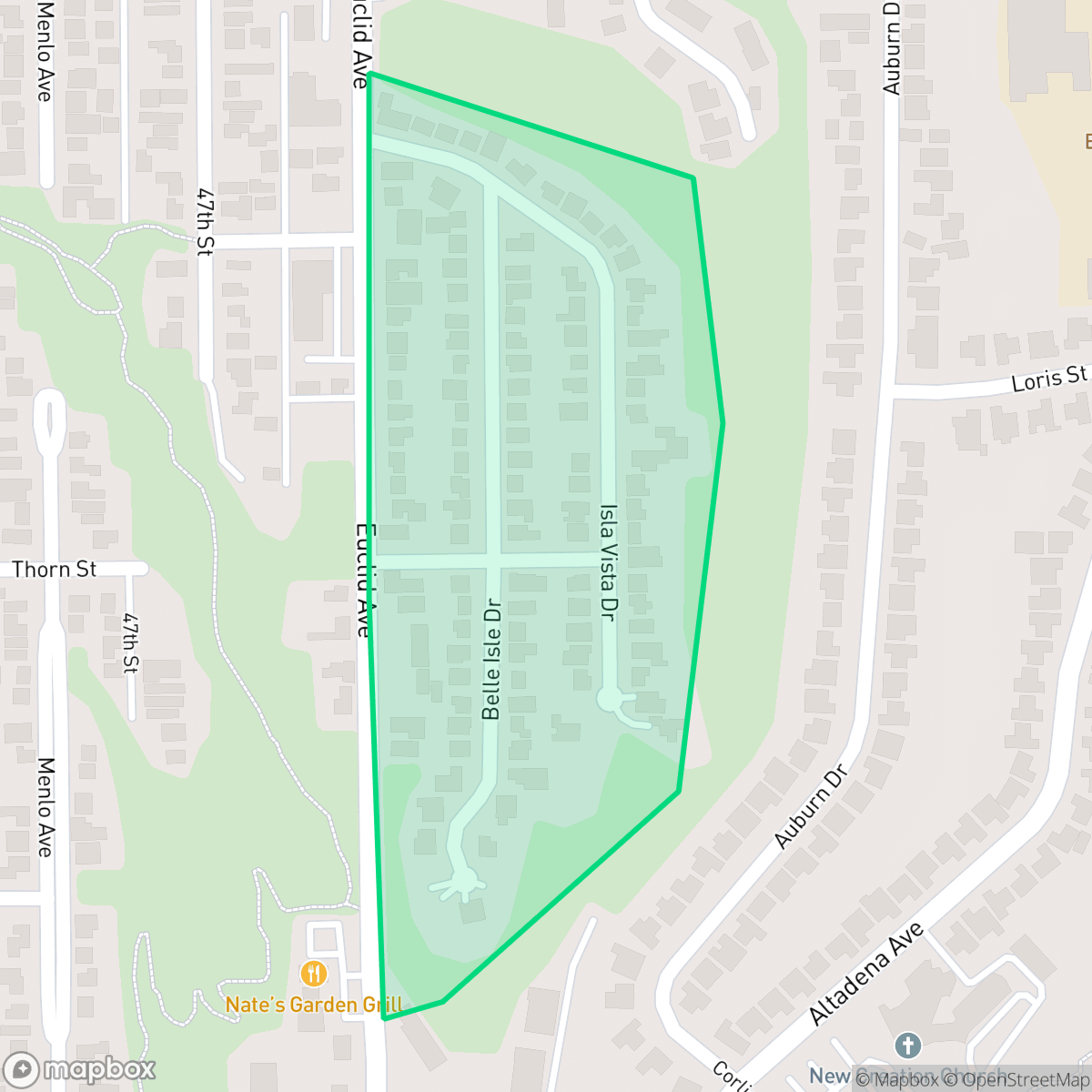
Established in 1926 by developers Love and Touhey, Islenair is a historic, early auto-oriented suburb in San Diego’s City Heights area. Perched above Chollas Valley and bordered by open canyons, the neighborhood was named "Islenair" (Island-in-the-air) to evoke an oasis in the clouds. It is designated as a city historic district because it serves as an intact microcosm of the early 20th-century "small house movement". Developed in stages between 1927 and 1952, Islenair features curving, tree-lined streets—such as Belle Isle Drive and Isla Vista Drive—lined with well-preserved Spanish Eclectic, Minimal Traditional, and Ranch-style homes. Characterized by its original 50-foot-wide lots and historic sidewalk stamps, the neighborhood retains its distinct, working-class suburban character.
The neighborhood functions as a dense suburban pocket defined by its structured grid and consistent sidewalk network, which makes it exceptionally walkable compared to the broader city. Residents benefit from a clean environment free of industrial hazards, with many properties showcasing well-manicured landscaping and high visual appeal. Local landmarks like Nate's Garden Grill and the New Creation Church serve as community focal points, though the area remains predominantly residential with limited commercial activity within walking distance.
Prospective residents should weigh the aesthetic and walkability benefits against specific environmental and infrastructure considerations. According to iHuus data, the neighborhood experiences noticeable road traffic noise and carries a high risk for fire hazards due to the surrounding canyon topography. Educational options fall under the San Diego City Unified School District, which presents a mixed landscape of academic potential and systemic budget challenges. This area is well-suited for those prioritizing historical charm and a structured, pedestrian-friendly environment over high-energy nightlife or immediate access to commercial hubs.
Neighborhood Scores Across 15 Qualities
Residential spacing is higher than the San Diego average, offering a balance of density and separation. While some street-facing homes are closely packed, many lots benefit from natural buffers provided by adjacent canyons.
Pedestrian connectivity is exceptional due to a structured residential grid with continuous sidewalks on both sides of most streets. According to iHuus data, the neighborhood offers more accessible crossings and pedestrian-priority zones than the San Diego average.
Property aesthetics range from upscale estates with private pools to standard middle-class housing. According to iHuus data, the overall visual appeal is slightly below the San Diego average.
Natural canyon areas and local school grounds provide significant green space for walking dogs. According to iHuus data, opportunities for pet exercise are slightly below the San Diego average.
Open land and natural canyon buffers are frequently interspersed with residential lots, creating a landscape that is very similar to the San Diego average. According to iHuus data, the area features a mix of dense suburban development and scattered homes amidst woodland.
Residential streets and green spaces blend with occasional lively hubs featuring local dining and community landmarks. According to iHuus data, the area offers a slightly more active atmosphere than the San Diego average, though most amenities require a drive as few businesses are within walking distance.
Steady sounds from nearby busy streets are present, though acoustic levels are notably more tranquil than the San Diego average according to iHuus data.
Air quality fluctuates between acceptable and unhealthy levels, sitting slightly below the San Diego average. Sensitive groups should remain aware of occasional periods of poor air quality according to iHuus data.
Industrial facilities and warehouses are entirely absent from this area, which maintains a higher level of separation from heavy industry than most of San Diego. According to iHuus data, the landscape is composed exclusively of residential and light commercial uses with no detectable hazardous sites.
Health insurance coverage among Islenair residents is notably lower than the San Diego average. According to iHuus data, a minority of the local population maintains active health coverage.
Voting patterns and census indicators show a predominantly liberal political leaning that is more pronounced than the San Diego average. According to iHuus data, this area is characterized by highly progressive social and political trends.
Residents live alongside a balanced mix of young adults, families, and seniors. According to iHuus data, the age distribution is slightly more concentrated in certain age brackets than the San Diego average.
Property flooding is a significant concern in this area, as Islenair sits within a designated floodplain. According to iHuus data, the risk levels here are much higher than the average for San Diego.
Address-Level Insights for Islenair


iHuus Neighborhood Intelligence Insights
Get address-level neighborhood insights for Islenair
- Street-level scores — see how individual blocks compare, not just neighborhood averages
- Micro-zone boundaries — identify quiet pockets, flood boundaries, and walkable clusters before you visit
- 15 dimensions in full — walkability, noise, air quality, school quality, insurance coverage, population age profile, urban/rural index, and more
- Boundary risk alerts — know if your address sits near a block boundary where scores drop, the kind of detail no listing will ever mention
- School insights — individual school ratings and insights, not just district-level data
- Compare before you commit — side-by-side data across neighborhoods, down to block precision
No credit card required
Compare with Any Neighborhood
| Dimension | Islenair | Adams North |
|---|---|---|
| 🚶 Walkabilityavg 8.58 | ||
| 🔊 Acoustic Comfortavg 3.33 | ||
| 🤫 Privacy Indexavg 4.87 | ||
| 🎨 Visual Appealavg 6.85 | ||
| 🐕 Dog Friendlinessavg 6.91 | ||
| 🗺️ Urban-Rural Indexavg 6.6 | ||
| ✨ Neighborhood Vibeavg 5.12 | ||
| 🏥 Health Insurance Coverageavg 7.53 | ||
| 🌿 Air Qualityavg 6.36 | ||
| 🏭 Industrial Proximityavg 9.12 | ||
| 🌊 Flood Safetyavg 4.2 | ||
| 🗳️ Ideological Leanavg 8.51 | ||
| 👥 Population Age Profileavg 4.8 | ||
| 🔥 Fire Safetyavg 0.61 | ||
| 🏫 School Quality |
Islenair Rankings
School Districts Serving Islenair
School Insights for Islenair
Below average outcomes; significant attendance and academic challenges.
School Insights
See what's really behind every school rating near Islenair
- Individual school ratings — each school's own score with outcome context, not just a district average
- Enrollment & class size data — student-to-teacher ratio and how it compares to the state average
- Full demographics breakdown — ethnicity and gender composition for every school in the enrollment zone
- Every school in the district — all schools within the enrollment boundary ranked by rating, not just the closest one
- Grade levels & benchmarks — elementary through high school, with below/above state-average flags
No credit card required