Horton Plaza, San Diego
Updated · 1,824 residents
Horton Plaza is a high-energy urban core in downtown San Diego, defined by its exceptional walkability and dense concentration of dining and cultural attractions. Residents experience a bustling environment with limited private outdoor space and notable noise from constant road traffic.
Key Highlights
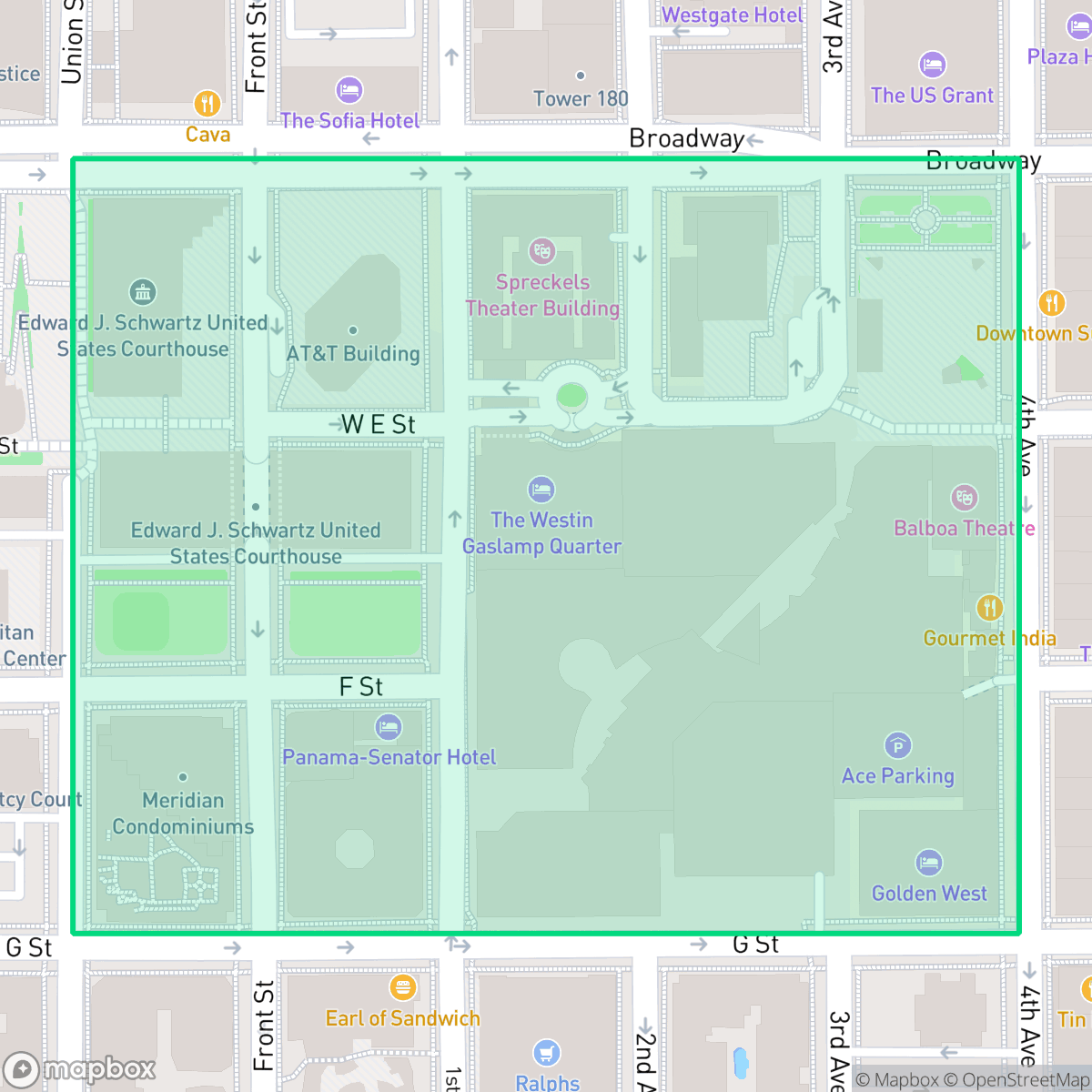
About Horton Plaza
Centering on downtown San Diego's historic town square, the Horton Plaza area originated in 1870 when developer Alonzo Horton cleared land in front of his Horton House hotel for public use, deeding it to the city in 1895. The plaza became a civic hub, anchored by landmarks like the grand U.S. Grant Hotel (built on the hotel's former site) and the 1910 Broadway Fountain, designed by architect Irving Gill. In 1985, the neighborhood underwent a major urban renewal with the opening of the Horton Plaza shopping mall. Designed by Jon Jerde, the five-level mall was a postmodern architectural icon of "experience architecture" with a labyrinthine, colorful "Festival Marketplace" layout. Today, the area continues to evolve as the former mall is redeveloped into a modern mixed-use tech campus.
The neighborhood functions as a high-density urban center, characterized by a mix of modern commercial skyscrapers and residential complexes. It serves as a vibrant hub for activity, featuring proximity to major cultural landmarks like The New Children's Museum and local green spaces such as Pantoja Park. According to iHuus data, the area maintains a high level of liveliness, offering an array of diverse dining options and a central location that keeps residents connected to the broader downtown San Diego landscape. As the former shopping mall site transitions into a modern tech campus, the area continues to solidify its role as a primary destination for work and leisure.
Living in this district requires accepting the trade-offs of a dense, concrete-heavy environment. The area is exceptionally walkable, yet it lacks significant private outdoor space or dog-friendly parks. Prospective residents should also be prepared for a noisy atmosphere, as road traffic contributes to a higher-than-average ambient sound level. This location is best suited for professionals and urban dwellers who prioritize immediate access to city amenities and a fast-paced lifestyle over quiet, suburban-style living or extensive private property.
Neighborhood Scores Across 15 Qualities
Shared walls in residential complexes and high-density skyscrapers create minimal personal separation. According to iHuus data, privacy levels here are significantly lower than the San Diego average.
Pedestrian-priority crossings and continuous sidewalks throughout the district make navigating the area on foot exceptionally easy. According to iHuus data, the grid system and sidewalk accessibility are significantly higher than the San Diego average.
Modern structures and high-density urban development define the area, though the visual landscape is less lush than the San Diego average. According to iHuus data, the skyline consists primarily of functional commercial and residential buildings rather than private estates or expansive greenery.
Dense urban blocks and heavy concrete coverage provide very little access to public green space for pets. According to iHuus data, dog-friendly amenities and nearby parks are significantly below the San Diego average.
Characterized by tall skyscrapers and extensive asphalt coverage, this area lacks greenery and feels significantly more paved than the San Diego average. According to iHuus data, the landscape consists of large commercial blocks and high-density urban infrastructure.
Dense urban activity and major regional attractions create a level of energy significantly higher than the San Diego average. Residents have immediate access to a diverse variety of dining and cultural landmarks, according to iHuus data.
Frequent disturbances from nearby railroad tracks and heavy freeway traffic characterize the area. This level of acoustic activity is notably higher than the San Diego average, according to iHuus data.
Air quality levels here fluctuate between acceptable and unhealthy, representing a slight dip compared to the San Diego average. Sensitive groups may experience occasional concern during certain periods, according to iHuus data.
Heavy industrial facilities and warehouses are entirely absent from this area. Residents benefit from an urban landscape that is significantly cleaner of industrial hazards than the San Diego average.
Voting patterns and census indicators show a predominantly liberal political leaning, which is slightly more pronounced than the San Diego average.
A varied mix of young adults, families, and older residents characterizes the area. This demographic spread is more balanced than the San Diego average, according to iHuus data.
Flood risk in this area is significantly lower than the city average, though some residual risk remains as the neighborhood sits within a 500-year floodplain according to iHuus data.
Address-Level Insights for Horton Plaza


iHuus Neighborhood Intelligence Insights
Get address-level neighborhood insights for Horton Plaza
- Street-level scores — see how individual blocks compare, not just neighborhood averages
- Micro-zone boundaries — identify quiet pockets, flood boundaries, and walkable clusters before you visit
- 15 dimensions in full — walkability, noise, air quality, school quality, insurance coverage, population age profile, urban/rural index, and more
- Boundary risk alerts — know if your address sits near a block boundary where scores drop, the kind of detail no listing will ever mention
- School insights — individual school ratings and insights, not just district-level data
- Compare before you commit — side-by-side data across neighborhoods, down to block precision
No credit card required
Compare with Any Neighborhood
| Dimension | Horton Plaza | Adams North |
|---|---|---|
| 🚶 Walkabilityavg 8.58 | ||
| 🔊 Acoustic Comfortavg 3.33 | ||
| 🤫 Privacy Indexavg 4.87 | ||
| 🎨 Visual Appealavg 6.85 | ||
| 🐕 Dog Friendlinessavg 6.91 | ||
| 🗺️ Urban-Rural Indexavg 6.6 | ||
| ✨ Neighborhood Vibeavg 5.12 | ||
| 🏥 Health Insurance Coverageavg 7.53 | ||
| 🌿 Air Qualityavg 6.36 | ||
| 🏭 Industrial Proximityavg 9.12 | ||
| 🌊 Flood Safetyavg 4.2 | ||
| 🗳️ Ideological Leanavg 8.51 | ||
| 👥 Population Age Profileavg 4.8 | ||
| 🔥 Fire Safetyavg 0.61 | ||
| 🏫 School Quality |
Horton Plaza Rankings
School Districts Serving Horton Plaza
School Insights for Horton Plaza
Below average outcomes; significant attendance and academic challenges.
School Insights
See what's really behind every school rating near Horton Plaza
- Individual school ratings — each school's own score with outcome context, not just a district average
- Enrollment & class size data — student-to-teacher ratio and how it compares to the state average
- Full demographics breakdown — ethnicity and gender composition for every school in the enrollment zone
- Every school in the district — all schools within the enrollment boundary ranked by rating, not just the closest one
- Grade levels & benchmarks — elementary through high school, with below/above state-average flags
No credit card required