Hillcrest, San Diego
Updated · 13,787 residents
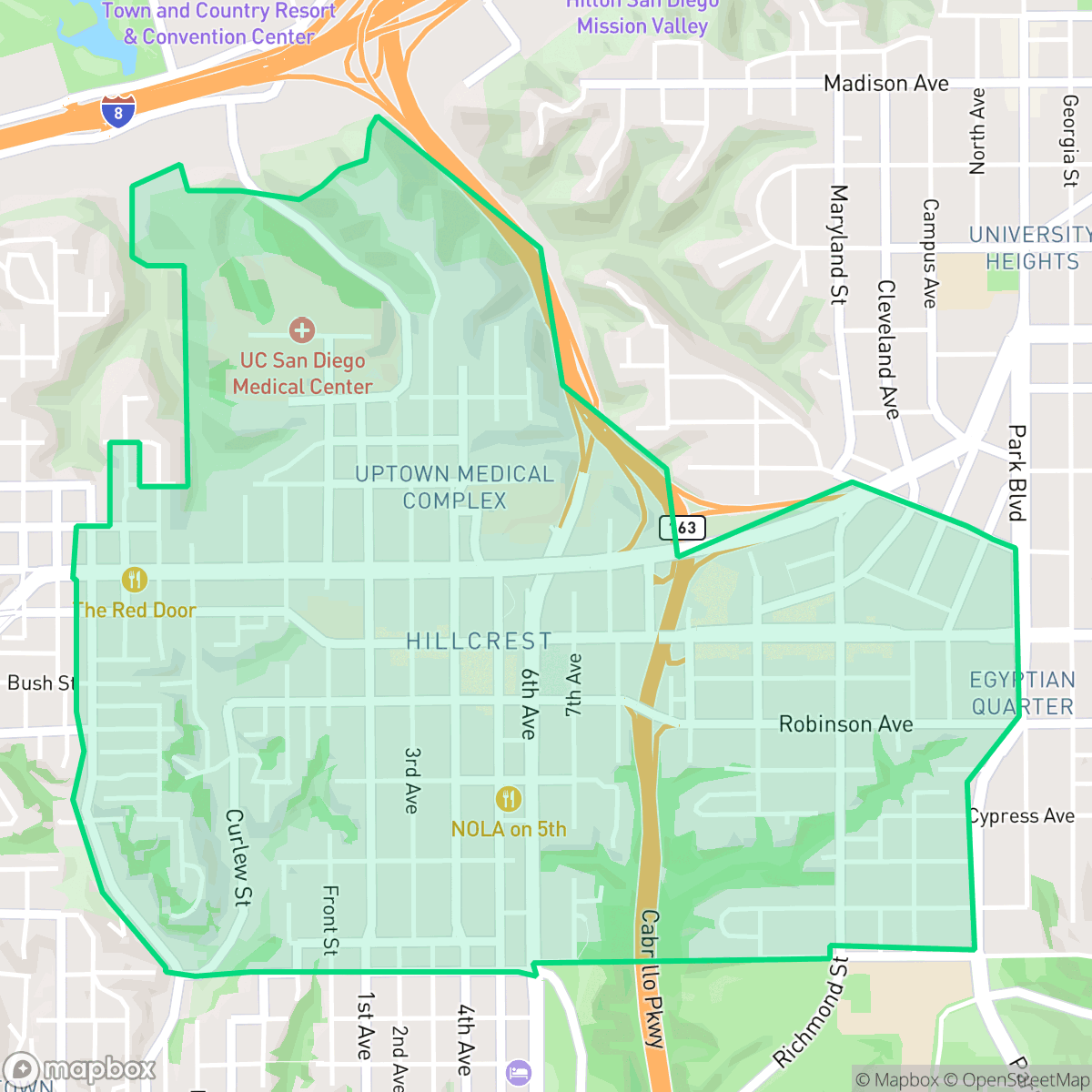
Hillcrest is a highly walkable, socially vibrant district known for its diverse dining scene and strong progressive community values. Its dense urban grid and central location make it a premier hub for those seeking a pedestrian-friendly lifestyle in the heart of San Diego.
Key Highlights
About Hillcrest
Established in the early 1900s, Hillcrest evolved from a chaparral-covered mesa into a vibrant residential and commercial hub, significantly shaped by the 1907 subdivision by William Whitson. The neighborhood is defined by its eclectic architectural mix, ranging from historic Craftsman homes to mid-century modern buildings, and is famously marked by the iconic 1940 'HILLCREST' sign at the intersection of University and Fifth Avenues. Since the 1970s, Hillcrest has served as the heart of San Diego's LGBTQ+ community, transforming into a center for political activism and cultural expression. This 'gayborhood' status, combined with its pedestrian-friendly streets, locally owned businesses, and proximity to Balboa Park, has solidified its reputation as an urban, diverse, and culturally significant district, frequently recognized for its history of trendsetting and community-led development.
The area functions as a central social hub, characterized by a high concentration of local eateries, coffee shops, and nightlife options that contribute to a lively atmosphere. Residents benefit from exceptional walkability, as the neighborhood features a continuous grid of sidewalks and frequent crosswalks that connect residential blocks to commercial corridors. The demographic profile is notably multi-generational, creating a balanced mix of families, young professionals, and older residents. According to iHuus data, the neighborhood maintains a higher level of social energy than the city average, supported by a lack of industrial activity and a focus on residential and commercial vitality.
Prospective residents should weigh the benefits of this urban lifestyle against specific environmental and structural trade-offs. The area faces elevated risks regarding fire and flood safety, requiring attention to local emergency preparedness. Additionally, the dense urban layout results in varying levels of privacy between structures and occasional traffic noise from busy thoroughfares. While the neighborhood is free from industrial hazards, air quality can fluctuate, and those sensitive to environmental factors should monitor local conditions regularly.
Neighborhood Scores Across 15 Qualities
Building proximity varies significantly across the area, ranging from tightly packed urban apartments to detached homes with canyon buffers. This level of privacy is slightly lower than the San Diego average due to dense urban blocks and multi-family units with minimal separation between structures.
Continuous sidewalks and frequent crosswalks throughout the residential and commercial grid make navigating the area on foot easy. This level of connectivity is significantly higher than the San Diego average according to iHuus data.
Hillside properties often feature large modern footprints and private pools, though other parts of the area consist of denser, standard apartment complexes. This visual variety aligns with the city average for San Diego.
Large canyon parks and natural trails provide excellent walking opportunities in the southern areas, though some parts of the neighborhood have narrow sidewalks and limited public green space. According to iHuus data, overall dog friendliness in Hillcrest is slightly below the San Diego average.
A blend of dense urban blocks and suburban residential streets defines this area. According to iHuus data, Hillcrest is less suburban than the San Diego average, featuring a higher concentration of multi-story buildings and commercial density.
Frequent activity and a notable concentration of local eateries and coffee shops make this area significantly more lively than the San Diego average. While many blocks offer a calm, suburban feel with ample greenery, the neighborhood maintains a higher level of social energy due to its diverse mix of dining and nightlife options.
Steady sounds from nearby busy streets are present; however, acoustic levels are slightly more tranquil than the San Diego average according to iHuus data.
Air quality in Hillcrest fluctuates between acceptable and unhealthy levels, appearing slightly lower than the San Diego average. Sensitive groups should monitor local conditions during periods of poor visibility or stagnant air.
The area is composed entirely of residential, commercial, and medical structures with no detected warehouses or heavy industrial hazards. This lack of industrial activity is even more pronounced here than the average found throughout San Diego, according to iHuus data.
Health insurance access is exceptionally high among Hillcrest residents, significantly surpassing the San Diego average according to iHuus data.
Voting patterns and census indicators show a much more liberal political leaning than the San Diego average. According to iHuus data, the area is characterized by deeply progressive community values.
Residents live alongside a diverse blend of young professionals, families, and seniors. According to iHuus data, this demographic spread is slightly more balanced than the average seen across San Diego.
Significant flood risk exists here as portions of the area fall within a designated floodplain; according to iHuus data, this risk level is notably higher than the San Diego average.
Extreme fire hazards exist within this area, representing a significantly higher risk than the San Diego average. According to iHuus data, the neighborhood requires maximum protection measures due to these severe safety concerns.
Address-Level Insights for Hillcrest


iHuus Neighborhood Intelligence Insights
Get address-level neighborhood insights for Hillcrest
- Street-level scores — see how individual blocks compare, not just neighborhood averages
- Micro-zone boundaries — identify quiet pockets, flood boundaries, and walkable clusters before you visit
- 15 dimensions in full — walkability, noise, air quality, school quality, insurance coverage, population age profile, urban/rural index, and more
- Boundary risk alerts — know if your address sits near a block boundary where scores drop, the kind of detail no listing will ever mention
- School insights — individual school ratings and insights, not just district-level data
- Compare before you commit — side-by-side data across neighborhoods, down to block precision
No credit card required
Compare with Any Neighborhood
| Dimension | Hillcrest | Adams North |
|---|---|---|
| 🚶 Walkabilityavg 8.58 | ||
| 🔊 Acoustic Comfortavg 3.33 | ||
| 🤫 Privacy Indexavg 4.87 | ||
| 🎨 Visual Appealavg 6.85 | ||
| 🐕 Dog Friendlinessavg 6.91 | ||
| 🗺️ Urban-Rural Indexavg 6.6 | ||
| ✨ Neighborhood Vibeavg 5.12 | ||
| 🏥 Health Insurance Coverageavg 7.53 | ||
| 🌿 Air Qualityavg 6.36 | ||
| 🏭 Industrial Proximityavg 9.12 | ||
| 🌊 Flood Safetyavg 4.2 | ||
| 🗳️ Ideological Leanavg 8.51 | ||
| 👥 Population Age Profileavg 4.8 | ||
| 🔥 Fire Safetyavg 0.61 | ||
| 🏫 School Quality |
Hillcrest Rankings
School Districts Serving Hillcrest
School Insights for Hillcrest
Below average outcomes; significant attendance and academic challenges.
School Insights
See what's really behind every school rating near Hillcrest
- Individual school ratings — each school's own score with outcome context, not just a district average
- Enrollment & class size data — student-to-teacher ratio and how it compares to the state average
- Full demographics breakdown — ethnicity and gender composition for every school in the enrollment zone
- Every school in the district — all schools within the enrollment boundary ranked by rating, not just the closest one
- Grade levels & benchmarks — elementary through high school, with below/above state-average flags
No credit card required