Harborview, San Diego
Updated · 1,735 residents
Harborview is a dense, highly walkable waterfront neighborhood defined by its high-energy urban atmosphere and proximity to major maritime landmarks. Residents benefit from immediate access to public green spaces like Waterfront Park, though the area experiences significant noise from road traffic and industrial activity.
Key Highlights
About Harborview
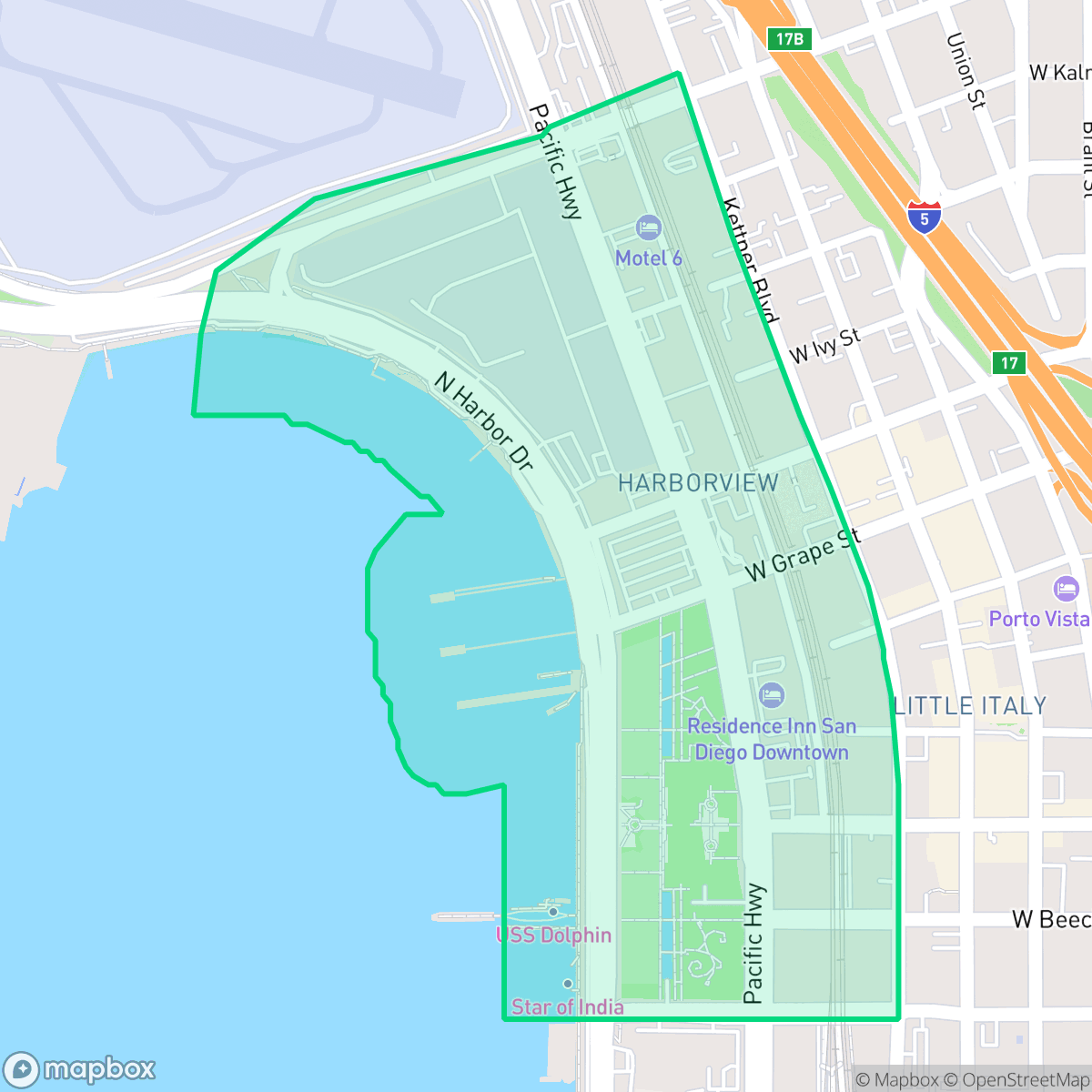
Originally part of the 1850 Middletown land tract, the waterfront neighborhood of Harborview in downtown San Diego historically hosted a thriving Italian and Portuguese fishing community. It is notable for preserving downtown San Diego’s largest remaining concentration of late 19th-century Victorian residences, including Queen Anne and Folk Victorian cottages. The neighborhood's maritime identity is anchored by the Maritime Museum of San Diego, which displays historic vessels like the 1863 Star of India. Another prominent local landmark is the historic, Beaux-Arts/Spanish Revival-style San Diego County Administration Center, completed in 1938. Today, the area seamlessly blends its rich naval and industrial history with modern public spaces, most notably the expansive Waterfront Park situated along the San Diego Bay.
The neighborhood functions as a high-density urban core where high-rise structures and commercial activity dominate the landscape. It offers an exceptionally walkable environment, allowing residents to easily navigate between the waterfront, local dining establishments, and cultural venues. The presence of large maritime piers and active port facilities contributes to a lively, industrial-adjacent atmosphere that defines the daily experience of living in this part of downtown San Diego.
Living in this area involves distinct trade-offs, particularly regarding acoustic comfort and personal privacy. Due to the high density of residential and commercial buildings, residents often share walls and encounter significant noise from road traffic and nearby transit corridors. The neighborhood is best suited for individuals who prioritize central city access and a fast-paced lifestyle over quiet, secluded environments. Families should note that local schools operate within the San Diego City Unified School District, which currently faces budget and operational challenges that may impact educational stability.
Neighborhood Scores Across 15 Qualities
Close proximity between buildings and narrow separations create a sense of limited privacy. According to iHuus data, residential structures are more tightly packed here than is typical for San Diego.
Wide sidewalks and dedicated pedestrian zones along the waterfront make navigating the area on foot easy. While a major freeway creates some interruptions in the grid, the walkability remains slightly above the San Diego average according to iHuus data.
Standard high-density blocks and mixed-use apartment complexes define the visual landscape. This area offers a functional urban environment that is less visually diverse than the San Diego average.
Access to green space for pets is below the San Diego average due to a dense urban fabric and narrow sidewalks. While Waterfront Park provides some lawns and walking paths, much of the neighborhood consists of heavy pavement.
Large scale airport infrastructure, commercial docks, and dense multi-story blocks characterize this area. This landscape is significantly less urbanized than the San Diego average, consisting largely of industrial hubs and transit-oriented developments.
Social activity and local dining options are more concentrated here than in the San Diego average. While some areas feature high-energy coastal developments and diverse restaurants, other pockets remain calm and industrial in nature.
Frequent loud disturbances from nearby airport runways and heavy rail lines characterize the area. This level of acoustic activity is significantly higher than the San Diego average, according to iHuus data.
Air quality in this area fluctuates between acceptable and unhealthy levels, which is slightly lower than the San Diego average. Residents and sensitive groups may experience occasional concerns during periods of poor air quality according to iHuus data.
Active commercial, maritime, and logistics operations are present alongside residential areas. This level of industrial proximity is notably lower than the San Diego average, though residents may encounter noise from nearby airport runways and port warehouses.
Health insurance coverage among residents is notably lower than the San Diego average. According to iHuus data, a small portion of the population currently holds active health coverage.
Voting patterns and census indicators in Harborview reflect a more progressive political leaning than the San Diego average, according to iHuus data.
Residents live alongside a balanced mix of young professionals, families, and seniors. This age distribution is roughly in line with the broader San Diego area according to iHuus data.
Significant flood risk is present in this area, which is considerably higher than the San Diego average. Residents should be aware of increased vulnerability to water inundation according to iHuus data.
Address-Level Insights for Harborview


iHuus Neighborhood Intelligence Insights
Get address-level neighborhood insights for Harborview
- Street-level scores — see how individual blocks compare, not just neighborhood averages
- Micro-zone boundaries — identify quiet pockets, flood boundaries, and walkable clusters before you visit
- 15 dimensions in full — walkability, noise, air quality, school quality, insurance coverage, population age profile, urban/rural index, and more
- Boundary risk alerts — know if your address sits near a block boundary where scores drop, the kind of detail no listing will ever mention
- School insights — individual school ratings and insights, not just district-level data
- Compare before you commit — side-by-side data across neighborhoods, down to block precision
No credit card required
Compare with Any Neighborhood
| Dimension | Harborview | Adams North |
|---|---|---|
| 🚶 Walkabilityavg 8.58 | ||
| 🔊 Acoustic Comfortavg 3.33 | ||
| 🤫 Privacy Indexavg 4.87 | ||
| 🎨 Visual Appealavg 6.85 | ||
| 🐕 Dog Friendlinessavg 6.91 | ||
| 🗺️ Urban-Rural Indexavg 6.6 | ||
| ✨ Neighborhood Vibeavg 5.12 | ||
| 🏥 Health Insurance Coverageavg 7.53 | ||
| 🌿 Air Qualityavg 6.36 | ||
| 🏭 Industrial Proximityavg 9.12 | ||
| 🌊 Flood Safetyavg 4.2 | ||
| 🗳️ Ideological Leanavg 8.51 | ||
| 👥 Population Age Profileavg 4.8 | ||
| 🔥 Fire Safetyavg 0.61 | ||
| 🏫 School Quality |
Harborview Rankings
School Districts Serving Harborview
School Insights for Harborview
Below average outcomes; significant attendance and academic challenges.
School Insights
See what's really behind every school rating near Harborview
- Individual school ratings — each school's own score with outcome context, not just a district average
- Enrollment & class size data — student-to-teacher ratio and how it compares to the state average
- Full demographics breakdown — ethnicity and gender composition for every school in the enrollment zone
- Every school in the district — all schools within the enrollment boundary ranked by rating, not just the closest one
- Grade levels & benchmarks — elementary through high school, with below/above state-average flags
No credit card required