Grantville, San Diego
Updated · 8,649 residents
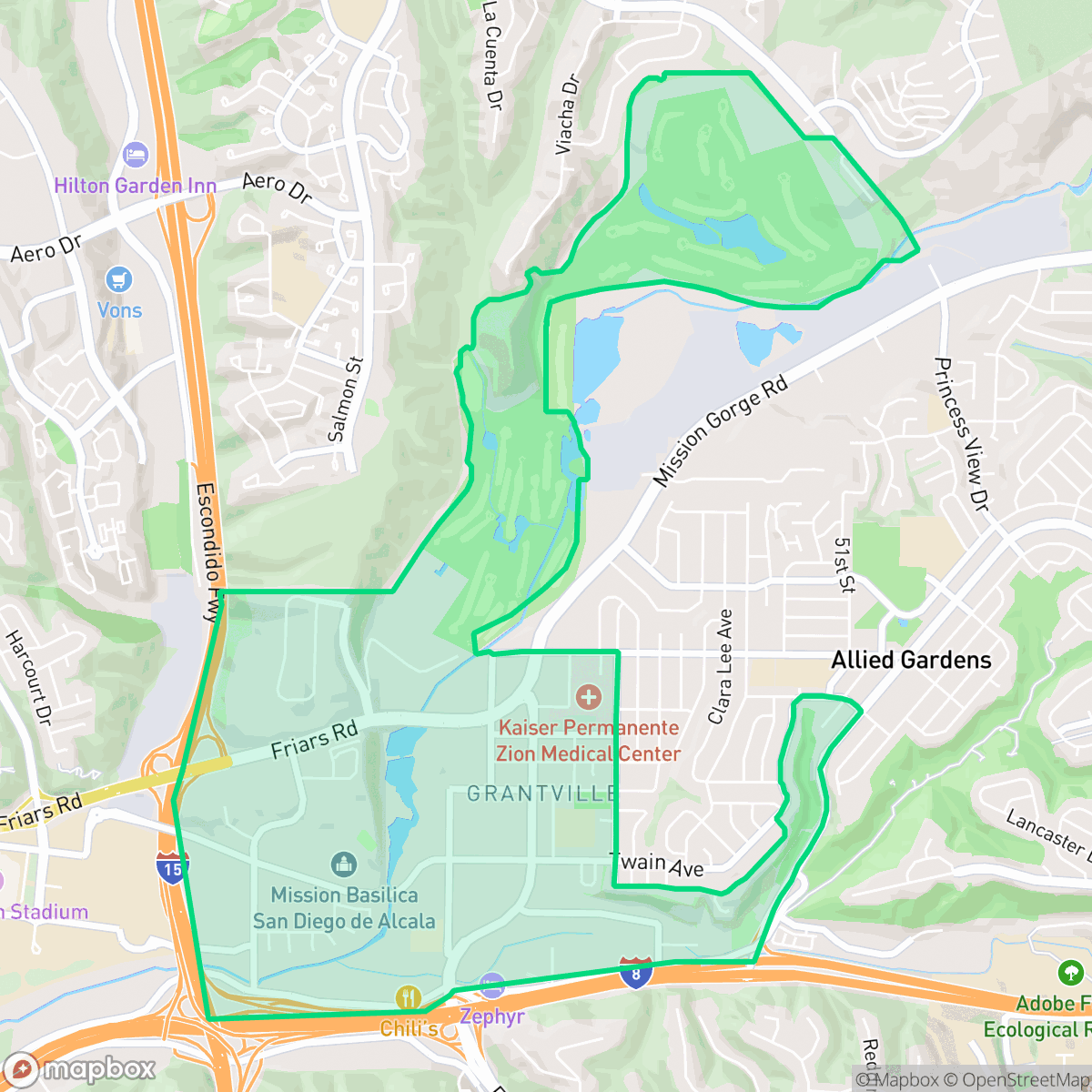
Grantville serves as a transit-oriented gateway to Mission Trails Regional Park, characterized by a mix of dense multi-family housing and light industrial zones. While the area offers high walkability and proximity to diverse dining options, residents should expect notable noise levels from nearby highway traffic and a lack of privacy due to high-density residential layouts.
Key Highlights
About Grantville
Established as one of San Diego’s oldest communities, Grantville's history dates back to 1774 when the historic Mission San Diego de Alcalá was relocated to the area. In 1887, the Junipero Land and Water Company laid out a 1,500-lot townsite originally named "Orchard". It was soon renamed "Grantville" in honor of President Ulysses S. Grant as part of an unsuccessful bid to secure a national home for disabled Civil War veterans. The original town plan featured north-south streets named for its founders, east-west streets named for Civil War heroes, and a central 20-acre garden called Grant Circle. Annexed by San Diego between 1948 and 1954, modern Grantville has evolved from an agricultural and light industrial hub into a transit-oriented neighborhood that serves as the gateway to Mission Trails Regional Park.
The neighborhood functions as a blend of suburban residential life and active commercial corridors. It features a high concentration of multi-family complexes, townhomes, and apartments, often situated near light industrial warehouses and storage facilities. Local social hubs and a variety of eateries, ranging from ethnic cuisine to casual dining, contribute to a functional, if car-dependent, daily experience. Residents benefit from consistent sidewalk networks and internal pedestrian paths, which facilitate movement between local complexes and nearby green spaces.
Prospective residents should consider the trade-offs of living in this transit-adjacent corridor. The area experiences significant road traffic noise, which impacts overall acoustic comfort. While the proximity to canyon trails and nature preserves provides excellent opportunities for dog owners and outdoor enthusiasts, the dense housing configuration results in limited privacy. The area is best suited for those who prioritize accessibility to major transit routes and regional outdoor recreation over absolute quiet or suburban seclusion.
Neighborhood Scores Across 15 Qualities
Building proximity varies between shared-wall multi-unit structures and detached homes with small yards. According to iHuus data, residents can expect more separation between neighbors than is typical for the rest of San Diego.
Residential cul-de-sacs and internal pedestrian paths provide safe walking options, though the area is less walkable than the San Diego average. Sidewalks are available on certain streets, and low-traffic zones are common throughout the neighborhood according to iHuus data.
Upscale amenities and large, well-maintained homes characterize much of this area. Residents will find the streetscape slightly more polished than the San Diego average, featuring frequent private pools and spacious driveways.
Expansive nature preserves and canyon trails in the southeast quadrant provide ample space for exercise. According to iHuus data, the abundance of connected green spaces and wide, low-traffic paths makes this area more suitable for dog owners than the San Diego average.
Frequent open land and undeveloped canyon systems provide a more natural setting than the typical San Diego landscape. According to iHuus data, the area features a mix of scattered homes, industrial zones, and significant green space.
Local activity is relatively subdued, with a landscape dominated by industrial zones and low-density residential pockets. This area offers less social density and fewer commercial destinations than the San Diego average.
Frequent noise from nearby railroad tracks and heavy freeway traffic is common in this area. According to iHuus data, acoustic comfort levels are lower than the San Diego average.
Air quality levels fluctuate between acceptable and unhealthy, presenting occasional concerns for sensitive groups. According to iHuus data, the air quality in Grantville is slightly lower than the San Diego city average.
Residential life is largely undisturbed by heavy industry, though some residents live near light commercial areas and logistics facilities. This level of industrial proximity is noticeably lower than the city average, according to iHuus data.
Health insurance access is exceptionally high among residents, significantly exceeding the San Diego average according to iHuus data.
Voting patterns and census indicators reflect a predominantly liberal political leaning that is slightly more pronounced than the San Diego city average.
A balanced mix of young adults, families, and seniors defines the area. This demographic spread is slightly more even than the San Diego average, according to iHuus data.
Flood risk in this area is higher than the San Diego average, though official FEMA studies for this specific zone remain incomplete. Residents should remain aware of potential drainage concerns during heavy rain events according to iHuus data.
Extreme fire hazards exist within this area, representing a significantly higher risk than the San Diego average according to iHuus data.
Address-Level Insights for Grantville


iHuus Neighborhood Intelligence Insights
Get address-level neighborhood insights for Grantville
- Street-level scores — see how individual blocks compare, not just neighborhood averages
- Micro-zone boundaries — identify quiet pockets, flood boundaries, and walkable clusters before you visit
- 15 dimensions in full — walkability, noise, air quality, school quality, insurance coverage, population age profile, urban/rural index, and more
- Boundary risk alerts — know if your address sits near a block boundary where scores drop, the kind of detail no listing will ever mention
- School insights — individual school ratings and insights, not just district-level data
- Compare before you commit — side-by-side data across neighborhoods, down to block precision
No credit card required
Compare with Any Neighborhood
| Dimension | Grantville | Adams North |
|---|---|---|
| 🚶 Walkabilityavg 8.58 | ||
| 🔊 Acoustic Comfortavg 3.33 | ||
| 🤫 Privacy Indexavg 4.87 | ||
| 🎨 Visual Appealavg 6.85 | ||
| 🐕 Dog Friendlinessavg 6.91 | ||
| 🗺️ Urban-Rural Indexavg 6.6 | ||
| ✨ Neighborhood Vibeavg 5.12 | ||
| 🏥 Health Insurance Coverageavg 7.53 | ||
| 🌿 Air Qualityavg 6.36 | ||
| 🏭 Industrial Proximityavg 9.12 | ||
| 🌊 Flood Safetyavg 4.2 | ||
| 🗳️ Ideological Leanavg 8.51 | ||
| 👥 Population Age Profileavg 4.8 | ||
| 🔥 Fire Safetyavg 0.61 | ||
| 🏫 School Quality |
Grantville Rankings
School Districts Serving Grantville
School Insights for Grantville
Below average outcomes; significant attendance and academic challenges.
School Insights
See what's really behind every school rating near Grantville
- Individual school ratings — each school's own score with outcome context, not just a district average
- Enrollment & class size data — student-to-teacher ratio and how it compares to the state average
- Full demographics breakdown — ethnicity and gender composition for every school in the enrollment zone
- Every school in the district — all schools within the enrollment boundary ranked by rating, not just the closest one
- Grade levels & benchmarks — elementary through high school, with below/above state-average flags
No credit card required