Grant Hill, San Diego
Updated · 5,077 residents
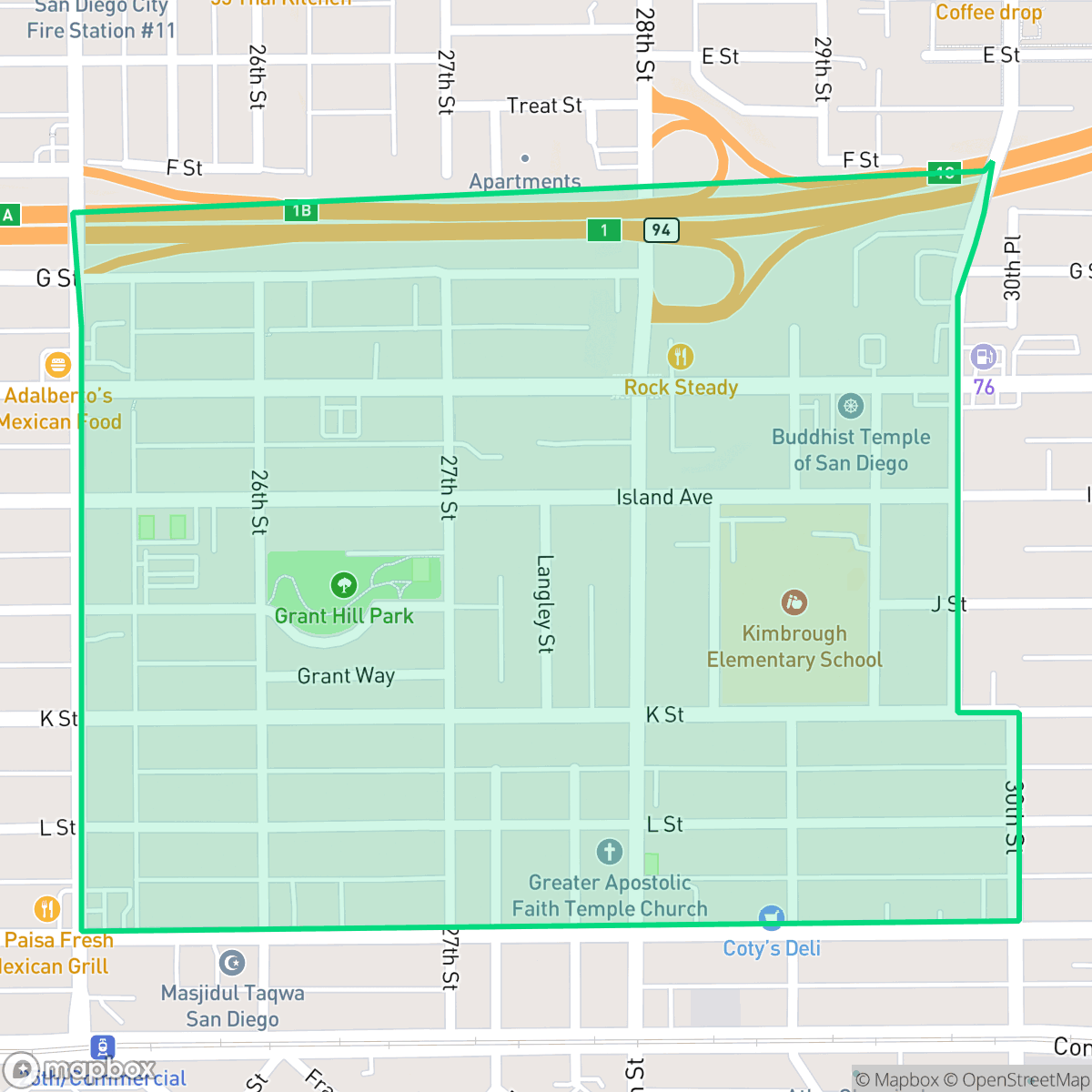
Grant Hill is a highly walkable urban neighborhood defined by its steep topography and dense residential grid. Residents benefit from consistent sidewalk access and a central park, though the area experiences significant noise from nearby road traffic and limited privacy due to close building proximity.
Key Highlights
About Grant Hill
Originally subdivided in 1887 as Mount Gilead, the central San Diego neighborhood of Grant Hill was renamed in 1906 after Ulysses S. Grant Jr.—son of the 18th U.S. President—purchased and re-subdivided the land. Development progressed slowly over eight decades, yielding a diverse architectural landscape along 25th Street that features Queen Anne cottages, San Francisco Stick, and Craftsman bungalows. The neighborhood is physically defined by its steep topography and distinctive cobblestone retaining walls crafted by the Berger Brothers, a local family of German stonemasons. Historically a welcoming haven for diverse ethnic groups, notable residents included Japanese restaurateur Kikuye Kawamoto, who built a Spanish Colonial Revival home here in 1936. At the neighborhood's summit lies Grant Hill Park, acquired by the city in 1940, which offers legendary panoramic views of the San Diego Bay and the Coronado Bay Bridge.
This neighborhood functions as a dense, low-rise urban environment with a layout that prioritizes pedestrian connectivity. The streetscape features a mix of multi-family housing and light commercial activity, anchored by local favorites like Dark Horse Coffee Roasters and various Mexican eateries. While the grid layout makes it exceptionally easy to navigate on foot, the proximity to major transit corridors contributes to a consistent ambient noise level of 65 decibels. According to iHuus data, the area maintains a distinct urban character despite its high-density constraints and limited private outdoor space.
Prospective residents should weigh the benefits of high walkability against the realities of urban living in this sector. The neighborhood features tightly packed housing with minimal distance between structures, which impacts overall privacy. Public education options include Kimbrough Elementary and King-Chavez Preparatory Academy, though the broader school district faces ongoing fiscal and operational challenges. With limited private yards and narrow parkways, pet owners may find the area restrictive, making the local park the primary destination for outdoor activity.
Neighborhood Scores Across 15 Qualities
Residential structures are situated very close to one another on narrow lots, resulting in less privacy than the San Diego average. According to iHuus data, many homes feature shared property lines or minimal separation between buildings.
Extremely easy to navigate on foot due to a dense, interconnected grid and consistent sidewalks on both sides of most streets. This level of accessibility is notably higher than the San Diego average, though a major high-traffic freeway corridor does bisect the area.
Housing consists primarily of dense, mid-sized apartment complexes and standard tract homes with small yards. This urban landscape offers less greenery and fewer private amenities than the San Diego average, according to iHuus data.
Limited public green space and narrow sidewalks make walking dogs more challenging than in other parts of the city. While some grid streets offer access to athletic fields, much of the area features dense housing with minimal park access near major highway infrastructure.
A blend of low-rise urban grids and small residential lots defines the area, offering more greenery and open space than the typical San Diego urban environment. According to iHuus data, the neighborhood maintains a suburban character with a balance of streets and green space that is less dense than the city average.
A steady rhythm of residential life and light industrial activity creates a calmer atmosphere than the San Diego average. While some blocks offer diverse dining and coffee shops, the surrounding area remains primarily suburban and subdued.
Frequent sound from nearby railroad tracks and major freeway traffic creates a noisy environment. According to iHuus data, acoustic comfort in this area is lower than the San Diego average.
Air quality levels fluctuate between acceptable and unhealthy, occasionally posing risks to sensitive groups. According to iHuus data, these conditions are slightly lower than the San Diego city average.
Largely residential with only occasional light commercial or automotive yards, this area features less industrial activity than the San Diego average. Some northern and western corridors contain warehouses or an electrical substation that may contribute to localized noise.
Health insurance coverage among residents is notably lower than the San Diego average, according to iHuus data.
Voting patterns and census indicators show a significantly more liberal leaning than the San Diego average, according to iHuus data.
Residents experience a varied demographic mix of young adults, families, and seniors. This age distribution is slightly lower than the San Diego average, according to iHuus data.
Significant flood risk exists within this area as it is located inside a 100-year floodplain, which is much higher than the San Diego average. Residents should be aware that flood insurance is typically required for properties here according to iHuus data.
Address-Level Insights for Grant Hill


iHuus Neighborhood Intelligence Insights
Get address-level neighborhood insights for Grant Hill
- Street-level scores — see how individual blocks compare, not just neighborhood averages
- Micro-zone boundaries — identify quiet pockets, flood boundaries, and walkable clusters before you visit
- 15 dimensions in full — walkability, noise, air quality, school quality, insurance coverage, population age profile, urban/rural index, and more
- Boundary risk alerts — know if your address sits near a block boundary where scores drop, the kind of detail no listing will ever mention
- School insights — individual school ratings and insights, not just district-level data
- Compare before you commit — side-by-side data across neighborhoods, down to block precision
No credit card required
Compare with Any Neighborhood
| Dimension | Grant Hill | Adams North |
|---|---|---|
| 🚶 Walkabilityavg 8.58 | ||
| 🔊 Acoustic Comfortavg 3.33 | ||
| 🤫 Privacy Indexavg 4.87 | ||
| 🎨 Visual Appealavg 6.85 | ||
| 🐕 Dog Friendlinessavg 6.91 | ||
| 🗺️ Urban-Rural Indexavg 6.6 | ||
| ✨ Neighborhood Vibeavg 5.12 | ||
| 🏥 Health Insurance Coverageavg 7.53 | ||
| 🌿 Air Qualityavg 6.36 | ||
| 🏭 Industrial Proximityavg 9.12 | ||
| 🌊 Flood Safetyavg 4.2 | ||
| 🗳️ Ideological Leanavg 8.51 | ||
| 👥 Population Age Profileavg 4.8 | ||
| 🔥 Fire Safetyavg 0.61 | ||
| 🏫 School Quality |
Grant Hill Rankings
School Districts Serving Grant Hill
School Insights for Grant Hill
Below average outcomes; significant attendance and academic challenges.
School Insights
See what's really behind every school rating near Grant Hill
- Individual school ratings — each school's own score with outcome context, not just a district average
- Enrollment & class size data — student-to-teacher ratio and how it compares to the state average
- Full demographics breakdown — ethnicity and gender composition for every school in the enrollment zone
- Every school in the district — all schools within the enrollment boundary ranked by rating, not just the closest one
- Grade levels & benchmarks — elementary through high school, with below/above state-average flags
No credit card required